
Spain's Nursing Home Protocols: Dates, Jurisdiction and UME
Debate over Spain's nursing home protocols during the pandemic: conflicting dates, jurisdictional disputes and UME military reports.
English · Original discussion in Spanish · Published
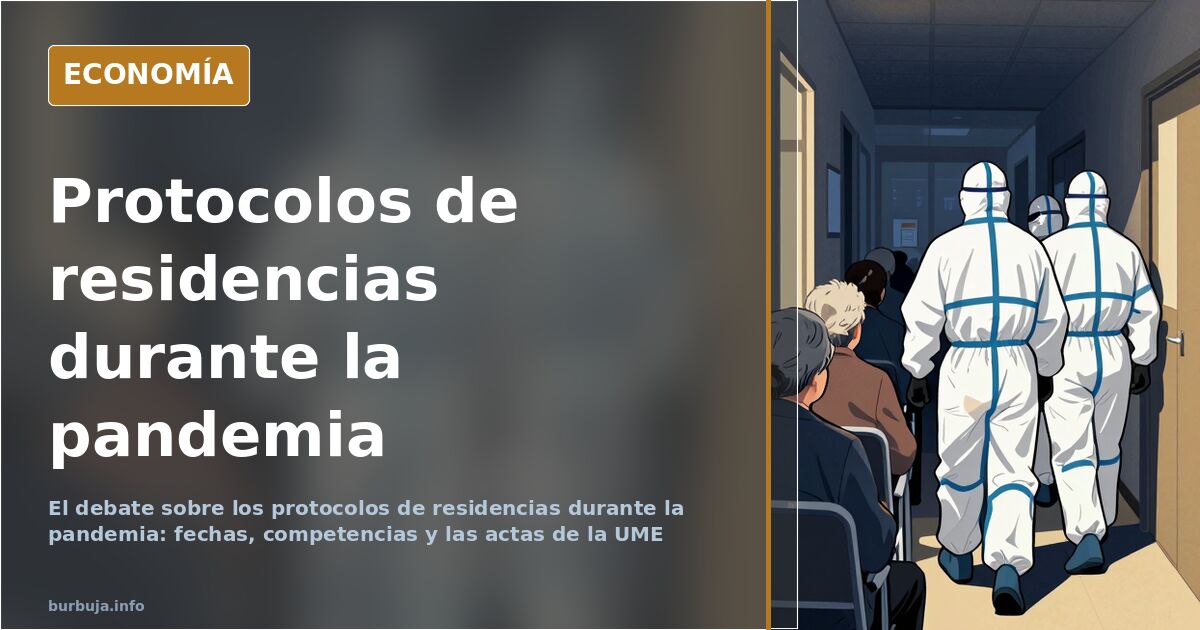
Nursing homes: the protocol nobody signed but everyone applied
Every time the issue resurfaces, the debate over the nursing home protocols applied during the worst months of the pandemic in Spain reopens the same uncomfortable question: who signed them, who ordered them, and who could have stopped them. On the table are documents with dates, judicial rulings interpreted differently by each side, and no final sentence assigning responsibility.
There is one datum that orders the entire labyrinth. The protocol pointed to as the origin of the disaster in Madrid's nursing homes is dated May 26, 2020. The argument relying on this date claims that the mortality peak had already passed by then. The accusation responds with another date, March 19, 2020, when the Ministry of Health issued the order that communities subsequently transposed. It is the same document read forwards and backwards. The monthly breakdown of deaths—what percentage fell into each stage of the state of alarm—is exactly what each side handles at its convenience.
Who had jurisdiction over nursing homes during the state of alarm?
Here the debate becomes heated, and here too each side finds its alibi. On the table is Royal Decree 463/2020, which declared the state of alarm, cited as the instrument that concentrated powers in the central government. With this argument, responsibility for what peine in nursing homes jumps from the autonomous regions to the Ministry. According to circulating rulings, a judge has already ruled that management of nursing homes during the pandemic corresponded to the State, not the community.
The opposing version does not dispute the decree, but its interpretation. It argues that health competencies never left the communities, that protocols were executed by regional services, and that whoever governs Madrid is responsible for what their department did. The role, they say, would be the same in every community: a copy of what the Ministry ordered. In the background appears the thesis that distributes blame among Pedro Sánchez, Pablo Iglesias, and the rest of the regional presidents, whom one faction points to as accomplices of the same machinery.
Triage: who gets treated when there are no ventilators
The most uncomfortable point is not legal, but clinical. When hospitals become saturated, someone decides who gets intubated and who gets sedated. One of the most repeated versions asserts that the protocol established that a coordinator—and not the primary care physician—would assess hospital admission, which in practice discriminated based on where people lived rather than life expectancy. Another reading, defended vigorously, adds that the protocol regulated only transfer, not admission, and that families who wanted to take their elderly relatives home were able to do so.
The counterattack is direct: in a health catastrophe, protocols exist to avoid improvisation, and the alternative to triage is not saving everyone, but saving no one. This is debated with survival percentages in hand. A young person with an 80% probability of recovery versus an elderly person with 15%. Choosing the former is a decision nobody wants to sign, yet according to this version, almost everyone applied it. Those defending the criterion recall that it was not designed for a specific nursing home, but for any scenario with limited resources.
The judicial front: Olona, the UME, and Supreme Court records
Running parallel to the health debate is the political one. VOX has revived the issue through judicial channels: its spokesperson, Macarena Olona, announced a new appeal regarding nursing homes and claimed the Government lied to the Supreme Court during the processing of the previous one. The stated objective is to obtain the records of the UME (Military Emergency Unit) when its troops entered the nursing homes. "You will all know what our heroes found," she wrote. These are partisan assertions and, for now, without a ruling to support them.
From 'she did it' to 'everyone did it'
A third thesis is gaining ground: guilt is shared. That the order came from Madrid, but that the framework was set by the central government and that other communities applied similar protocols. From this perspective, settling scores with a single president is a way of dodging the blame of the entire system. Pointing in the same direction are those demanding accountability from the healthcare staff who applied them, the gerontologists who drafted them, and the nursing home directors who looked the other way.
That is the crux: each link has an excuse pointing to the next. The nursing home director will say they trinc an order; the counselor, that they trinc a ministerial protocol; the minister, that they executed the law. The chain does not break anywhere, and that explains why no one has paid for what peine in those rooms.
What can happen now
With this material, the predictable outcome is that the case advances through judicial channels without being resolved in the short term, and that each new appeal reopens the same discussion about dates. If courts confirm that jurisdiction was state-level, the focus will shift to the Ministry; if confirmed as regional, it will return to Madrid. And if nothing is confirmed, it will remain exactly where it is: in a crossfire of accusations with no responsible party. None of these outcomes will bring back those who died, and that—it is worth remembering—is the only thing no one disputes.
Every time the issue resurfaces, the debate over the nursing home protocols applied during the worst months of the pandemic in Spain reopens the same uncomfortable question: who signed them, who ordered them, and who could have stopped them. On the table are documents with dates, judicial rulings interpreted differently by each side, and no final sentence assigning responsibility.
There is one datum that orders the entire labyrinth. The protocol pointed to as the origin of the disaster in Madrid's nursing homes is dated May 26, 2020. The argument relying on this date claims that the mortality peak had already passed by then. The accusation responds with another date, March 19, 2020, when the Ministry of Health issued the order that communities subsequently transposed. It is the same document read forwards and backwards. The monthly breakdown of deaths—what percentage fell into each stage of the state of alarm—is exactly what each side handles at its convenience.
Who had jurisdiction over nursing homes during the state of alarm?
Here the debate becomes heated, and here too each side finds its alibi. On the table is Royal Decree 463/2020, which declared the state of alarm, cited as the instrument that concentrated powers in the central government. With this argument, responsibility for what peine in nursing homes jumps from the autonomous regions to the Ministry. According to circulating rulings, a judge has already ruled that management of nursing homes during the pandemic corresponded to the State, not the community.
The opposing version does not dispute the decree, but its interpretation. It argues that health competencies never left the communities, that protocols were executed by regional services, and that whoever governs Madrid is responsible for what their department did. The role, they say, would be the same in every community: a copy of what the Ministry ordered. In the background appears the thesis that distributes blame among Pedro Sánchez, Pablo Iglesias, and the rest of the regional presidents, whom one faction points to as accomplices of the same machinery.
Triage: who gets treated when there are no ventilators
The most uncomfortable point is not legal, but clinical. When hospitals become saturated, someone decides who gets intubated and who gets sedated. One of the most repeated versions asserts that the protocol established that a coordinator—and not the primary care physician—would assess hospital admission, which in practice discriminated based on where people lived rather than life expectancy. Another reading, defended vigorously, adds that the protocol regulated only transfer, not admission, and that families who wanted to take their elderly relatives home were able to do so.
The counterattack is direct: in a health catastrophe, protocols exist to avoid improvisation, and the alternative to triage is not saving everyone, but saving no one. This is debated with survival percentages in hand. A young person with an 80% probability of recovery versus an elderly person with 15%. Choosing the former is a decision nobody wants to sign, yet according to this version, almost everyone applied it. Those defending the criterion recall that it was not designed for a specific nursing home, but for any scenario with limited resources.
The judicial front: Olona, the UME, and Supreme Court records
Running parallel to the health debate is the political one. VOX has revived the issue through judicial channels: its spokesperson, Macarena Olona, announced a new appeal regarding nursing homes and claimed the Government lied to the Supreme Court during the processing of the previous one. The stated objective is to obtain the records of the UME (Military Emergency Unit) when its troops entered the nursing homes. "You will all know what our heroes found," she wrote. These are partisan assertions and, for now, without a ruling to support them.
From 'she did it' to 'everyone did it'
A third thesis is gaining ground: guilt is shared. That the order came from Madrid, but that the framework was set by the central government and that other communities applied similar protocols. From this perspective, settling scores with a single president is a way of dodging the blame of the entire system. Pointing in the same direction are those demanding accountability from the healthcare staff who applied them, the gerontologists who drafted them, and the nursing home directors who looked the other way.
That is the crux: each link has an excuse pointing to the next. The nursing home director will say they trinc an order; the counselor, that they trinc a ministerial protocol; the minister, that they executed the law. The chain does not break anywhere, and that explains why no one has paid for what peine in those rooms.
What can happen now
With this material, the predictable outcome is that the case advances through judicial channels without being resolved in the short term, and that each new appeal reopens the same discussion about dates. If courts confirm that jurisdiction was state-level, the focus will shift to the Ministry; if confirmed as regional, it will return to Madrid. And if nothing is confirmed, it will remain exactly where it is: in a crossfire of accusations with no responsible party. None of these outcomes will bring back those who died, and that—it is worth remembering—is the only thing no one disputes.
Summary of a discussion on Burbuja.info - Foro de economía, actualidad y política., translated from Spanish and reviewed before publication. Read the full discussion (194 replies).
More summaries
-
Women-Only Sol Campout: Housing and Electoral Calculations
The Tenants' Union calls for a women-only campout in Sol to demand affordable housing. The exclusion sparks debate on policy models.
-
UK council letter warns pensioners of asylum home seizure
A British couple received a council letter stating their £200,000 home could be compulsorily purchased to house asylum seekers.
-
Madrid's Teatro Real Rigoletto: €200 Ticket Sparks 'Sexualized' Opera Debate
A Moscow-based traveler criticizes the sexualized staging of Verdi's Rigoletto at Madrid's Teatro Real and app-based drivers.
-
Tuit Proposing Ban on Cis-Hetero White Men's Vote Sparks Hate Crime Debate
A viral tweet suggesting banning cis-heterosexual white men from voting reignites debate on the symmetric application of hate speech laws in Spain.
-
Alguazas Dog Owner: 'Just Puppies, Two Bites' After Fatal Attack
Josefa Bravo, 96, died four days after an attack in Alguazas. Her neighbor, the dogs’ owner, claims injuries were not animal-related.
-
Spain to mandate electric scooter insurance this year
DGT plans mandatory insurance for e-scooters in Spain. Prosecutors demand coverage after 285,000 units sold in 2021.