
Spain's Nuclear Regulator Defends Appointing Non-Experts
A CSN commissioner argues that excessive technical knowledge can be counterproductive during Spain's nuclear phase-out.
English · Original discussion in Spanish · Published
Spain's Nuclear Safety Council defends appointing commissioners with limited technical expertise
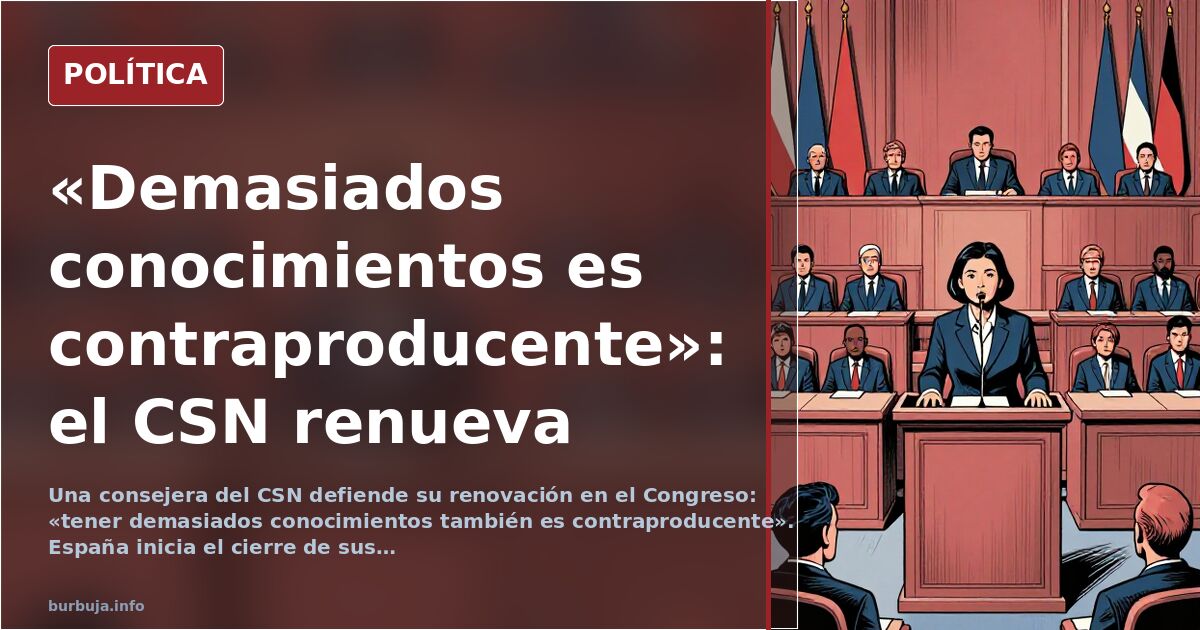
The Nuclear Safety Council (CSN) is the body responsible for overseeing Spain's atomic power plants. On Thursday, at the Congress of Deputies, the presidential candidate and four aspiring commissioners appeared before parliament. Among them was Pilar Lucio, born in Plasencia in 1972, a graduate in Political Science and Sociology from Complutense University, former Equality Minister for the Extremadura regional government, and former MP, who seeks to renew her seat on the regulator. She defended her candidacy with a phrase that has already gone viral: "To be a commissioner on the Nuclear Safety Council, it is not essential to have extraordinary technical knowledge in this field, although it obviously helps. But be careful, because having too much knowledge can also be counterproductive."
This statement was not a slip of the tongue. It served to support the candidacy of her colleague Silvia Calzón, former State Secretary for Health and previously based in La Moncloa, for the same body. The detail matters: Spain is about to begin the closure and dismantling of its nuclear power plants, with all the implications for radiological safety, waste management, and supply.
What is decided at the CSN and why the timing is delicate
According to its own definition, the Council's mission is "to protect workers, the population, and the environment from the harmful effects of ionizing radiation," ensuring that nuclear and radioactive facilities operate safely, and establishing measures against radiological emergencies, regardless of their origin. This is no ordinary administrative posting: it is the last technical filter before a political decision becomes physical risk.
The timeline aggravates the issue. Dismantling a nuclear fleet is the longest, most expensive, and technically demanding phase of the entire cycle: decontamination, spent fuel management, and site monitoring for decades. Placing politically trusted profiles there instead of technical experts is not just an organizational detail. It is the difference between auditing and obeying.
The underlying argument: what use is a commissioner who doesn't know?
In the debate generated by this case, an uncomfortable and rather cynical thesis emerges: if the post is meant to execute a roadmap already decided in La Moncloa, it is better not to have independent judgment. Those who know too much ask questions, object, and leave written records. Those who don't know, sign. Part of the analysis suggests that the regulator is becoming a ratification chamber for decisions taken elsewhere, and that declared incompetence functions as an alibi: if something blows up, ignorance is claimed.
The most repeated parallel is that of the DANA (severe storm) management: an emergency official who, according to admissions made in court, lacked experience in the role. The lesson drawn is not that incompetence is tolerable, but that it is functional. No one resigns for not knowing. One resigns for knowing and staying silent.
From cronyism to system: complaints beyond the CSN
The Lucio-Calzón case has acted as a trigger for broader discontent: the perception that technical appointments respond to party quotas rather than CVs. Some summarize it with a classic example: putting someone without a driver's license in charge of Traffic. The joke is funny until it is applied to a body that monitors ionizing radiation.
The diagnosis repeated across various registers is that of a party apparatus meritocracy: years of militancy weigh more than a PhD, resulting in a state where sensitive posts are filled by loyalty, not competence. This is not a new phenomenon, but the CSN has a particularity that makes it more serious: its errors are not corrected in the next legislative term. They are measured in sieverts and decades.
The date of the matter and what remains unresolved
At the time of this discussion, Lucio appeared as a candidate seeking to renew her position, and Calzón as a candidate for commissioner. The Congress listened. There is no known resolution regarding the outcome of the renewals, nor whether Lucio's words will have consequences in the procedure. The file remains exactly there: a phrase uttered in parliamentary session, a regulatory body pending reconfiguration, and a nuclear fleet entering its most delicate phase. With these elements, it is not strange that someone said that out loud. What is strange is that it needs to be said.
The Nuclear Safety Council (CSN) is the body responsible for overseeing Spain's atomic power plants. On Thursday, at the Congress of Deputies, the presidential candidate and four aspiring commissioners appeared before parliament. Among them was Pilar Lucio, born in Plasencia in 1972, a graduate in Political Science and Sociology from Complutense University, former Equality Minister for the Extremadura regional government, and former MP, who seeks to renew her seat on the regulator. She defended her candidacy with a phrase that has already gone viral: "To be a commissioner on the Nuclear Safety Council, it is not essential to have extraordinary technical knowledge in this field, although it obviously helps. But be careful, because having too much knowledge can also be counterproductive."
This statement was not a slip of the tongue. It served to support the candidacy of her colleague Silvia Calzón, former State Secretary for Health and previously based in La Moncloa, for the same body. The detail matters: Spain is about to begin the closure and dismantling of its nuclear power plants, with all the implications for radiological safety, waste management, and supply.
What is decided at the CSN and why the timing is delicate
According to its own definition, the Council's mission is "to protect workers, the population, and the environment from the harmful effects of ionizing radiation," ensuring that nuclear and radioactive facilities operate safely, and establishing measures against radiological emergencies, regardless of their origin. This is no ordinary administrative posting: it is the last technical filter before a political decision becomes physical risk.
The timeline aggravates the issue. Dismantling a nuclear fleet is the longest, most expensive, and technically demanding phase of the entire cycle: decontamination, spent fuel management, and site monitoring for decades. Placing politically trusted profiles there instead of technical experts is not just an organizational detail. It is the difference between auditing and obeying.
The underlying argument: what use is a commissioner who doesn't know?
In the debate generated by this case, an uncomfortable and rather cynical thesis emerges: if the post is meant to execute a roadmap already decided in La Moncloa, it is better not to have independent judgment. Those who know too much ask questions, object, and leave written records. Those who don't know, sign. Part of the analysis suggests that the regulator is becoming a ratification chamber for decisions taken elsewhere, and that declared incompetence functions as an alibi: if something blows up, ignorance is claimed.
The most repeated parallel is that of the DANA (severe storm) management: an emergency official who, according to admissions made in court, lacked experience in the role. The lesson drawn is not that incompetence is tolerable, but that it is functional. No one resigns for not knowing. One resigns for knowing and staying silent.
From cronyism to system: complaints beyond the CSN
The Lucio-Calzón case has acted as a trigger for broader discontent: the perception that technical appointments respond to party quotas rather than CVs. Some summarize it with a classic example: putting someone without a driver's license in charge of Traffic. The joke is funny until it is applied to a body that monitors ionizing radiation.
The diagnosis repeated across various registers is that of a party apparatus meritocracy: years of militancy weigh more than a PhD, resulting in a state where sensitive posts are filled by loyalty, not competence. This is not a new phenomenon, but the CSN has a particularity that makes it more serious: its errors are not corrected in the next legislative term. They are measured in sieverts and decades.
The date of the matter and what remains unresolved
At the time of this discussion, Lucio appeared as a candidate seeking to renew her position, and Calzón as a candidate for commissioner. The Congress listened. There is no known resolution regarding the outcome of the renewals, nor whether Lucio's words will have consequences in the procedure. The file remains exactly there: a phrase uttered in parliamentary session, a regulatory body pending reconfiguration, and a nuclear fleet entering its most delicate phase. With these elements, it is not strange that someone said that out loud. What is strange is that it needs to be said.
Also available in: Deutsch
Summary of a discussion on Burbuja.info - Foro de economía, actualidad y política., translated from Spanish and reviewed before publication. Read the full discussion (130 replies).
More summaries
-
France's overseas voting model: a virtual province for Argentina?
France gives its expats 11 dedicated MPs. As overseas voting grows in Spain, a proposal to create a virtual province for Argentina gains traction.
- Silvia Orriols: nemesis of the pastel separatism (Alejo Vidal-Quadras in Vozpópuli)
-
Madrid PP gives 48 hours to clear Sol camp
Madrid's PP gives 48 hours to clear the Sol encampment, citing cobblestones, stoves and knives; banners against Ayuso appear.
-
Villarejo: Ex-Spanish Police Chief Threatens to Expose State Corruption
Former Spanish police chief Villarejo holds 22 properties and compromising audio tapes, threatening a final revelation that could destabilize Spain's political landscape.
-
Spanish Police Officer Sued for Infiltrating Activist Group
Five activists file a criminal complaint against an undercover officer accused of using personal relationships to gather intelligence.
-
Spain's Sánchez faces scrutiny over shifting political stances
Online debate questions whether Spanish PM Pedro Sánchez lies or adapts, citing archival video evidence and criticism of his management style.