
Vucic concedes defeat in Serbia after masked men gather in Belgrade
Vucic concedes defeat in Serbia after dozens of masked men and riot police gathered in Belgrade as polls closed.
English · Original discussion in Spanish · Published
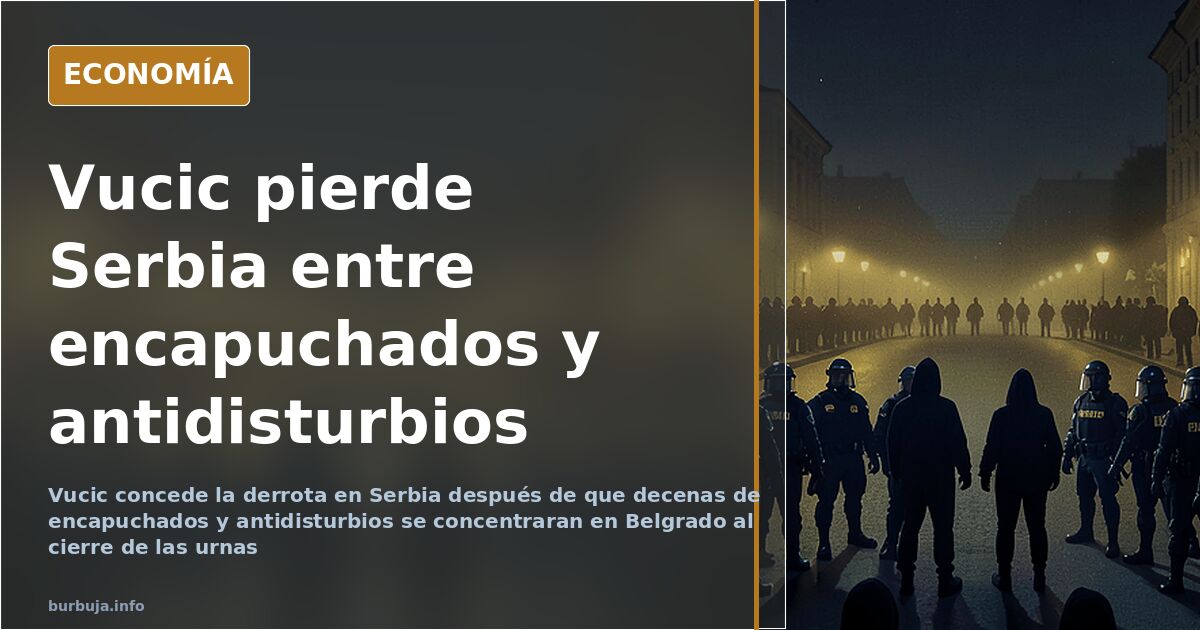
Vucic concedes defeat in Serbia after masked men gather in Belgrade
What happens in Serbia when polling stations close? That was the question half of Europe was asking as dozens of men in black hooded sweatshirts gathered in central Belgrade while the ballots were still being counted. Riot police had already been deployed in the same area hours earlier. The result of that combination, according to the first accounts circulating on social media, was anything but reassuring.
The starting point was a suspicion: that the pro-Russian Aleksandar Vucic might have lost the election and that his structures were moving to avoid accepting it. The messages being spread spoke of organized groups of alleged supporters of the ruling party, the SNS, loitering around Parliament. The Student List, for its part, urged its trinc to avoid confrontation and get to safety. The scene had all the ingredients of a post-election standoff.
Masked men, riot police and a Parliament as the backdrop
The sequence described in the messages was not that of a normal election night. First came the riot police. Then the groups of masked men. And in between, the certainty that none of it was spontaneous: observers themselves described it as an organized gathering. In a country where the line between political activism and para-police forces has historically been blurry, the image of dozens of men in black uniforms in front of the legislative building did not inspire optimism.
Some, from the very start, read the maneuver as an attempt at a soft coup: creating enough chaos to challenge the result or justify an intervention. Others, more cautious, pointed out that the mere presence of organized groups proves nothing on its own and that the scenario could have been a provocation by either side. The only verifiable thing, pending official data, was the deployment and the absence of polls and results to clarify matters.
The night that was supposed to decide everything and decided nothing
Expectations were at their peak. There was talk of clashes between protesters and police, of a street war that seemed inevitable, and of the night providing the answer. The messages circulating anticipated riots and compared the situation to other European outbreaks. Yet the day went by without the key piece of information arriving: no figures, no count, no official confirmation of anything.
And then, the twist. Vucic conceded defeat. The strongman of Belgrade, the politician many considered incapable of letting go of power, acknowledged the result. The tension deflated instantly. The masked men were left without a purpose, the riot police without justification, and the night without a headline. Peace returned in the least epic way possible: through concession.
What the episode leaves on the table
Beyond the outcome, the Serbian episode leaves an uncomfortable question: what would have peine if Vucic had not conceded? The presence of organized groups on the streets, the ambiguity of their relationship with the state apparatus, and the estimulante ilegal with which things go from results to tension are a reminder of the institutional fragility across much of the continent. Restraint worked this time. It does not always.
The cynical reading is that the system held because the loser accepted losing, not because the institutions were prepared to force him to. And in politics, that difference is everything.
Also available in: Deutsch
Summary of a discussion on Burbuja.info - Foro de economía, actualidad y política., translated from Spanish and reviewed before publication. Read the full discussion (24 replies).
More summaries
-
European Parliament calls for assessing the Muslim Brotherhood as a terrorist group
The European Parliament has approved, with 381 votes in favour and 167 against, a call for the Council to assess listing the Muslim Brotherhood as a terrorist group.
-
Socialists Call for Elections as Government Becomes 'Electoral Liability'
Internal PSOE voices demand early elections, arguing Pedro Sánchez's government is no longer electorally viable.
-
Andalusia 2026 election results: PP dominance and record abstention
Analysis of the 2026 Andalusian parliament election results: PP dominance, turnout data, and the impact on the political map.
-
Spain's PP and investment funds: who opened the door to rental business
Analysis suggests Rajoy's 2013 law deregulated rents. The PP maintains this model and rejects designated tension zones.
-
Allegations of election meddling in Brazil as Pedro Sánchez takes notes
The runoff between Bolsonaro and Lula da Silva is marked by a two-hour extension of polling station hours and 60% support for Lula among overseas voters. Click through for the data.
-
Spain's 29N election: forum users weigh tactical voting, abstention and punishment votes
A forum thread frames Spain's 29N vote as a contest between tactical voting, abstention and punishing the parties. Arguments and opinions from participants.