
Night Shifts and Female Managers: Spanish Workplace Tensions
A heated debate on a Spanish economic forum links night shifts, female managers, and workplace toxicity to gender and hierarchy.
English · Original discussion in Spanish · Published
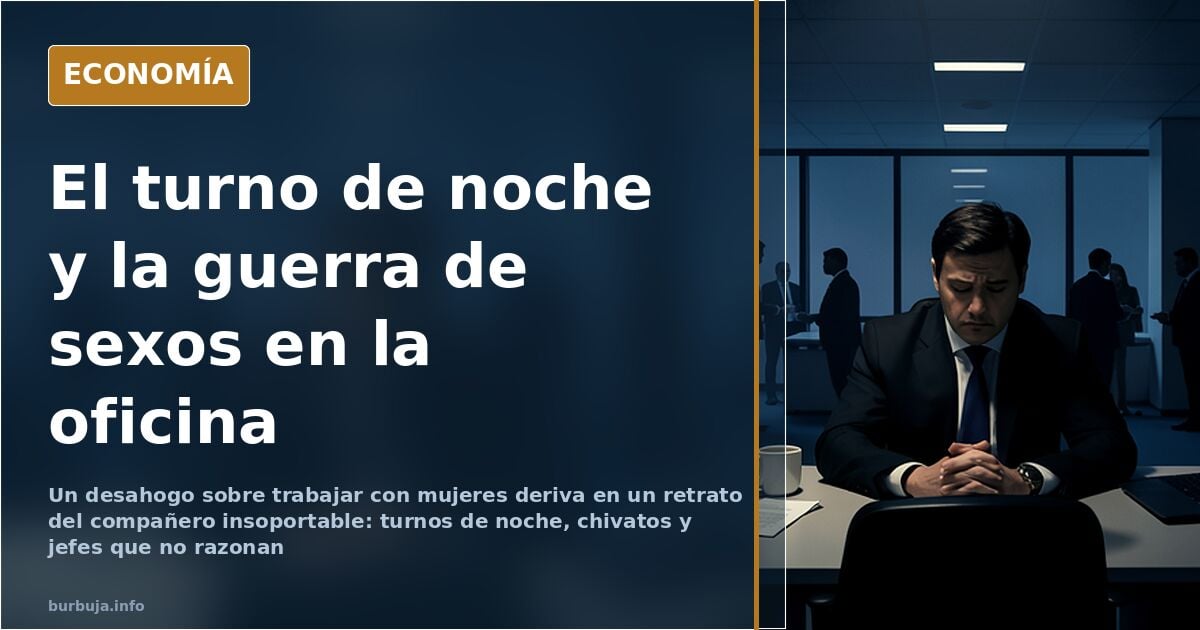
Night Shifts and Office Witches: Anatomy of Workplace Discontent
Working with women is a tumor. That’s the blunt thesis opening a discussion in the Economy subforum. Far from staying as a provocative headline, it branches into a litany of work experiences: night shifts, obsessive middle managers, snitches, office crying, and the suspicion that promotions always go to climbers. The premise is simple: the work environment degrades when gender, hierarchy, and precariousness intersect.
The starting point is an unfiltered complaint about colleagues described as “hypocritical, incompetent harpies.” From there, the conversation splits into two currents. One argues the problem isn’t staff gender but human nature: there are “bastards” on both sides, and the night shift, with its misery and solitude, selects a specific profile. Another insists that coexisting with women adds layers of complexity—emotional, hierarchical, even sensual—that men don’t bring.
The Night Shift as a Personnel Filter
Someone with nearly 20 years in industrial maintenance hasn’t worked with a single woman, except in travel or payroll management. The account is bitter: people who didn’t finish basic education struggling to write an email, middle managers with OCD functioning “like Terminators,” wolves in sheep’s clothing, and, as a supporting star, those who choose the night shift. The description of nocturnal work is an ecosystem apart: hospitals, data centers, audits in empty buildings, garages, and electrical rooms. The company requires two people for safety, not productivity.
Some defend this shift as “the only thing keeping me alive.” Calm, absence of bosses, less noise. Against this romantic view, another message states that night shift workers “all live in La Sagra,” and a third concludes: “Requiem for a Sagreño.” The geographic irony counters any epic narrative of the night shift.
Female Hierarchy and the Machismo Trump Card
The focus shifts to management. The female boss appears as a management issue: if pointed out an error, she might use the machismo trump card and go to Human Resources. The term “Charocracy” summarizes distrust toward female authority that, according to this current, protects itself with gender labels rather than results. In parallel, “inhuman HR chars” are described as walking garbage using their position to feel superior.
The counterargument arrives quickly: there are psychopaths with and without degrees, and the problem is the company tolerating them. Middle manager selection, it is argued, rewards control obsession and inability to reason. In this scheme, OCD isn’t a gender defect but a profile fitting suspiciously well with internal bureaucracy.
Crying, Chatter, and Aesthetics in the Office
Personal anecdotes occupy much of the exchange. Civil servants over 30 are described crying “copiously” for leaving a child at daycare or a mother at a nursing home. Another message claims women under 30 “start crying during the workday” weekly. The diagnosis is relentless: crying “sets the mood” in the office like a decaying backdrop.
The other major reproach is acoustic. Constant, irrelevant, strident chatter is compared to a drill from 8 AM to 3 PM. Complaints extend to aesthetics: a candidate with low-cut neckline in an interview, the interviewer not hiding his gaze, and the conclusion that “it’s not professional to show breasts.” The reply comes with sarcasm: “They wear them so the boss looks.”
The Snitch, Cliques, and Backstabbing
The private security and maintenance ecosystem has its own fauna. It recounts the arrival of a snitch brought from another city to report the slightest irregularity. The defense of the informant is that those doing their job don’t antiestéticar the squealer. The reply is that these sectors abound with slackers forming “cliques” to dodge mistakes and blame newcomers.
The scene completes with day shift workers finding used cups, missing headphones, and drinks consumed by night workers. Someone created a user on a colleague’s computer to watch movies at dawn. Camaraderie, in this version, is a coat of paint over backstabbing.
Generational Gap and Bitterness
The most acidic portrait is reserved for 60-year-old women: divorced, alone, with traumatized 30-year-old children, and PSOE voters “to share their bitterness with the world.” This is the crudest generalization, coexisting with the claim that women “are girls all their lives” while men have two phases. The eclipse anecdote—six women screaming or crying versus men smiling and saying “it’s cool”—is used as textbook proof.
Against this narrative, the most skeptical voice asks for calm: “I’ve worked with men and women. Bastards on both sides. There’s everything.” Another message responds with the only logical exit: “Then don’t work with women. Or better yet, don’t work.”
The prediction, with reservations: as long as public debate rewards gender labels as hierarchical shields and companies can’t distinguish between demanding managers and PowerPoint-wielding psychopaths, discontent will keep seeking scapegoats. The tumor, if it exists, relates more to work organization than to the chromosome of the person signing the report.
Also available in: Deutsch
Summary of a discussion on Burbuja.info - Foro de economía, actualidad y política., translated from Spanish and reviewed before publication. Read the full discussion (76 replies).
More summaries
-
Theft and fear plague night shift at Navarra Hospital
A nurse reports stolen bags and phones during a night shift at Navarra Hospital, noting the thief returned at 3 AM.
-
Autocares Plana manager dies after punch; driver faces prison
A bus driver in Tarragona is in prison after a fatal punch to his superior. The judge suspects intentional homicide, sparking debate over workplace violence.
-
Barcelona riots raise hybrid attack theory
A TikTok and WhatsApp callout led to riots in Barcelona; one circulating estimate puts it at 130 arrests, 70 of them minors. Comparisons are drawn with Milan and Ceuta.
-
Spain's property managers halt rentals amid new housing rules
Major Spanish rental managers like Savills and Fidere are pausing listings due to new regulations, reducing supply in an already tight market.
-
Spain’s Muslim Converts Demand Local Islam
UCIDE estimates over 4% Muslims in Spain vs INE's 2%. Some 200,000 are native Spaniards seeking an Islam free from foreign interference.
-
Viral Claim Accuses Spanish Teachers of Indoctrination
A viral post labels teachers as political commissars and claims the state removes children from non-compliant families, reigniting debate on public schooling.