
Spain's Municipal Immigration Map: What It Actually Measures
The ABC map tracks the dominant foreign nationality per municipality, not total population. It excludes naturalized citizens and second-generation residents, limiting its scope.
English · Original discussion in Spanish · Published
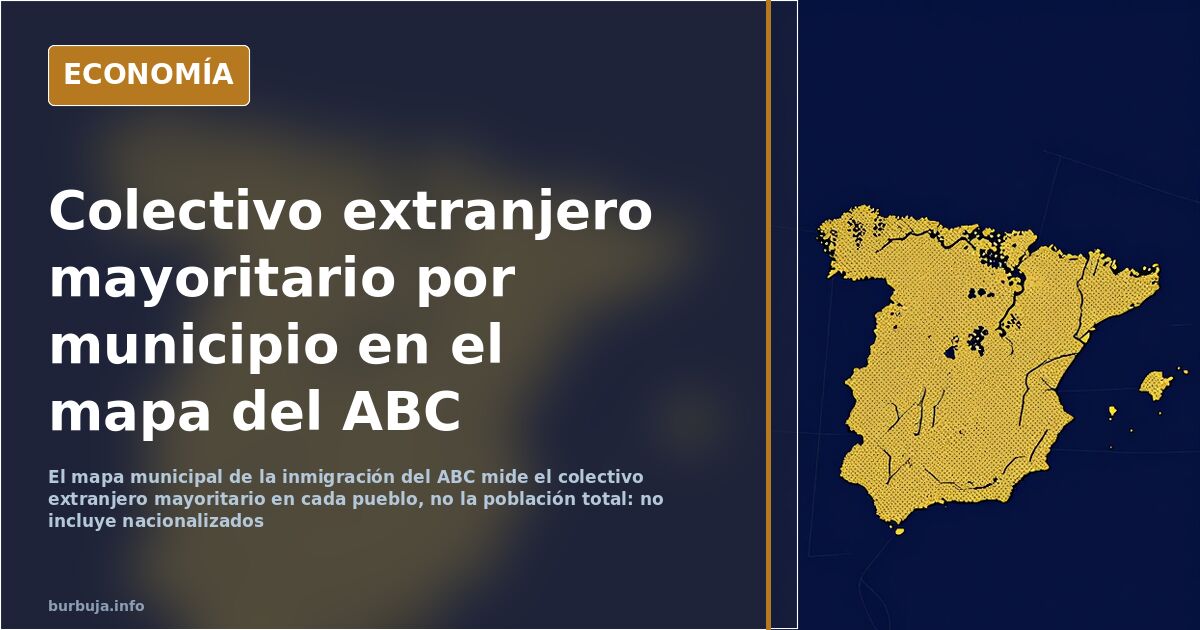
What the ABC municipal immigration map measures
The ABC published a detailed immigration map for Spain, breaking down data by municipality. The visualization shows the origin of registered foreign residents, highlighting the dominant group in each town. Its release sparked broad interpretations, with claims that some cities have foreign majorities. This reading holds only under a specific interpretation. A closer look narrows the conclusion significantly.
What the map measures: Foreign origin, not total population
The map’s design is its own limit. It includes only residents with foreign nationality, excluding naturalized citizens and second-generation individuals. Therefore, do not interpret its colors as a majority of the total population: the map indicates the predominant group among foreigners, not the entire municipality.
The most repeated correction aligns with this: municipalities with a foreign majority of the total population are few and small. The scale threshold confirms this: the largest municipality with no registered immigrant population has 333 inhabitants. With such small nuclei, any percentage is volatile.
Some argue the map does not match their local reality, where foreign proportions vary by area.
INE figures vs. circulating estimates
It is crucial to distinguish data from intuition. While some estimates cite 18 million migrants and their children, INE figures cited by participants place those born abroad at around 9 million, and naturalizations granted in the last 23 years remain below 3 million. These are distinct magnitudes and cannot be simply added.
This nuance matters because the long-term half of Spaniards residing abroad are naturalized; not all passport holders live here. Any calculation mixing both groups inflates the result. The debate on the real volume of foreign-origin population remains open, with ranges varying by what is counted.
The map that became inaccessible and the remaining CSV
Some claim the viewer was removed shortly after publication, leaving only the associated CSV file. Whether this was a technical error or a deliberate removal is unconfirmed. What circulates are dumps and replicas of the same dataset.
This detail fueled suspicion. Some viewed it as top-down censorship on a sensitive issue; others dismissed it as a simple page crash. Without official confirmation, the hypothesis remains unresolved.
European coast, Latin American interior: the geographic pattern
A recurring reading points to a clear geographic distribution. European-origin residents concentrate in small coastal towns, while Latin American and African origins appear in the interior and urban centers. This pattern repeats across several provinces.
In Galicia, recent shifts are noted: African-origin workers have replaced Romanians in certain areas within just two years. This is the type of movement a municipal map captures late, as registration lags behind street reality.
From data to forecast: the analysis drift
The conversation splits as it pogre. One block discusses methodology, percentages, and sources; another jumps straight to forecasting, calling for mass deportations and predicting ethnic conflict. The so-called Kalergi Plan conspiracy theory, lacking any evidence, also emerges.
Amidst these are repeated arguments in the thread: that the migration boom arrived around 2000 with the housing bubble, that the first immigration law dates to 1985, that Sweden has started deporting undocumented Iraqis, or that the EU is considering excluding certain Canary Islands retention zones from Spanish territory. Each data point is used for convenience.
Where the analysis stalls
Here, the count stops. The map measures nationalities, not real population; it excludes naturalized citizens and second-generation residents; and in nuclei of 300 inhabitants, any percentage is fragile. No one has yet quantified the core question: how many foreign-origin residents truly live in Spain, and how many municipalities have a foreign majority of the total population. That number still does not exist.
The ABC published a detailed immigration map for Spain, breaking down data by municipality. The visualization shows the origin of registered foreign residents, highlighting the dominant group in each town. Its release sparked broad interpretations, with claims that some cities have foreign majorities. This reading holds only under a specific interpretation. A closer look narrows the conclusion significantly.
What the map measures: Foreign origin, not total population
The map’s design is its own limit. It includes only residents with foreign nationality, excluding naturalized citizens and second-generation individuals. Therefore, do not interpret its colors as a majority of the total population: the map indicates the predominant group among foreigners, not the entire municipality.
The most repeated correction aligns with this: municipalities with a foreign majority of the total population are few and small. The scale threshold confirms this: the largest municipality with no registered immigrant population has 333 inhabitants. With such small nuclei, any percentage is volatile.
Some argue the map does not match their local reality, where foreign proportions vary by area.
INE figures vs. circulating estimates
It is crucial to distinguish data from intuition. While some estimates cite 18 million migrants and their children, INE figures cited by participants place those born abroad at around 9 million, and naturalizations granted in the last 23 years remain below 3 million. These are distinct magnitudes and cannot be simply added.
This nuance matters because the long-term half of Spaniards residing abroad are naturalized; not all passport holders live here. Any calculation mixing both groups inflates the result. The debate on the real volume of foreign-origin population remains open, with ranges varying by what is counted.
The map that became inaccessible and the remaining CSV
Some claim the viewer was removed shortly after publication, leaving only the associated CSV file. Whether this was a technical error or a deliberate removal is unconfirmed. What circulates are dumps and replicas of the same dataset.
This detail fueled suspicion. Some viewed it as top-down censorship on a sensitive issue; others dismissed it as a simple page crash. Without official confirmation, the hypothesis remains unresolved.
European coast, Latin American interior: the geographic pattern
A recurring reading points to a clear geographic distribution. European-origin residents concentrate in small coastal towns, while Latin American and African origins appear in the interior and urban centers. This pattern repeats across several provinces.
In Galicia, recent shifts are noted: African-origin workers have replaced Romanians in certain areas within just two years. This is the type of movement a municipal map captures late, as registration lags behind street reality.
From data to forecast: the analysis drift
The conversation splits as it pogre. One block discusses methodology, percentages, and sources; another jumps straight to forecasting, calling for mass deportations and predicting ethnic conflict. The so-called Kalergi Plan conspiracy theory, lacking any evidence, also emerges.
Amidst these are repeated arguments in the thread: that the migration boom arrived around 2000 with the housing bubble, that the first immigration law dates to 1985, that Sweden has started deporting undocumented Iraqis, or that the EU is considering excluding certain Canary Islands retention zones from Spanish territory. Each data point is used for convenience.
Where the analysis stalls
Here, the count stops. The map measures nationalities, not real population; it excludes naturalized citizens and second-generation residents; and in nuclei of 300 inhabitants, any percentage is fragile. No one has yet quantified the core question: how many foreign-origin residents truly live in Spain, and how many municipalities have a foreign majority of the total population. That number still does not exist.
Summary of a discussion on Burbuja.info - Foro de economía, actualidad y política., translated from Spanish and reviewed before publication. Read the full discussion (321 replies).
More summaries
-
Retired at 60: Spain’s 1,440-Euro Pension and 450-Euro Rent Case
Maricarmen retired at 60 with a 1,440-euro pension and 450-euro rent in El Retiro. The case highlights unpaid building fees, IBI, water, and heating costs.
-
Fernando Esteso Dies at 80: The Comedian Who Funded Serious Spanish Cinema
Spanish comedian Fernando Esteso died at 80. His low-budget films subsidized serious cinema until the Mira Law changed the industry.
-
Boomer Unemployment Surpasses Youth: A Generational Debt?
For the first time, joblessness among those over 55 exceeds youth rates. The debate on pensions and generational fairness intensifies.
-
Spain’s Political Crisis Deepens as Judicial Pressure Mounts on Cash Payments
Judicial pressure over cash payments and speculation about Sánchez’s resignation drive Spain’s political instability.
-
Trucker’s 3,000-Euro Net Salary: The Figure Dividing the Sector
A national route driver earns 3,000 euros net, sparking debate, while others cap salaries at 1,500. Allowances bridge the gap.
-
Garriga’s Insult Reignites Debate on Hate Crime Laws in Spain
Ignacio Garriga responds to a critic with an insult, reopening the debate on whether it constitutes a hate crime or political criticism.