
Garriga’s Insult Reignites Debate on Hate Crime Laws in Spain
Ignacio Garriga responds to a critic with an insult, reopening the debate on whether it constitutes a hate crime or political criticism.
English · Original discussion in Spanish · Published
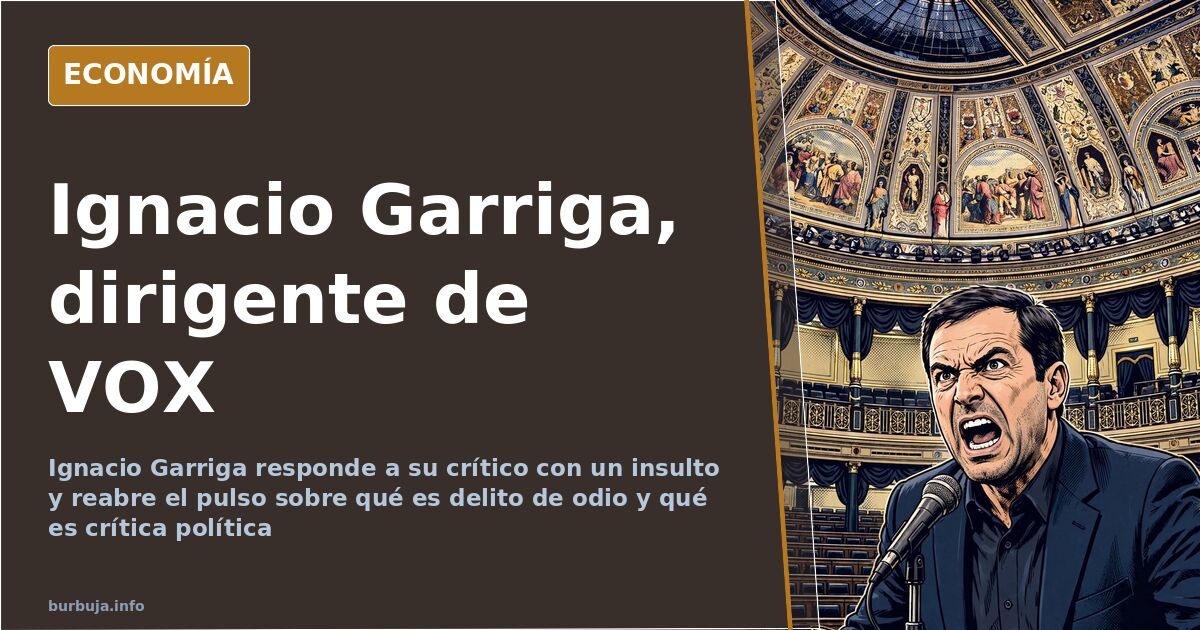
Garriga insults critic, reigniting legal debate
VOX leader Ignacio Garriga responded to critics with a message calling for "perversos words full of hate" while praising his mother, his Catalan identity, and "fighting against wind and tide" for his region's future. He concluded by targeting an "ugly racist" and "separatists," reigniting the debate on where political criticism ends and insults begin.
The discussion quickly moved from the incident to the core issue: how far one can discuss a public figure's origin without falling into the very accusation made against the opponent.
What did Garriga say and who was he responding to?
The reply was directed, according to the episode's interpretation, at commentator Federico Jiménez Losantos. Garriga's message did not name anyone, but the exchange of statements between the two allowed identification of the recipient. Before this clash, and according to the surrounding narrative, the broadcaster had alluded to burning German beer halls, an approach some considered xenophobic without labeling it a hate crime. This precedent now serves as a benchmark. Notable is not the outburst itself, but that it comes from a leader who usually positions himself on the side of the offended when the blow comes from the other direction.
When does an insult become a hate crime?
Here lies the crux. It is argued that courts have already classified another statement about burning German establishments as political criticism, leaving unclear what margin remains to prosecute verbal excess. From this perspective, if justice did not see a crime in that, it is unlikely to see one now. On the other side, it is argued that labeling someone by their skin tonalidad or origin is not opinion, but an attack, and that legal avenues should open. The same question applies to the derogatory term directed at Garriga himself regarding his skin tonalidad: if that is a hate crime, why was the other not? The asymmetry is what troubles both sides the most.
Garriga's origin and Guinea's past
The controversy shifted to the leader's origin. It was stated that his mother was born in Guinea in 1947, when the territory was a Spanish province, and that his father came from a wealthy family. From this, an argument repeated aloud is drawn: that Guinea was a province and not Spain proper, and therefore the presence of Black population in the peninsula is later. In response, another part argues that Spain was also built with African and Caribbean territories. To support this, the Constitution of 1876 was cited, which mentioned Cuba and Puerto Rico as overseas provinces, and a repeated fact: that in 1904, natives of Guinea were considered minors. The exchange stalled on a simple legal point: recognizing a child admits no conditions, and denying nationality based on the parent's origin does not fit the legal system.
VOX's strategy and minorities as a shield
A third line pointed to the party's image politics. It is argued that VOX places people from minorities in visible positions to shield itself from accusations of racism, and that this move backfires when the person responds like anyone else. The comparison hovering over the exchange concerned profiles that serve to discomfort one side or another depending on the moment. The paradox pointed out is old: the party boasts of breaking molds and at the same time turns its minorities into proof of innocence. When one of these figures steps out of the script, the convenience clock starts ticking.
Blood purity, empires, and a drift going out of control
The conversation ended in Spanish history. One side argued that blood purity statutes responded to a religious criterion and not a biological one, and therefore a convert was marked while an Amerindian could be considered pure. The other replied that penalizing the origin of the mother or grandparents is exactly discrimination by origin, and that baptism was not enough to erase it. In the middle appeared the material motive: it was recalled that every empire, the Spanish included, was built to accumulate wealth, and that the ideological justification came later. The detail is not minor, because it confronts official epic with accounting.
There remains a disconcerting fact. Among the arguments used to discuss Garriga's Spanishness, it is cited at the same time that Spain was among the last European countries to abolish slavery. Historical shame is used to speak about the present of the party's most prominent leader. The reproach and the response resemble each other more than both sides would admit.
VOX leader Ignacio Garriga responded to critics with a message calling for "perversos words full of hate" while praising his mother, his Catalan identity, and "fighting against wind and tide" for his region's future. He concluded by targeting an "ugly racist" and "separatists," reigniting the debate on where political criticism ends and insults begin.
The discussion quickly moved from the incident to the core issue: how far one can discuss a public figure's origin without falling into the very accusation made against the opponent.
What did Garriga say and who was he responding to?
The reply was directed, according to the episode's interpretation, at commentator Federico Jiménez Losantos. Garriga's message did not name anyone, but the exchange of statements between the two allowed identification of the recipient. Before this clash, and according to the surrounding narrative, the broadcaster had alluded to burning German beer halls, an approach some considered xenophobic without labeling it a hate crime. This precedent now serves as a benchmark. Notable is not the outburst itself, but that it comes from a leader who usually positions himself on the side of the offended when the blow comes from the other direction.
When does an insult become a hate crime?
Here lies the crux. It is argued that courts have already classified another statement about burning German establishments as political criticism, leaving unclear what margin remains to prosecute verbal excess. From this perspective, if justice did not see a crime in that, it is unlikely to see one now. On the other side, it is argued that labeling someone by their skin tonalidad or origin is not opinion, but an attack, and that legal avenues should open. The same question applies to the derogatory term directed at Garriga himself regarding his skin tonalidad: if that is a hate crime, why was the other not? The asymmetry is what troubles both sides the most.
Garriga's origin and Guinea's past
The controversy shifted to the leader's origin. It was stated that his mother was born in Guinea in 1947, when the territory was a Spanish province, and that his father came from a wealthy family. From this, an argument repeated aloud is drawn: that Guinea was a province and not Spain proper, and therefore the presence of Black population in the peninsula is later. In response, another part argues that Spain was also built with African and Caribbean territories. To support this, the Constitution of 1876 was cited, which mentioned Cuba and Puerto Rico as overseas provinces, and a repeated fact: that in 1904, natives of Guinea were considered minors. The exchange stalled on a simple legal point: recognizing a child admits no conditions, and denying nationality based on the parent's origin does not fit the legal system.
VOX's strategy and minorities as a shield
A third line pointed to the party's image politics. It is argued that VOX places people from minorities in visible positions to shield itself from accusations of racism, and that this move backfires when the person responds like anyone else. The comparison hovering over the exchange concerned profiles that serve to discomfort one side or another depending on the moment. The paradox pointed out is old: the party boasts of breaking molds and at the same time turns its minorities into proof of innocence. When one of these figures steps out of the script, the convenience clock starts ticking.
Blood purity, empires, and a drift going out of control
The conversation ended in Spanish history. One side argued that blood purity statutes responded to a religious criterion and not a biological one, and therefore a convert was marked while an Amerindian could be considered pure. The other replied that penalizing the origin of the mother or grandparents is exactly discrimination by origin, and that baptism was not enough to erase it. In the middle appeared the material motive: it was recalled that every empire, the Spanish included, was built to accumulate wealth, and that the ideological justification came later. The detail is not minor, because it confronts official epic with accounting.
There remains a disconcerting fact. Among the arguments used to discuss Garriga's Spanishness, it is cited at the same time that Spain was among the last European countries to abolish slavery. Historical shame is used to speak about the present of the party's most prominent leader. The reproach and the response resemble each other more than both sides would admit.
Summary of a discussion on Burbuja.info - Foro de economía, actualidad y política., translated from Spanish and reviewed before publication. Read the full discussion (393 replies).
More summaries
-
Federico Jiménez Losantos leaves EsRadio: Carlos Cuesta to take over
Federico Jiménez Losantos leaves EsRadio for health reasons, with Carlos Cuesta stepping in amid nepotism and subsidy criticism
-
Federico Jiménez Losantos: the conspiracy prophet challenging Spain's official narrative
Jiménez Losantos's accusations about Zapatero and Vox, once dismissed as eccentric, are gaining traction in analytical circles. Is this the end of...
-
Negocios TV Alert Claims Explosions in Frankfurt
An unverified alert suggests explosions shook Frankfurt center; the European Central Bank (ECB) is mentioned without confirmation.
-
Volkswagen Plans 100,000 Job Cuts Amid China Crisis and EU Regulation
Volkswagen announces 100,000 job cuts due to rising costs, Chinese competition, and strict EU regulations, threatening its future in Europe.
-
Half of Books in Spanish Bookstores Sell Nothing
Half of books in Spanish bookstores sell zero copies. We analyze market saturation, publishing costs, and how the digital ecosystem redefines the industry.
-
Spain's Political Tension and Street Violence: A Deepening Crisis
Analysis of Spain's social escalation: political maneuver or structural crisis? Polarization extends beyond sports.