
Spain's minimum income benefit denied over 2025 income threshold
Six months of waiting and a denial based on 2025 income: Spain's IMV is calculated on past earnings and excludes those who no longer have them. The debate over…
English · Original discussion in Spanish · Published
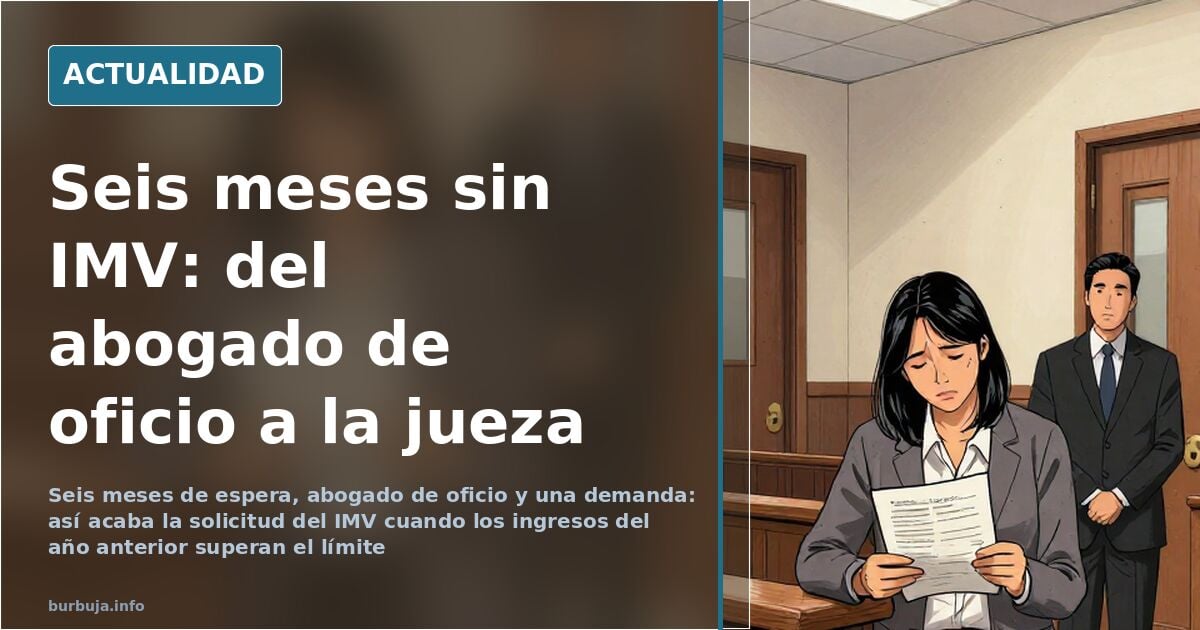
The IMV denied for having earned 'too much' in 2025
Six months of waiting, a denial for exceeding the previous year's income threshold, and a court-appointed lawyer to try to overturn it. That is the journey described by a person who identifies as autistic and lives in Spain, and who saw the benefit fail to arrive over an administrative detail: the income declared in 2025. The paradox is familiar to anyone who has dealt with the Ingreso Mínimo Vital (Spain's minimum living income scheme): eligibility is calculated on past earnings, not on the current situation. While the courts decide, the question hovering over any conversation about the benefit is a different one: what do you do once it finally comes through?
The IMV is granted or denied by looking backwards
The case that opens this discussion is a textbook example. The applicant says they earned 'too much money in 2025' and that is why the administration shut the door on them. It does not matter that they no longer have that income: the system assesses the closed tax year. The institutional response is mechanical; the human one is not. Hence they have turned to a free lawyer and are awaiting a court ruling. It is the portrait of a mechanism that protects budgetary balance before the circumstances of the person applying.
In that context, the question 'what are you going to do when they approve your IMV?' stops being a joke and becomes a thermometer. Because the benefit, when it arrives, does not solve life: it sustains it. And that explains the answers.
From the easy joke to the arithmetic of dignity
The reactions range from banter to analysis. Some respond with dark humour about what to do with the money —spend it on vices— and others directly mock the requirements: if the problem is the paperwork, changing your identity or your origin would do the trick. That kind of comment, which appears in the discussion, reflects a widespread perception: that access to benefits depends less on need than on the box you tick.
Against that, another part of the debate claims the paguita (small benefit payment) as a right, not charity. 'I'm just a little autistic Spaniard who wants to live with dignity,' sums up the opening post. The phrase condenses the clash: the person asking for the benefit does not see themselves as a parasite, but as someone the system owes a safety net.
Paying contributions is not the same as receiving a benefit
One of the most substantial interventions in the exchange comes from a retiree receiving 974 euros a month. Their argument is sharp: that is not a benefit, it is a pension earned through contributions. The distinction matters, because in the collective imagination contributory and non-contributory benefits are lumped together as if they were the same. They are not. And that confusion fuels cross resentment between those who receive and those who do not.
The same participant adds a jarring detail: anyone 'from the fifth arsehole' earns more than he does. The comparison, unverified, points to a known reality: the amount of low pensions and the IMV are so close that the line between working and not working blurs.
Family capital as an alternative to the benefit
Another strand of the debate flatly rejects asking for the benefit. 'I refuse to collect a parasite's handout from the system,' says a voice claiming to live off private family capital. The applicant's reply is not long in coming: parasitising your family is based, parasitising the system is cringe. The quip has substance: in Spain, the real support network has historically been the family, not the state. And whoever has that network does not need the other one.
The exchange turns tense when someone accuses the person rejecting the benefit of wishing death by starvation on those who ask for it. It is the exact point where the analysis gets stuck: there is no agreement on whether the benefit is a right or a favour, nor on whether those who do not need it should stay quiet or set an example.
Summary of a discussion on Burbuja.info - Foro de economía, actualidad y política., translated from Spanish and reviewed before publication. Read the full discussion (19 replies).
More summaries
-
Spain's IMV: €20,353 Asset Cap and Residency Rules
Spain's Minimum Vital Income sets a €20,353.62 asset limit for adults and requires municipal registration. The debate over eligibility and system costs remains open.
-
71% of Spain's former unaccompanied minors registered with social security
According to the Spanish government, 71% of young migrants who left state care are registered with Social Security. However, this metric counts registrations, not necessarily actual jobs.
-
Spain: ex-partner squats man's home for 20 years, leaves after 10-year court battle
Mónica Medina has left her ex-partner's home, actor Emilio, after 20 years of occupation and a 10-year legal battle. The case reopens the debate over Spain's slow courts.
-
Juan Atkins, Detroit Techno Pioneer and Cybotron Founder, Dies
Juan Atkins, founder of Cybotron, Model 500, and Metroplex Records, has died. He laid the foundations of Detroit techno alongside Derrick May and Kevin Saunderson.
-
Learjet crashes in Florida: 9 aboard, including 20-year-old co-pilot
A Learjet 60 with nine people on board crashed from 41,000 feet into a Greenacres, Florida street. The co-pilot was just 20 years old.
-
Legal gap may leave goalkeeper free after on-field death
Rules punish reckless tackles even with ball contact, but Spanish Penal Code requires proof of excess to charge for field deaths.