
Spain's 'Mileurista' Pays Rent But Gets No Rental Subsidy
A worker earning 1,150 euros pays 500 for rent but receives no young rental bonus or 200-euro aid, highlighting Spain's housing affordability gap.
English · Original discussion in Spanish · Published
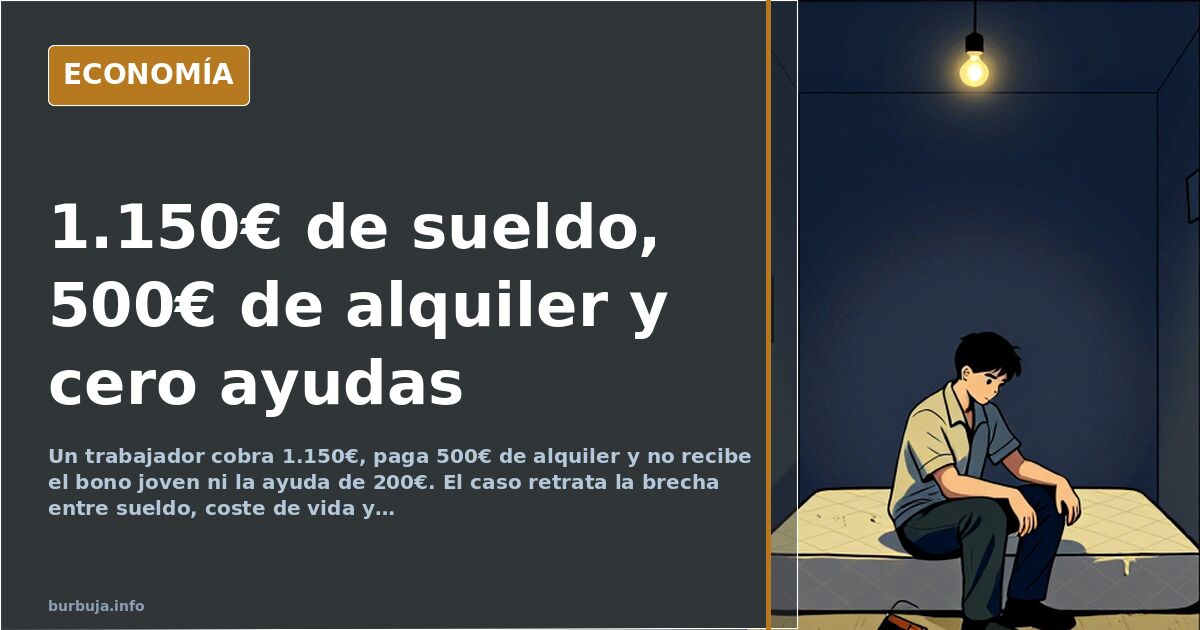
Living on 1,150 euros and paying 500 in rent: the aid that never arrives
An active worker earns between 1,150 and 1,180 euros monthly, lives alone in a 35-square-meter apartment, and pays 500 in rent. He applied for the young rental bonus as soon as he was eligible but has received no response. The 200-euro aid appears as ACTIVE in the system but remains unresolved. With these figures, he says there are months when he does not make ends meet and he has considered turning to Caritas.
The monthly breakdown that leaves no room for error
The expense sheet, published in an initial edition, is devastatingly simple: 500 in rent, 200 for food, 150 for gas, 34 for the gym, 50 for electricity —70 in December for heating—, 60 for water every two months, 30 for the phone, and 20 for internet. All of this on a salary of around 20,000 euros gross annually.
To this fixed structure are added unforeseen costs that no savings cover. Replacing the exhaust pipe to pass the vehicle inspection cost 300 euros at once. There are months with an overdraft. The housing, clarified in a third edition, is a room with a bathroom, and he cannot afford anything else. The margin is not narrow: it does not exist.
Why is the young rental bonus not granted?
Because there is no resolution, not because there is a denial. The affected party does not claim his application was rejected: he claims the file is stuck without any communication. The 200-euro aid is marked as ACTIVE and does not move forward; the young rental bonus has been without response for months. It is the difference between a closed door and a door no one answers.
This episode describes an administrative management problem rather than a policy one. Those who meet the requirements do not necessarily receive payment; those who do receive it do not always see the process resolved. This gives rise to the sense of grievance dominating the story: some know people in better situations who have received both aids, while the applicant remains waiting.
From criticism of the gym to blaming outsiders
The majority response was not solidarity. Part of the debate targeted non-essential expenses: the gym, protein, the car. The argument that 34 euros are a luxury rather than a necessity was repeated endlessly. The counter-argument was not long in coming: if saving 30 euros a month fixed someone’s life, the problem would not be the gym.
Another current shifted toward public spending and immigration. It is argued that certain groups access aids sooner, a claim made by supporters without any verifiable data, coexisting with the opposite complaint: from those asking what specific aid they can apply for but finding none. The result is a debate pitting the disadvantaged against each other rather than addressing the root causes.
Cainism is the word that summarizes the tone. The one asking for aid bothers the one who does not receive it; the one who receives it bothers the one who pays. No one discusses the system’s design, only who is left out.
Taxes, comparative grievance, and the generational gap
The other axis of the issue is fiscal. Some declare paying more than 20,000 euros annually in taxes and argue that the problem is not the 200 euros of a one-time aid, but administrative duplicities, institutional advertising, or subsidies to intermediate structures. The diagnosis repeats: protesting against migrants receiving aid is targeting the wrong objective when money is dispersed much earlier.
The generational reading is the bitterest. It is recalled that two decades ago a salary of 1,000 euros allowed saving 100 monthly in Madrid, and today that same figure does not even cover rent. Those with teenage children assume they will stay home for years, and some already plan second nationalities for them to leave. The floating conclusion: working and being unable to live from it ceases to be an anomaly to become the norm.
There is consensus on the diagnosis but none on the solution. Lowering taxes, cutting administrations, demanding living wages, or moving abroad: each recipe has its defender and its refutation. The case remains unresolved, and the sense of exploitation persists.
An active worker earns between 1,150 and 1,180 euros monthly, lives alone in a 35-square-meter apartment, and pays 500 in rent. He applied for the young rental bonus as soon as he was eligible but has received no response. The 200-euro aid appears as ACTIVE in the system but remains unresolved. With these figures, he says there are months when he does not make ends meet and he has considered turning to Caritas.
The monthly breakdown that leaves no room for error
The expense sheet, published in an initial edition, is devastatingly simple: 500 in rent, 200 for food, 150 for gas, 34 for the gym, 50 for electricity —70 in December for heating—, 60 for water every two months, 30 for the phone, and 20 for internet. All of this on a salary of around 20,000 euros gross annually.
To this fixed structure are added unforeseen costs that no savings cover. Replacing the exhaust pipe to pass the vehicle inspection cost 300 euros at once. There are months with an overdraft. The housing, clarified in a third edition, is a room with a bathroom, and he cannot afford anything else. The margin is not narrow: it does not exist.
Why is the young rental bonus not granted?
Because there is no resolution, not because there is a denial. The affected party does not claim his application was rejected: he claims the file is stuck without any communication. The 200-euro aid is marked as ACTIVE and does not move forward; the young rental bonus has been without response for months. It is the difference between a closed door and a door no one answers.
This episode describes an administrative management problem rather than a policy one. Those who meet the requirements do not necessarily receive payment; those who do receive it do not always see the process resolved. This gives rise to the sense of grievance dominating the story: some know people in better situations who have received both aids, while the applicant remains waiting.
From criticism of the gym to blaming outsiders
The majority response was not solidarity. Part of the debate targeted non-essential expenses: the gym, protein, the car. The argument that 34 euros are a luxury rather than a necessity was repeated endlessly. The counter-argument was not long in coming: if saving 30 euros a month fixed someone’s life, the problem would not be the gym.
Another current shifted toward public spending and immigration. It is argued that certain groups access aids sooner, a claim made by supporters without any verifiable data, coexisting with the opposite complaint: from those asking what specific aid they can apply for but finding none. The result is a debate pitting the disadvantaged against each other rather than addressing the root causes.
Cainism is the word that summarizes the tone. The one asking for aid bothers the one who does not receive it; the one who receives it bothers the one who pays. No one discusses the system’s design, only who is left out.
Taxes, comparative grievance, and the generational gap
The other axis of the issue is fiscal. Some declare paying more than 20,000 euros annually in taxes and argue that the problem is not the 200 euros of a one-time aid, but administrative duplicities, institutional advertising, or subsidies to intermediate structures. The diagnosis repeats: protesting against migrants receiving aid is targeting the wrong objective when money is dispersed much earlier.
The generational reading is the bitterest. It is recalled that two decades ago a salary of 1,000 euros allowed saving 100 monthly in Madrid, and today that same figure does not even cover rent. Those with teenage children assume they will stay home for years, and some already plan second nationalities for them to leave. The floating conclusion: working and being unable to live from it ceases to be an anomaly to become the norm.
There is consensus on the diagnosis but none on the solution. Lowering taxes, cutting administrations, demanding living wages, or moving abroad: each recipe has its defender and its refutation. The case remains unresolved, and the sense of exploitation persists.
Also available in: Deutsch
Summary of a discussion on Burbuja.info - Foro de economía, actualidad y política., translated from Spanish and reviewed before publication. Read the full discussion (327 replies).
More summaries
-
Spain debates seizing private homes for social rent amid cost fears
Spain considers expropriating private flats for social rent, but high just compensation, price controls, and tight supply complicate the plan.
-
Madrid rent of €1,600 on an average salary of €2,077
A 45 m² flat in Madrid is listed at €1,600 a month, while the average salary in the capital is €2,077. The numbers don't add up.
-
Muface: Bal estimates 1.5 million civil servants affected
Edmundo Bal says 1.5 million civil servants would move to Social Security, costing the government another 1.5 million votes.
-
Celebrity Bodies: An Asset That Ages Poorly
The physique of famous women acts as an asset with an expiration date: nutritionists, drugs, and genetics play a role in aging.
-
Data Centers: 11,000 Facilities Amid Financial Doubts
Reports suggest 11,000 global data centers are built for demand 50 times higher than actual usage.
-
Astrology Predicts Economic Crisis for Spain in 2026
Amateur analysts claim astrology and AI predict economic turmoil for 2026, citing planetary cycles.