
Spain's Low Emission Zones: Political Support and Opposition
PSOE, Sumar and nationalists back Spain's ZBEs; PP approves but softens them; VOX opposes categorically.
English · Original discussion in Spanish · Published
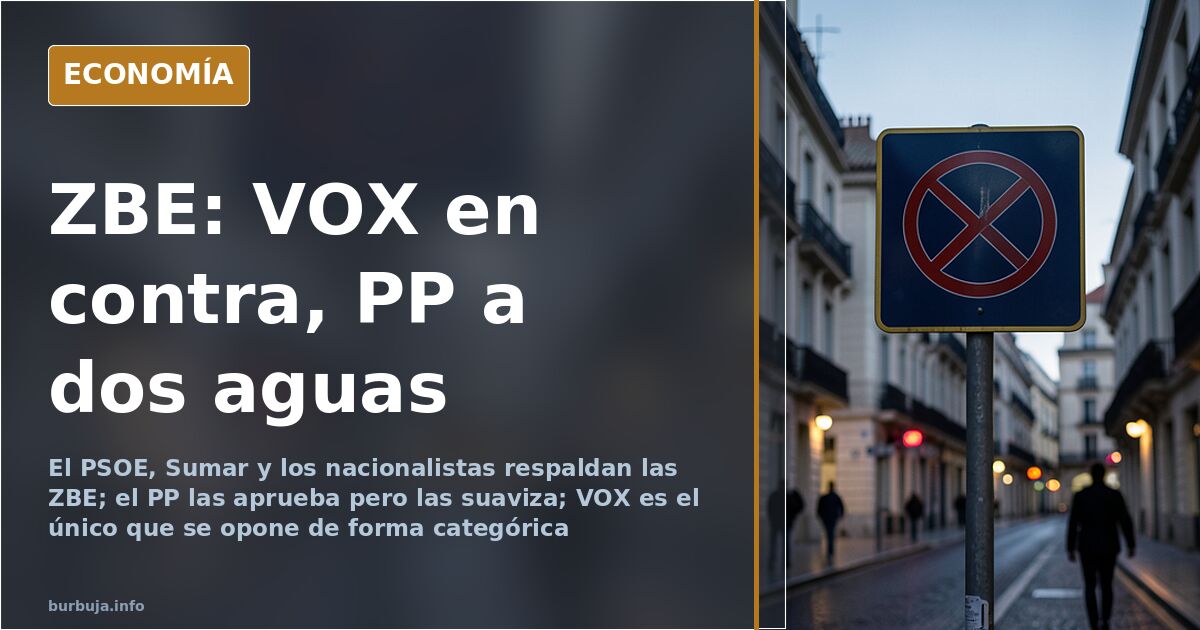
ZBEs in Spain: Who Supports, Who Blocks, and Who Pays
Drivers with older cars face a contradiction in Spanish cities: they cannot enter the center, yet paying for private parking seems to magically clear the air. This scene—paying to pollute instead of banning pollution—summarizes the political fight over Low Emission Zones (ZBE). EU rules mandate these zones but do not define their boundaries; local councils decide whether to cover half the city or just a few meters. That discretion drives both business interests and ideological clashes.
Supporters of ZBEs
The PSOE promotes implementation as part of sustainable mobility efforts and compliance with EU regulations and the Climate Change Law. They argue that rejecting these zones aligns with climate denialism and harms public health. Sumar, Podemos, and other left-wing parties support the framework, demanding stricter traffic controls and better public transport. Regionalist and nationalist parties like PNV, EH Bildu, or Coalición Canaria have backed regulatory ordinances in municipalities where they govern or support local sustainability measures, as seen in Basque town council votes.
PP’s Dual Approach: Ordinances Yes, Fines No
The People's Party occupies an uncomfortable yet politically profitable position. Nationally, it defends complying with EU guidelines and has approved ZBE ordinances in many capitals it governs, such as Madrid, Málaga, and Santander. In practice, however, it advocates for flexible application, delaying mandatory norms, or softening restrictions and penalties. In the Senate and some regional parliaments, it voted against PSOE motions aimed at strengthening these zones, and in municipalities like Santa Cruz de Tenerife, it even requested removing their mandatory status. Some describe this as a two-faced stance; others call it covert opposition. Consequently, voters are unsure what they are actually supporting.
VOX: The Only Unconditional Opponent
VOX presents itself as the only party categorically rejecting ZBEs across all institutions: town halls, regional parliaments, and Brussels. Its official discourse labels them as restrictions on freedom of movement, revenue-generating schemes via fines, and direct punishments for workers, families, and shopkeepers who cannot afford electric vehicles or environmental badges. The party fights in courts to overturn these ordinances—achieving suspensions in capitals like Málaga and challenging them in Catalonia—and demands halting them in coalition-run municipalities.
Old Cars as a Social Class: A Complaint Unitling Half of Spain
The most repeated criticism is not climatic but social. It argues that wealthy Tesla owners enter centers easily and receive parking benefits, while those with decade-old cars are excluded. The idea of private parking as a pass is viewed cynically: paying ten minutes for a garage allows picking someone up where one would otherwise be fined. The conclusion drawn is that the rule measures ability to pay, not emissions. In medium-sized cities like Soria, complaints mix with the feeling that patterns designed for large metropolises are being applied indiscriminately.
The Front of Car-Free Residents
Opposing this narrative is another current: residents without cars in city centers appreciate restricted circulation because they breathe cleaner air and see functional cities. From this perspective, the problem is not ZBEs but urban models forcing long car commutes. The conflict involves material interests, not just party acronyms: those who park at their door versus those demanding free sidewalks. Meanwhile, a crucial detail remains: EU rules do not draw the map; local councillors do. That is where true political negotiation happens, yet almost no one discusses it.
Also available in: Deutsch
Summary of a discussion on Burbuja.info - Foro de economía, actualidad y política., translated from Spanish and reviewed before publication. Read the full discussion (28 replies).
More summaries
-
Cristina Calero, Canary Islands MP, dies aged 35
Cristina Calero, a MP for Coalición Canaria in Spain, has died at 35 after falling suddenly ill. Her death has sparked debate about young people's health and speculation over the…
-
AfD unveils plan to dismantle the EU and curb Von der Leyen's power
AfD presents its plan to turn the EU into a Union of Sovereign Nations, end European elections as we know them and cut back the power of Von der Leyen's Commission.
-
PP's CGPJ Deal Sparks Voter Backlash in Spain
The PP and PSOE agreed to renew the Spanish judicial council, a move critics call a betrayal of conservative voters.
-
Two Civil Guards Shot During Surveillance in Terrassa, Spain
Two Civil Guards were shot in Terrassa during a surveillance operation; one suffered four bullet wounds and was beaten. The incident highlights security concerns in Spain.
-
Voting doesn't extend life: correlation, not causation
The link between voting and longevity is a real correlation but a false prescription; voters were already healthier and more integrated.
-
Madrid's Growth Plan: Water Limits Hit by Six Million Target
Debates on adding six million residents to Madrid clash with water scarcity, protected land, and strained public transport.