
Spain's lottery has no memory: hot numbers are a myth
Fifty years of playing doesn't improve your odds. Focus on avoiding shared prizes by skipping dates and obvious patterns.
English · Original discussion in Spanish · Published
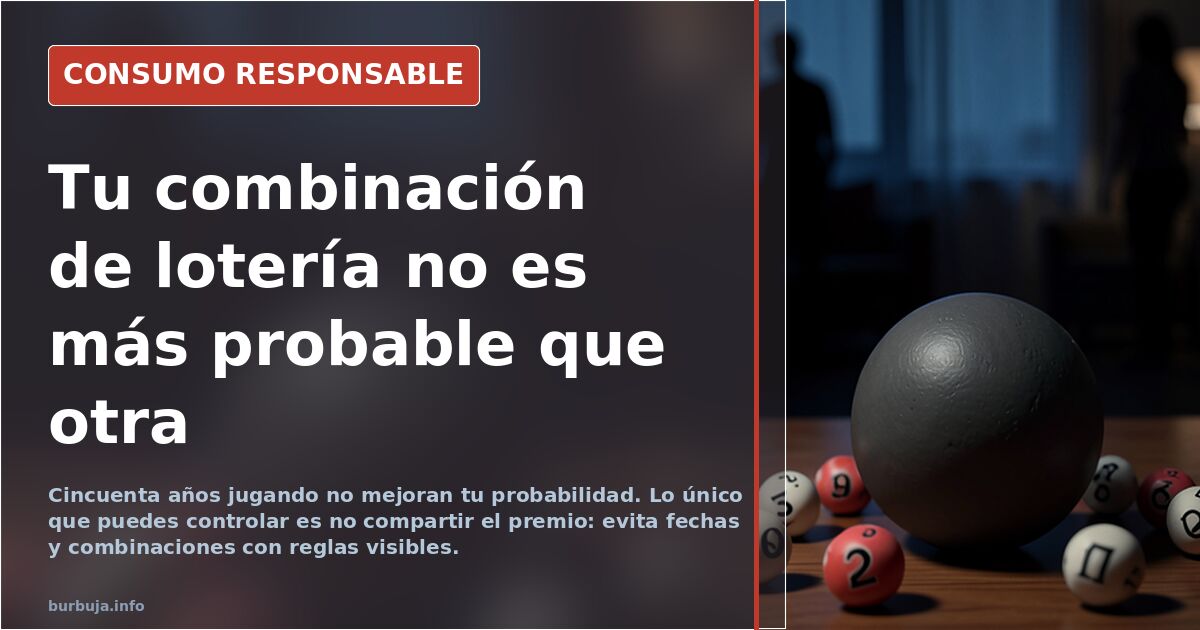
La lotería no tiene memoria: por qué tu combinación no es más probable
Playing La Primitiva for fifty years won't bring you any closer to the jackpot. The probability of winning the next draw is identical for a veteran player and someone buying their first ticket. This is the first concept mathematicians must explain repeatedly, yet it faces the most resistance: the drum has no memory of yesterday's balls; it only contains distinct physical objects.
This leads to the second idea, which has real practical consequences. All combinations are equally probable, but not all are equally shared. Choosing 1, 2, 3, 4, 5, and 6 doesn't reduce your chances of winning; it multiplies the likelihood of splitting the prize with a legion of players who had the same idea. Here enters Spanish player psychology: wedding dates, birthdays, anniversaries. Numbers from 1 to 12 cover months and days; those from 1 to 31 cover days of the month. A combination with two or three numbers above 31 reduces this unwanted company.
¿Es más probable una combinación con pares e impares equilibrados?
No. The parity of the balls is irrelevant to the probability of them being drawn. The only relevant factor is that they are all different. Putting 49 colored balls in the drum and drawing six colors would be exactly the same game, without any meaningful even or odd distinction. The intuition that a balanced split between evens and odds, or between halves of the range, offers better chances is a statistical mirage: it confuses the shape of the aggregate distribution of results with the probability of a specific combination.
Some argue otherwise vehemently, but the counterargument is simple: if a drum holds 25 white and 25 black balls, drawing six whites is just as probable as drawing three of each. What changes is the number of distinct combinations producing that split, not the probability of a specific extraction. Confusing these two concepts is the most repeated error in any conversation about chance.
Jugar la misma combinación varias veces: la única jugada con lógica
The lottery doesn't allow you to reserve a combination exclusively. But there is a partial substitute: repeating the same ticket. If you play four identical Bonoloto tickets and there are two other winners, you get around 66% of the prize. You don't increase your probability of winning, but you secure the split if you do win. It is the only decision with mathematical basis in the entire process, aside from the most obvious one: not playing at all.
Comparing products also yields uncomfortable numbers for the most popular ones. 20 euros for a Christmas lottery ticket buys a 1 in 100,000 chance of winning 400,000 euros. That same 20 euros, spent daily on Bonoloto, gives a 1 in 349,596 chance of hitting six numbers, with an average prize to share of about 375,000 euros. Expected profitability is poor in both cases; in the latter, it is also variable depending on how many others win.
There remains the detail that disorients anyone watching two consecutive draws: two winning combinations sharing five numbers, separated by just two days. It happens, and it will happen again. Chance isn't obligated to maintain recognizable chaos monotony. The difference lies between calculating the probability of a pre-defined coincidence and finding some striking coincidence after reviewing hundreds of draws. We only notice the pattern once it has appeared. That is where analysis ends and storytelling begins.
Also available in: Deutsch
Summary of a discussion on Burbuja.info - Foro de economía, actualidad y política., translated from Spanish and reviewed before publication. Read the full discussion (22 replies).
More summaries
-
Spain's Christmas Lottery: Whole Tickets vs. Shares Spark Couple Conflict
A man gives whole tickets to his family but shares to his wife's, causing tension over fairness and reciprocity in holiday gifts.
-
Lottery: Suspicious Patterns and Undisputed Opacity
Probability explains consecutive numbers, but the repeated 73073 and 11 Bonoloto winners fuel doubts about lottery draws.
-
Lottery: The Scam Isn't in the Drum, It's in the 40% Withheld
The lottery only returns 60% of what's collected: you pay €1 to get back €0.60 on average. These are the real odds for each draw and why almost...
-
Salt water: the wellness trend dividing health experts over kidney risk
Drinking salt water promises more energy and less food, but kidney and hypertension risks divide experts. Data, testimonials and the science behind it…
-
Spain: Insurers undervalue total loss cars for resale
In Spain, adjusters declare total losses with low payouts while reselling vehicles months later under the original owner's name.
-
Best canned fish: Cod liver to Spanish bonito
A can of cod liver may contain 10-20 times the daily recommended vitamin A, according to circulating calculations. Explore alternative canned seafood options.