
Spain's Christmas Lottery: Whole Tickets vs. Shares Spark Couple Conflict
A man gives whole tickets to his family but shares to his wife's, causing tension over fairness and reciprocity in holiday gifts.
English · Original discussion in Spanish · Published
Spain's Christmas Lottery: Whole Tickets vs. Shares Spark Couple Conflict
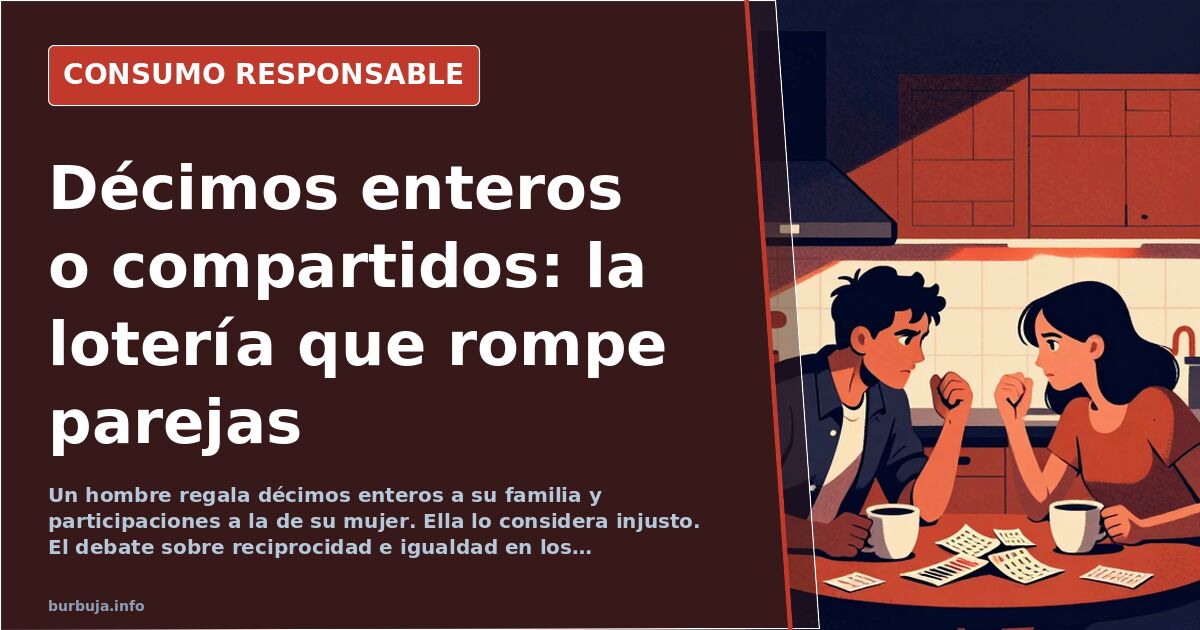
Every Christmas, a man gifts a full lottery ticket to his mother, sister, and aunt. They reciprocate with three full tickets. His vvife’s family operates differently, exchanging only small shares. He decided on strict reciprocity: full tickets for his side, shares for hers. His vvife considers this unfair, arguing that if they win, her family receives significantly less. This seemingly trivial dispute has sparked a 109-comment debate on deeper issues: Do you return exactly what you receive, or do you equalize treatment at all costs?
The Principle of Reciprocity: Give What You Get
Most analyses support clear reciprocity: if someone gives you a ticket, you give back a ticket. If they give a share, you give a share. This is basic diplomatic courtesy. The argument holds that gift value isn't measured by potential winnings, but by what is physically handed over. A ticket is a ticket; a share is a share.
Proponents argue that upgrading the gift—giving full tickets to those who only give shares—breaks symmetry and turns exchange into competition. Furthermore, if her family chooses shares, it is their custom, not an insult.
A nuance reinforces this: a gift is not a payment. Expecting exact returns turns a gift into a conditional transaction. If it is a transaction, conditions must be symmetric.
The Equality Argument: Same Treatment for Both Families
The opposing view starts from a different premise: fairness means treating both families equally, not just returning what was received. If his family gets full tickets, hers should too. Otherwise, there is discrimination based on family origin.
Supporters add a prospective calculation: if they win, his family receives triple what hers does. This is hard to explain at a Christmas dinner. In this logic, equality is measured by potential receipt, not actual giving.
Critics note this ignores the other party's will. If her family chose shares, forcing full tickets obliges them to receive more than they give. That is also an asymmetry, just in reverse.
The Real Cost: Shares Worth Less Than Snacks
Beyond ethics, a practical issue emerges: the real value of a share. Participants note lottery shares often have very low face values. A five-euro share barely buys snacks. A full ticket costs twenty euros.
This price difference drives the conflict. Gifting a twenty-euro ticket differs from gifting a five-euro share. If the exchange isn't symmetric, one side puts up more money. The economic imbalance is real, even if the gesture is identical.
The question arises: Should lottery gifts be measured by monetary value or intention? Reciprocity advocates say value; equality advocates say intention. There is no agreement here.
The Couple Dimension: Separate Assets and Gifts
The conflict extends beyond families to the couple. Separating lottery gifts—each partner handling their own family—is proposed as a practical solution. If each spouse manages their exchange, there is no comparative grievance.
However, this clashes with cohabitation reality. Money comes from common funds or individual income, and gift decisions affect both. Ultimately, the discussion isn't about lottery; it's about who decides how family money is distributed.
Some suggest the root problem is the woman prioritizing her birth family over the new unit. Others argue the man failed to build a new unity above previous ties. The lottery is merely the battlefield.
The Fool's Tax: Lottery as Bad Business
Amidst the debate, some question the practice itself. Statistically, Spain's Christmas Lottery is bad business. The State keeps a substantial part of revenue, and winning odds are minimal. Critics call it the "fool's tax."
The argument goes: if you fight over lottery, don't buy it. Money spent on tickets is mostly lost. Even if someone wins, the probability of winning *and* generating conflict is low. Ironically, the conflict exists before the draw.
This group concludes the problem isn't the lottery, but expectation management. If you gift expecting return, the gift is tainted. If you gift without expectation, no conflict occurs.
Who Is Wrong? The Unanswered Question
In the end, the title's question remains unanswered. There is no clear villain. Two logics clash: reciprocity (return what you get) and equality (treat everyone the same). Both make sense, yet they conflict.
Analysis reveals the dispute isn't about lottery. It is about expectations, family dynamics, money, and decision-making power in the relationship. The lottery is just the trigger, revealing pre-existing tensions.
If they buy tickets next year, the argument returns. If they don't, another reason will emerge. Because the problem was never the lottery.
Every Christmas, a man gifts a full lottery ticket to his mother, sister, and aunt. They reciprocate with three full tickets. His vvife’s family operates differently, exchanging only small shares. He decided on strict reciprocity: full tickets for his side, shares for hers. His vvife considers this unfair, arguing that if they win, her family receives significantly less. This seemingly trivial dispute has sparked a 109-comment debate on deeper issues: Do you return exactly what you receive, or do you equalize treatment at all costs?
The Principle of Reciprocity: Give What You Get
Most analyses support clear reciprocity: if someone gives you a ticket, you give back a ticket. If they give a share, you give a share. This is basic diplomatic courtesy. The argument holds that gift value isn't measured by potential winnings, but by what is physically handed over. A ticket is a ticket; a share is a share.
Proponents argue that upgrading the gift—giving full tickets to those who only give shares—breaks symmetry and turns exchange into competition. Furthermore, if her family chooses shares, it is their custom, not an insult.
A nuance reinforces this: a gift is not a payment. Expecting exact returns turns a gift into a conditional transaction. If it is a transaction, conditions must be symmetric.
The Equality Argument: Same Treatment for Both Families
The opposing view starts from a different premise: fairness means treating both families equally, not just returning what was received. If his family gets full tickets, hers should too. Otherwise, there is discrimination based on family origin.
Supporters add a prospective calculation: if they win, his family receives triple what hers does. This is hard to explain at a Christmas dinner. In this logic, equality is measured by potential receipt, not actual giving.
Critics note this ignores the other party's will. If her family chose shares, forcing full tickets obliges them to receive more than they give. That is also an asymmetry, just in reverse.
The Real Cost: Shares Worth Less Than Snacks
Beyond ethics, a practical issue emerges: the real value of a share. Participants note lottery shares often have very low face values. A five-euro share barely buys snacks. A full ticket costs twenty euros.
This price difference drives the conflict. Gifting a twenty-euro ticket differs from gifting a five-euro share. If the exchange isn't symmetric, one side puts up more money. The economic imbalance is real, even if the gesture is identical.
The question arises: Should lottery gifts be measured by monetary value or intention? Reciprocity advocates say value; equality advocates say intention. There is no agreement here.
The Couple Dimension: Separate Assets and Gifts
The conflict extends beyond families to the couple. Separating lottery gifts—each partner handling their own family—is proposed as a practical solution. If each spouse manages their exchange, there is no comparative grievance.
However, this clashes with cohabitation reality. Money comes from common funds or individual income, and gift decisions affect both. Ultimately, the discussion isn't about lottery; it's about who decides how family money is distributed.
Some suggest the root problem is the woman prioritizing her birth family over the new unit. Others argue the man failed to build a new unity above previous ties. The lottery is merely the battlefield.
The Fool's Tax: Lottery as Bad Business
Amidst the debate, some question the practice itself. Statistically, Spain's Christmas Lottery is bad business. The State keeps a substantial part of revenue, and winning odds are minimal. Critics call it the "fool's tax."
The argument goes: if you fight over lottery, don't buy it. Money spent on tickets is mostly lost. Even if someone wins, the probability of winning *and* generating conflict is low. Ironically, the conflict exists before the draw.
This group concludes the problem isn't the lottery, but expectation management. If you gift expecting return, the gift is tainted. If you gift without expectation, no conflict occurs.
Who Is Wrong? The Unanswered Question
In the end, the title's question remains unanswered. There is no clear villain. Two logics clash: reciprocity (return what you get) and equality (treat everyone the same). Both make sense, yet they conflict.
Analysis reveals the dispute isn't about lottery. It is about expectations, family dynamics, money, and decision-making power in the relationship. The lottery is just the trigger, revealing pre-existing tensions.
If they buy tickets next year, the argument returns. If they don't, another reason will emerge. Because the problem was never the lottery.
Also available in: Deutsch
Summary of a discussion on Burbuja.info - Foro de economía, actualidad y política., translated from Spanish and reviewed before publication. Read the full discussion (109 replies).
More summaries
-
Running vs. HIIT: The endurance running cult faces challenges
The death of a runner in the Gijón Half Marathon fuels the debate between running and HIIT. Analysis of the wear and tear of continuous running.
-
New cars drain family savings in Spain
New vehicles lose value instantly, and average salaries don't cover the cost. The second-hand market offers little relief.
-
Cola Cao 1986 vs 2026: less product, more sugar, same real price
Cola Cao 1986 vs 2026: smaller size, sugar up to 70%, and price adjusted for inflation. Is it still the same product? Data analysis.
-
200-Euro Bike Breaks Down Every Two Months, Owner Says
A €200 Rockrider ST 100 suffered repeated failures; forum users suggest the 'mid-range' starts at €700.
-
Shoppers Compare Prices at Mercadona, Lidl and Asian Markets
Forum users compare grocery prices at Mercadona, Lidl and Asian supermarkets in Spain, citing hikes of 10-35% and specific costs for butter and fruit.
-
Tesla S catches fire in Valencia after flooding, forum claims
A user reports a submerged Tesla S ignited in Valencia, destroying two homes and up to five vehicles. The brand was not mentioned on TV.