
Spain's legal route to owning a pistol: the F licence explained
The F licence allows pistol ownership in Spain for sport shooting only, not self-defence. The 24-joule limit and an octogenarian's case fuel the debate.
English · Original discussion in Spanish · Published
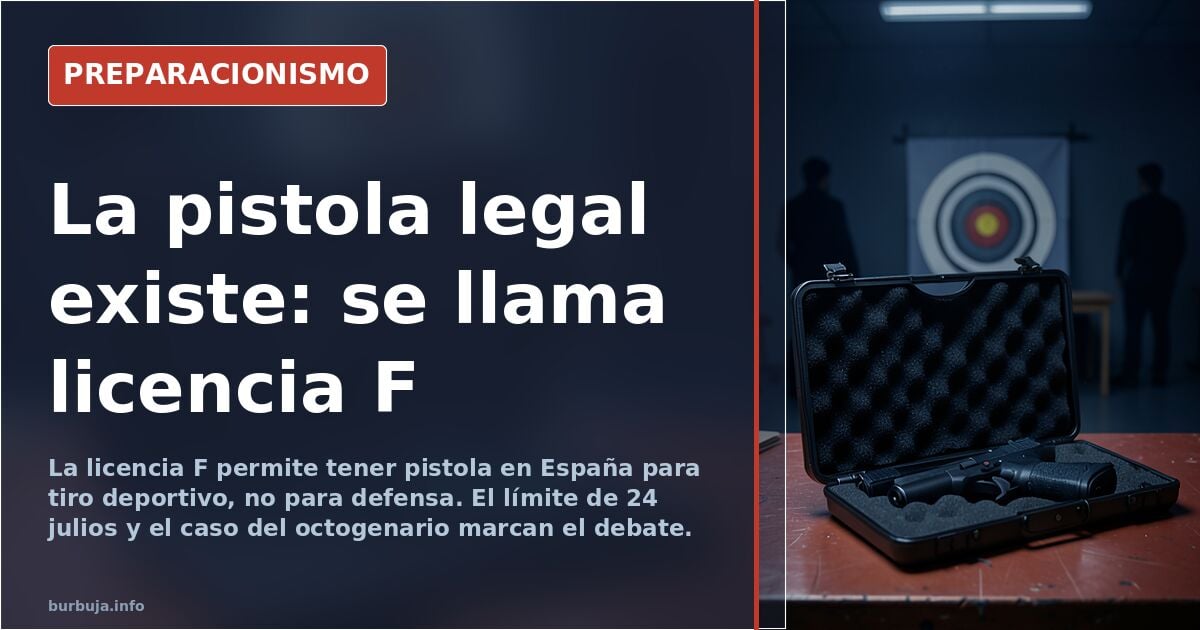
I want a pistol: the legal route exists and it's called the F licence
The question that opens the thread is simple, and the diagnosis it receives is nearly unanimous: in Spain, self-defence is not recognised as grounds for keeping a weapon at home. What does exist is a specific administrative door, the F licence for sport shooting, processed through the regional shooting federation and the Guardia Civil's Intervención de Armas (weapons office). Those who obtain it may keep short and long firearms for sporting practice, not for personal defence. The distinction matters: the law doesn't give you a gun to protect yourself, it gives you one to shoot a ten and a nine at the range.
From there, the discussion splits. One camp insists that the Spanish legal system is, in practice, incompatible with armed self-defence, and brings up the case of an octogenarian prosecuted after repelling an intruder. The other camp responds just as forcefully that the problem is not the law but ignorance: there are licences, there are federations, there are shooting ranges, and anyone claiming otherwise simply hasn't done the paperwork. The argument heats up and ends up leaving the legal terrain for the question of whether it's wise.
What the F licence actually allows and what it doesn't
The F licence is the sporting authorisation for short firearms. It is applied for with a report from the shooting federation of your autonomous community, a theoretical and practical exam, and subsequent registration with the Guardia Civil. The weapon is registered, stored under requirements, and its use limited to authorised facilities. None of that turns the pistol into a household security tool: taking it out of the home without justified reason or using it outside a shooting range is an administrative offence, and using it against a person opens a incivil procedure to be settled later.
The real cost of the process, according to those who have been through it, is the part least talked about: annual federation fees, insurance, a licensed gunsmith and the price of the gun itself. Some point out that shooting ranges usually help with the paperwork, and that the expense is high but bounded. The alternative raised in the conversation —buying without papers through an acquaintance with access to hunting estates— is described as a risky route that would not withstand any inspection.
The self-defence that never comes: the octogenarian's case
The episode that anchors the distrust is that of an elderly person prosecuted after repelling an intruder in their home. The case is used as proof that the law does not protect those who defend themselves, and the conclusion drawn is twofold: first, that the system treats the defender as a suspect; second, that calling the police after the incident worsens the procedural situation. It's a reading repeated in various forms, and no one on the other side rebuts it with concrete case law.
Against that, the technical objection is that unlawful orders need not be obeyed and that there is a duty to pursue crimes. The argument does not convince those who have already decided the problem is political rather than legal. And that's where the conversation settles: the paper says one thing, practice says another.
Crossbows, slingshots and catapults: what's legal and what isn't
The original query mentioned a crossbow or a slingshot firing steel balls. The technical answer given is that a crossbow can be bought in European gun shops and received at home if postal transport is avoided, while some claim that catapults and slingshots are banned in Spain. The distinction is not trivial: the weapons regulation classifies some objects and leaves others in a limbo resolved through express prohibition.
On effectiveness, the consensus is sceptical. A slingshot requires aim and years of practice; a catapult, even more. It's recalled that the Balearic slingers were elite troops in Antiquity, capable of piercing a helmet with a lead projectile, but their value depended on training nobody has today. The anecdote circulating —a neighbour who repelled an attacker with eleven pellets from an air pistol— is told as a lucky exception, not a method.
Air guns: the 24-joule limit
The most concrete data point in the exchange is technical: the Spanish legal limit for air guns is 24 joules. One user describes having tuned a 4.5 mm bolt-action pistol to nearly 300 metres per second and 22 joules with a short barrel, and warns that fitting the long barrel would make it a registrable firearm. The comparison offered puts the .22 LR at 120-150 joules and a 9 mm at 450-500. The implicit conclusion is that air guns serve to deter and to practise, not to stop.
The question left hanging is not which legal weapon is most effective, but whether it makes sense to arm yourself within a framework that, when the weapon is used, turns the defender into a suspect. With the F licence in hand and the licensed gunsmith's storage at home, the answer remains unwritten.
Also available in: Deutsch
Summary of a discussion on Burbuja.info - Foro de economía, actualidad y política., translated from Spanish and reviewed before publication. Read the full discussion (71 replies).
More summaries
-
Dream guns that Spanish law won't let you own or use
Spain's legal ceiling is high but not infinite: from a guideable .22 to an impossible .50 BMG, here's how it's decided which gun you can own and which stays a fantasy
-
Swamp house marketed as a zombie-proof refuge
A furnished house on a swamp is pitched as a zombie-proof refuge, but mosquitoes, alligators and isolation threaten the plan.
-
Neither sugar nor starch are essential nutrients: the body makes its own
The body produces glucose through gluconeogenesis and the brain can use ketone bodies: carbohydrates are not essential, though studies link moderate intake to lower mortality.
-
CO2 pistols: legal in Spain, but sales stalled by Guardia Civil
A forum user argues CO2 pistols remain legal in Spain, but the Guardia Civil halted sales after packaging labelled 'home defense' surfaced. Registering one…
-
Cheap heating this winter: a portable heat pump for €62 a year
A second-hand portable heat pump bought for €130 promises heating all winter long for €62 a year. Thermodynamics and the electricity tariff will put it to the test.
-
Honda EU22i or portable battery: the backup power dilemma
Honda EU22i at 90 dB from seven metres or a portable battery with 600 cycles: backup power for an apartment runs into noise and battery lifespan problems.