
Cheap heating this winter: a portable heat pump for €62 a year
A second-hand portable heat pump bought for €130 promises heating all winter long for €62 a year. Thermodynamics and the electricity tariff will put it to the test.
English · Original discussion in Spanish · Published
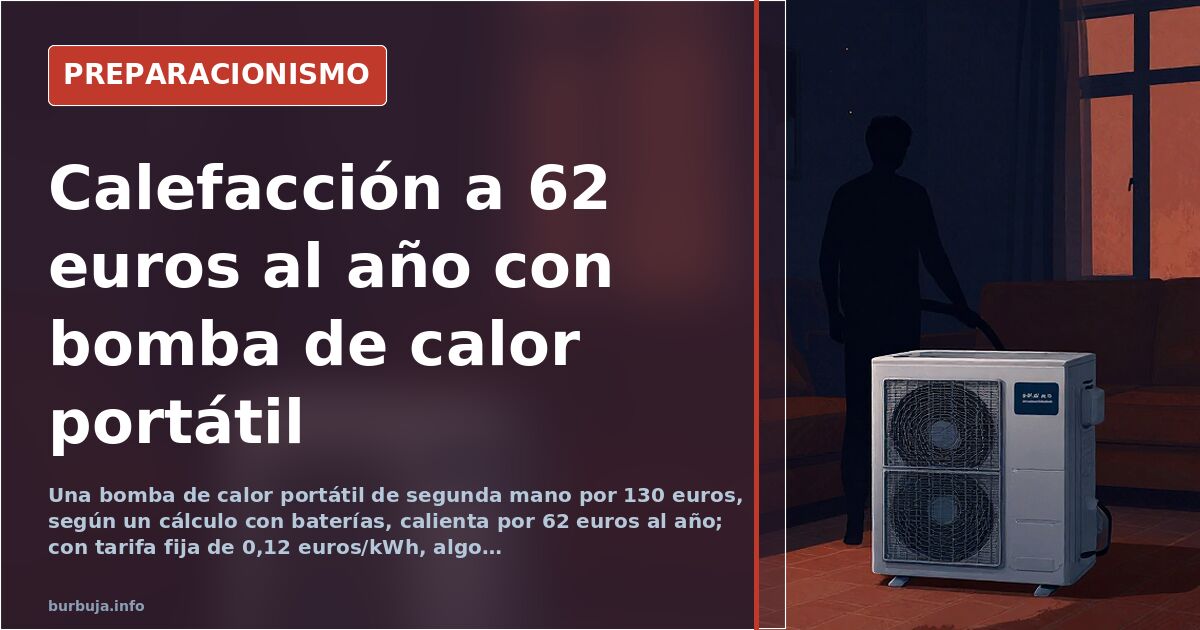
Cheap heating: the portable heat pump that promises €62 a year
An air conditioner with a heat pump, bought second-hand for €130 on Wallapop, heats a home for six months at eight hours a day for €62 a year. The calculation comes from a user who boasts having home batteries and an electricity price of €0.066 per kilowatt hour around the clock. The figure, which will raise more than one eyebrow, is the starting point of a debate that in the coming weeks will put thermodynamics — and the wallet of half of Spain — to the test.
The thesis is not that heat pumps are cheap. It is that there are heat pumps and heat pumps. The author of the argument distinguishes between units with the compressor outside — conventional splits — and portables that keep the compressor inside the home. His reasoning: with the latter, the outdoor cold hardly matters because the heat is drawn from the indoor air, which will always be warmer, and the cold air from the evaporator is expelled outside. A deduction that, he admits, he has not yet been able to prove at temperatures below 5 degrees.
What the first calculation says and where the savings come from
The number behind the proposal is easy to read and hard to replicate. **€62 a year** with six months of use at eight hours a day. The author himself admits that his electricity tariff is not most people's: with batteries, his kilowatt hour averages **€0.066**. And he adds that with a fixed tariff of €0.12 per kilowatt hour, the bill would rise to just over **€130 a year**. Still a figure that makes any gas boiler or conventional electric radiator look ridiculous.
The unit, bought second-hand for **€130** on Wallapop, was originally intended for summer and the expected 50-degree heat. The surprise came when trying it as heating. With 17 degrees outside, the outlet air reached 55 degrees. With 7 degrees outdoors, the air still came out at 55 degrees. From this he draws the hypothesis he wants to verify this winter: in a portable with an indoor compressor, performance does not depend on the outdoor temperature.
Thermodynamics is not negotiable: why the cold matters
Scepticism arrives quickly and with arguments. Some point out that a 2008 unit already struggled below 7 or 8 degrees, and that hot air stays up top while your feet freeze, because these appliances are designed for summer. The **single-hose penguin problem** is also raised: it expels air from the room, depressurises it and forces outdoor air in at street temperature, which sinks performance both for cooling and heating. The solution is a two-hose unit or sealing the outlet properly.
The deeper objection is more uncomfortable: if the heat pump were a miracle cure, millions of engineers would have imposed it by now. The technical answer is that a heat pump does not create energy, it moves it. For every electrical kilowatt hour it can deliver three or four of heat, and that abusa no law of thermodynamics: it is its most elementary application. What does change in extreme cold is the performance of the outdoor compressor, which has to defrost and works across a larger temperature gap. In a portable with the compressor inside, that gap is smaller.
The hole in the window and the noise of the compressor
Installation is the Achilles heel. You need a hole of about **15 centimetres** in the wall or window for the exhaust hose. Anyone with triple glazing and argon is not convinced, and rightly so: replacing a drilled pane costs more than **€200**, according to the experience of someone who already did it for another appliance. The author argues that with airtight windows, a sealed hole and an insulated hose, the portable is more efficient than people think. The problem, he says, is that almost nobody installs it properly because it is seen as a quick and cheap fix.
Noise is the other bill. The compressor inside the house can be heard, and more so at night. Some have fitted an anti-vibration system with rubber mounts so as not to disturb the downstairs neighbours. And heat distribution leaves room for improvement: the sensor is in the indoor unit, hot air rises and the floor stays cold. That is what ceiling fans with reverse mode are for, pushing warm air downwards.
Alternatives that cost less than €20
Against the heat pump, the range of low-cost solutions that appears in the discussion is wide. The **electric water heated mattress pad** (Orbegozo and similar) charges in a minute and releases heat for an hour and a half to two. The power rating, 550 or 850 watts, only changes how long it takes to charge, not the heat it stores. Each charge costs around two cents. An electric heating pad worn against the body, at 100 watts, lets you cope with temperatures of 5 to 10 degrees. And the kerosene storm lantern, with 100 to 300 watts of radiant heat, is the most extreme version of personal heating.
The problem with all these solutions is that they heat a person, not a house. For anyone who needs to warm several rooms, the comparison is different. And there the disconcerting figure is that of the owner of a rural holiday home who was spending **€2 per hour** on heating in each apartment. At that price, winter eats up any budget.
What remains to be proven
The central hypothesis is still open. The author admits it: he has not yet been able to test the unit below 7 degrees. This winter, with temperatures near zero in Madrid, will show whether the air keeps coming out at 55 degrees or whether physics presents the bill. Meanwhile, the €62-a-year calculation rests on an electricity tariff that is not within everyone's reach.
The prediction, with reservations: if performance holds up in moderate cold, the portable with an indoor compressor will become the cheapest option for those who cannot touch the building's communal boiler or afford a split. If not, it will remain what it is: a transitional solution for mild climates and tight budgets. January's data will decide.
Also available in: Deutsch
Summary of a discussion on Burbuja.info - Foro de economía, actualidad y política., translated from Spanish and reviewed before publication. Read the full discussion (60 replies).
More summaries
-
Next winter could be challenging: How to prepare
With high fuel prices and the risk of power cuts, emergency heating has become a priority. Butane, paraffin, or batteries: what to do...
-
CO2 pistols: legal in Spain, but sales stalled by Guardia Civil
A forum user argues CO2 pistols remain legal in Spain, but the Guardia Civil halted sales after packaging labelled 'home defense' surfaced. Registering one…
-
Honda EU22i or portable battery: the backup power dilemma
Honda EU22i at 90 dB from seven metres or a portable battery with 600 cycles: backup power for an apartment runs into noise and battery lifespan problems.
-
AI meets reverse engineering: REA hits 130,000 GitHub stars
REA is an MCP with over 130,000 stars on GitHub that connects Claude Code with Ghidra, IDA and Hopper. Here's how to install it and what its legal limits are.
-
Lemon with cloves doesn't work as a mosquito repellent: what the test proved
The lemon-and-cloves trick for keeping mosquitoes away falls apart: whoever tried it saw no results. Effective alternatives and why it's a myth.
-
Germination Test Shows Home-Saved Seeds Last Longer Than Expected
A germination test reveals the surprising longevity of home-saved seeds, even after 4 years. Find out which varieties hold up best.