
Honda EU22i or portable battery: the backup power dilemma
Honda EU22i at 90 dB from seven metres or a portable battery with 600 cycles: backup power for an apartment runs into noise and battery lifespan problems.
English · Original discussion in Spanish · Published
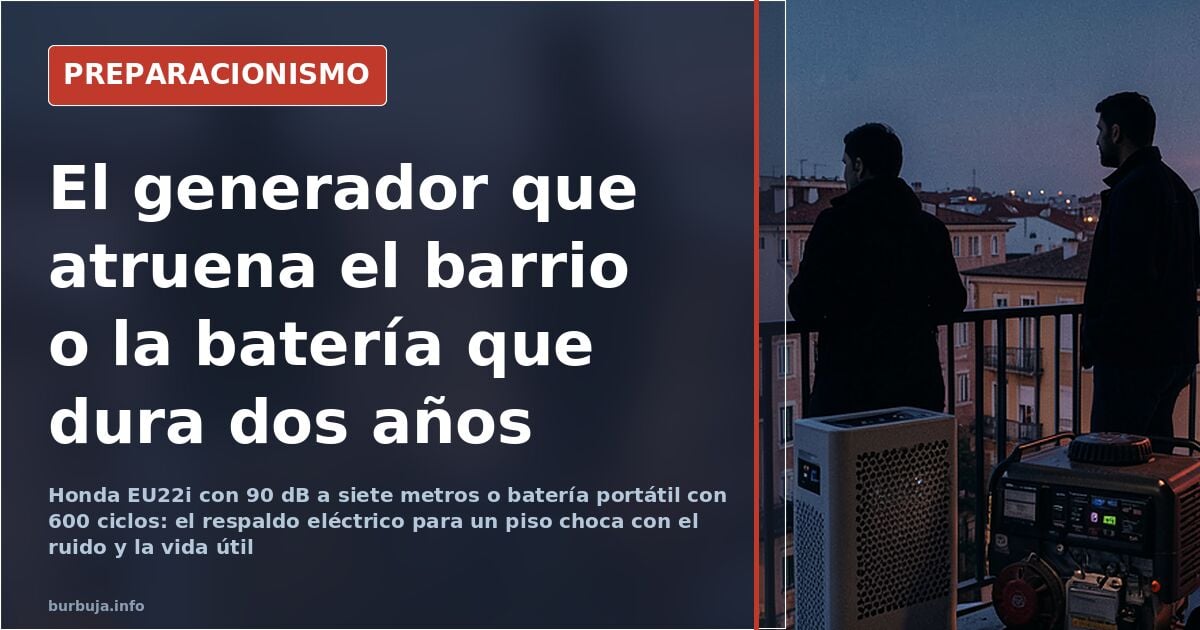
Honda EU22i or battery: the backup power question nobody solves
A power cut lasting more than six hours. The boiler shut down, frozen food on the verge of spoiling, and an apartment in the city where noise gives you away. With that scenario on the table, the conversation starts with a specific request: a quality portable generator, between 1,000 and 2,000 euros, around 2,500 W, manageable and quiet. The majority answer comes quickly and with a name attached: Honda.
The argument is not advertising. A 1,200 W unit with two decades of service still starts in a Galician village to power a fridge and a television when the grid goes down. The brand stands out as the safe bet, even if the price stings. The model mentioned, the EU22i, comes with a 230 V single-phase output and 1.8 kW, suited to the European plug.
Noise: the big problem nobody wants to hear
That is where things turn. The figure that throws everyone off: 90 dB at seven metres. For an urban terrace, that is a neon sign. Those who have tried it describe it bluntly: it thunders across the whole neighbourhood, and even placed under an open-air staircase it can be heard from the opposite side of the house. Proper soundproofing exists, but it is expensive.
The intended use mixes two worlds that do not always fit together: a vineyard hut with no electricity in Galicia and an apartment with prolonged outages. In the first case, the generator is a tool. In the second, it is an awkward neighbour that also announces there is something worth protecting. Some say it openly: in a city, during a long blackout, it is best to stay under the radar, and neither the light nor the roar help.
Petrol, oil and the temptation of the battery
The mechanics are quickly clarified: it is a four-stroke engine, petrol only, with separate engine oil, no mixing. The question of running it for a whole day is left hanging. And then the alternative that is gaining ground enters the scene: the power station with solar panels.
The EcoFlow Delta and its cousins are presented as the discreet option. It charges in under an hour from a 220 V socket or in about eight hours with panels. It powers four AC outlets and USB ports. It handles an 800 W brush cutter or a water pump without breaking a sweat. On sunny days, with some clouds in between, a four-hour session recovered 52% with peaks of 113 W from 160 W panels.
The problem is different: lifespan. Against the 600 cycles attributed to some units —two years of real use—, the higher-capacity cases stretch to five. For occasional backup, it fits. For daily household use, the maths falls apart.
Imported lithium and DIY electrics
The conversation drifts towards pure storage. LiFePO4 batteries bought on Asian platforms, shipped from Germany without going through customs, at 850 euros for 24 V and 300 Ah. The idea of building your own bank trinc tutorials is gaining ground over the closed brand system, which is more convenient and considerably more expensive.
The complete setup —unit plus a 160 W panel— exceeds 1,100 euros. Some justify it on medical grounds: without power, sleep apnoea becomes a serious problem. Others find it excessive for what it offers.
The final decision leans towards the portable battery. The outlets are tested, it works, and it is stored away for the extreme emergency. The panels remain in the box, unused. The petrol generator, meanwhile, waits its turn with a full tank and its noise in tow. Nobody has quite worked out which of the two is the right backup for an apartment.
Also available in: Deutsch
Summary of a discussion on Burbuja.info - Foro de economía, actualidad y política., translated from Spanish and reviewed before publication. Read the full discussion (74 replies).
More summaries
-
EcoFlow Delta Pro: One Year of Real Savings with a Battery and No Solar Panels
A year of real-world use of the EcoFlow Delta Pro as a home battery: €20-30/month bill, 10,800 Wh, 4,000 cycles, and the risks to avoid. Data and controversy.
-
Cheap heating this winter: a portable heat pump for €62 a year
A second-hand portable heat pump bought for €130 promises heating all winter long for €62 a year. Thermodynamics and the electricity tariff will put it to the test.
-
Self-defense against groups: Fleeing vs. legal risks
Facing three or more attackers, fleeing is the majority choice. The issue isn't strength, but the legal cost of self-defense.
-
CO2 pistols: legal in Spain, but sales stalled by Guardia Civil
A forum user argues CO2 pistols remain legal in Spain, but the Guardia Civil halted sales after packaging labelled 'home defense' surfaced. Registering one…
-
AI meets reverse engineering: REA hits 130,000 GitHub stars
REA is an MCP with over 130,000 stars on GitHub that connects Claude Code with Ghidra, IDA and Hopper. Here's how to install it and what its legal limits are.
-
Lemon with cloves doesn't work as a mosquito repellent: what the test proved
The lemon-and-cloves trick for keeping mosquitoes away falls apart: whoever tried it saw no results. Effective alternatives and why it's a myth.