
Spain's King Felipe VI at Mauthausen: Tribute Reignites Political Rift
King Felipe VI attended the 80th anniversary of Mauthausen's liberation, facing republican flags and criticism over historical neglect.
English · Original discussion in Spanish · Published
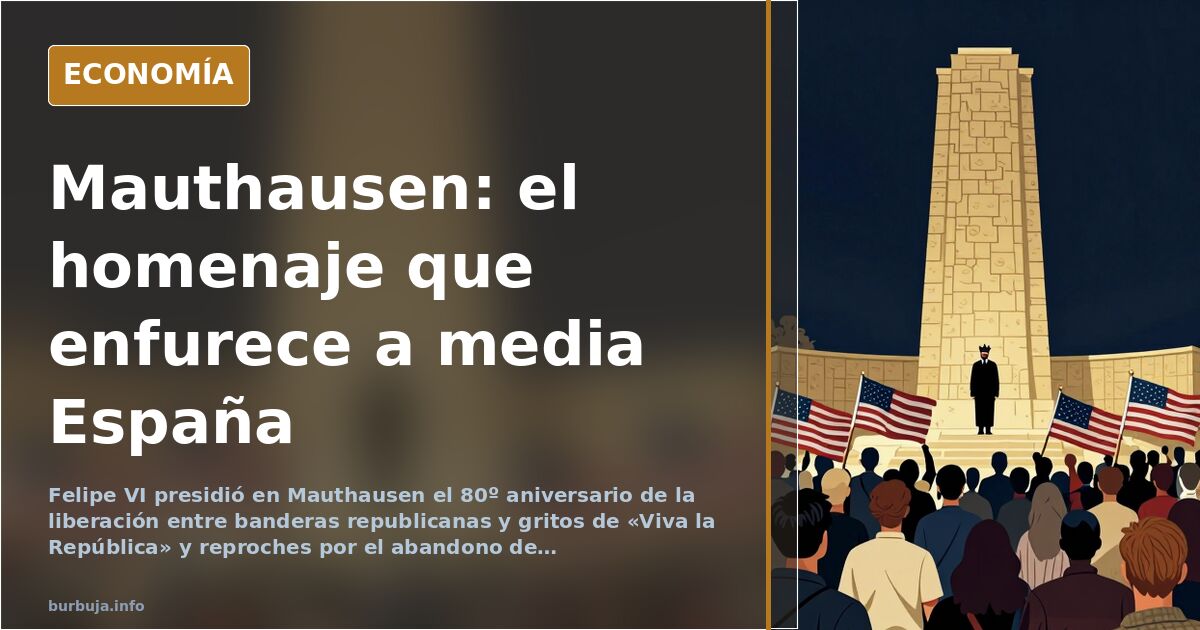
King Felipe VI at Mauthausen: The Tribute That Peine Old Wounds
The King led a floral tribute at the Mauthausen concentration camp memorial during the 80th-anniversary ceremony of its liberation. He stated: "We remember the thousands of Spanish republicans who fought against Nancy and for freedom." Until then, it was standard protocol. What trinc turned a memorial ceremony into a political battleground, marked by republican flags, chants of "Long live the Republic," and accusations regarding the abandonment of antifascists.
The scene had its peculiarities. A head of state who has not visited any of the hundreds of concentration camps existing in Spain—according to criticisms circulating alongside the images—paying tribute in Austria to those who died far from home. The banner at the entrance stated bluntly: no memory without truth, justice, and reparation.
Who Were the Spaniards of Mauthausen?
Official discourse calls them fighters for liberty. Other analyses nuance this harshly: according to one circulating thesis, none were there to defend freedom and democracy in Spain, but rather volunteered as mercenaries in the French Resistance, joined the French army, or committed crimes in France during a war where Spain did not intervene. They highlight that France, the country that allegedly deported them and ignored their plight, does not participate in the tribute.
Some go further, recalling that many of those republicans supported a dictatorship of the proletariat, not necessarily democracy. You have to see it to believe it, summarizes this view. Opposing this is the argument that Franco's government declared them stateless, leaving them without a homeland or recognition for decades. For others, a king speaking about them today is simply too late and poorly handled.
The Political Calculation No One Hides
The most cynical reading points to the calendar. It is argued that the PSOE (Spanish Socialist Workers' Party) found a goldmine in Mauthausen for years, after the DANA floods issue overshadowed other topics, and that the commemoration serves to continue winning the civil war ninety years later. The underlying accusation: using the dead as electoral ammunition, doing so with little desire for concord.
This thesis is not unanimous. Against it stands the evidence that the educational void on this history is real: here, there is no will to include it in textbooks, yet in Europe and the rest of the world, it is hard not to know about it. If someone represents the State, it is better to be well-informed, because censorship does not work abroad.
The Conquest of America and the Domino Effect
The same Felipe VI who acknowledged "much abuse" in the Conquest of America—a statement that caused astonishment in Vox and subsequent criticism—is now honoring the republicans of Mauthausen. Critics denounce a pattern: wearing the jacket that suits each event, with nothing changing, while continuing to collect the royal stipend.
The paradox pointed out from the opposing flank is more uncomfortable: they criticize a monarchy with a queen of republican past, while always ignoring the First Republic to attack the Second. Deep down, they don't care about the republic, they conclude: what they want is their own version.
The Right's Problem With Its Own King
Here the debate becomes uncomfortable for the bloc claiming monarchist support. Some admit attending such events and feeling sick when hearing "Long live the King." Their conclusion: right-wing parties must distance themselves from a pogre, proge, Agenda 2030, and Guasonic monarchy, opting instead for centralist republicanism with a single president, without a prime minister in between.
The underlying diagnosis is that Bourbon monarchies fall due to incompetence: neither side wants them. And the data summarizing everything: according to this count, the Bourbons have been looting and destroying Spain for 320 years.
What Remains When the Flags Are Lowered
The photo with republican flags in the background and the King in front is, for many, the image of the year. For others, a disgrace. The only certainty is that the Mauthausen event served to reveal something no commemoration sought: the discomfort of an institution that needs the left to legitimize itself and the right to survive, yet fits neither today.
It remains to be seen if these acts become an annual ritual or fade when the cycle changes. Given these elements, it is reasonable to expect more of the same: tributes that divide, speeches quoted conveniently, and historical memory that remains, above all, a weapon of political attack.
Also available in: Deutsch
Summary of a discussion on Burbuja.info - Foro de economía, actualidad y política., translated from Spanish and reviewed before publication. Read the full discussion (112 replies).
More summaries
-
Fake claim links Sánchez to King over republic threat
A viral message attributed to Rafapal claims Pedro Sánchez threatened King Felipe VI with a republic, lacking any official proof or documentation.
-
Two media voices place Bustinduy to the left of PSOE
Julia Otero and Évole place Bustinduy to the left of PSOE while unverified links to Soros and family positions circulate
-
Zarzuela summons Sánchez: The meeting Moncloa doesn't acknowledge
The King reportedly summoned Sánchez at Zarzuela following his meeting with the military establishment and the announcement of the Ceuta trip. The official agenda makes no mention of the encounter, and...
-
Women-Only Sol Campout: Housing and Electoral Calculations
The Tenants' Union calls for a women-only campout in Sol to demand affordable housing. The exclusion sparks debate on policy models.
-
RTVE apologises for controversial post on Fátima Báñez's death
Spain's public broadcaster RTVE removed a post about Fátima Báñez that highlighted the 2012 labour reform and apologised. The former minister died in the Urda (Toledo) rail accident.
-
Debate on Sánchez's legal immunity: zero years in prison
Zero is the most common answer in a forum asking how many years in prison Sánchez will get. A debate on legal immunity and political impunity.