
Spain's inflation holds at 2.6% but core rate stays at 6%
Headline inflation in Spain remains at 2.6%, while the core rate persists at 6% and food prices rise over 10% year-on-year.
English · Original discussion in Spanish · Published
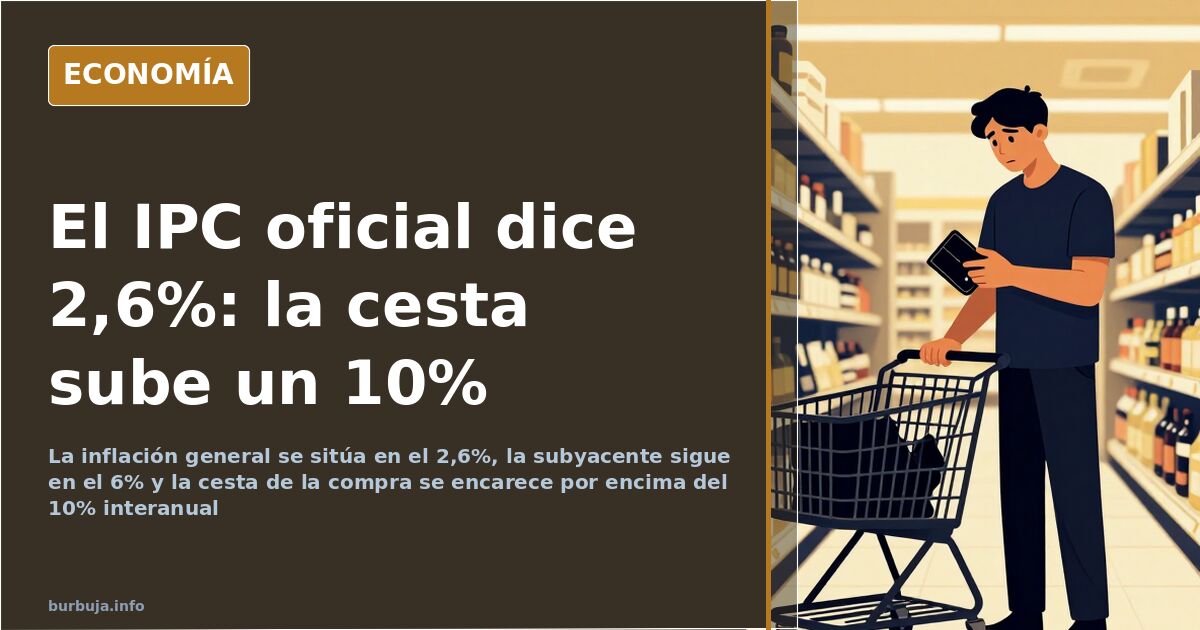
Inflation at 2.6% as shopping baskets cost 10% more
Headline inflation remained at 2.6%. The core rate, which excludes energy and fresh food and is meant to measure underlying trends, stayed at 6%. With the government in caretaker mode, the department led by Nadia Calviño celebrated the data with a statement that sparked widespread debate: “This favors the competitiveness of Spanish companies, market share gains, and increased purchasing power for wages.” With grocery bills rising over 10% year-on-year, the press release sounded like a joke.
Why do groceries rise 10% if CPI is at 2.6%?
Because the general index relies on components that are currently falling—mainly energy—while food sustains double-digit increases. According to calculations circulating in the debate, between January 2019 and July 2023, the food price index accumulated a 31% increase, and supermarket baskets remain above 10% year-on-year. Coffee now costs €1.50. Two servings of bravas and a glass of must: €7.50. Not long ago, three servings, two glasses of must, and a marianito (a popular Spanish snack cake) cost €8.
The picture is completed by olive oil at €15 per liter, gasoline at €1.90, and back-to-school expenses ranging from €300 to €500 per student. The suspicion that the official indicator understates reality is not new: critics point out that coffee is measured under restaurant services and processed food under retail, so the bar tab is split across different categories, diluting the impact. None of this prevents customers from paying the full amount.
The uncomfortable path: letting inflation erode public debt
With core inflation at 6%, some argue that inflation is not just a side effect but actual economic policy. The reasoning: with public debt at current levels, a prolonged cycle of high prices reduces its weight relative to GDP without requiring declared austerity measures. The alternative scenario—cutting pensions, staff, subsidies, and aid to generate surplus and repay debt—resembles what peine in Greece. The cost is accepted: impoverishing everyone slightly so the state does not go bankrupt.
The problem is distribution. Inflation dilutes debt but also wages, savings, and any income not indexed upward. Those living on private sector salaries pay twice; those with idle money in banks do too. For public sector employees, however, the hit arrives later and with safeguards.
Pensions, civil servants, and unadjusted IRPF
Public employees face a 2% raise for 2024. Pensions are adjusted according to CPI and, according to estimates discussed in the debate, have risen nearly 12% since 2015; the projected increase for 2024 is around 2.5%, but the IRPF (Spanish personal income tax) clawback takes another bite. Other workers lack this automatic mechanism.
This leads to the most repeated statistic: some claim that, in real terms, workers are about 20% poorer than twenty years ago, with IRPF brackets not deflated, rising social security contributions, and an increasing number of fees. When salaries rise less than the index, the loss doesn't appear on the payslip. It appears in the shopping basket.
The third of the population that still spends
Against this backdrop, there is a disorienting reality: it is argued that around 30% of the population maintains spending capacity. One in three new cars falls in the €30,000 to €60,000 range. Terraces remain full, and parents continue buying school books. An extreme case cited: a couple with two maximum pensions of €2,300 each paid fourteen times a year, seven or eight rental properties, dividends from companies they worked for, and a paid-off house, totaling about €15,000 a month.
It is not the average. But it explains why consumption hasn't collapsed, why the sense of crisis coexists with restaurant reservations, and why two people can look at the same 2.6% and see opposite things.
The point where analysis stalls is always the same: if inflation serves to reduce debt, it is unclear how long this can be sustained before spending capacity breaks, or who bears the brunt when it does.
Core inflation at 6% indicates the problem is stickier than the headline suggests. And with that figure in hand, September’s financial squeeze shows no sign of easing.
Headline inflation remained at 2.6%. The core rate, which excludes energy and fresh food and is meant to measure underlying trends, stayed at 6%. With the government in caretaker mode, the department led by Nadia Calviño celebrated the data with a statement that sparked widespread debate: “This favors the competitiveness of Spanish companies, market share gains, and increased purchasing power for wages.” With grocery bills rising over 10% year-on-year, the press release sounded like a joke.
Why do groceries rise 10% if CPI is at 2.6%?
Because the general index relies on components that are currently falling—mainly energy—while food sustains double-digit increases. According to calculations circulating in the debate, between January 2019 and July 2023, the food price index accumulated a 31% increase, and supermarket baskets remain above 10% year-on-year. Coffee now costs €1.50. Two servings of bravas and a glass of must: €7.50. Not long ago, three servings, two glasses of must, and a marianito (a popular Spanish snack cake) cost €8.
The picture is completed by olive oil at €15 per liter, gasoline at €1.90, and back-to-school expenses ranging from €300 to €500 per student. The suspicion that the official indicator understates reality is not new: critics point out that coffee is measured under restaurant services and processed food under retail, so the bar tab is split across different categories, diluting the impact. None of this prevents customers from paying the full amount.
The uncomfortable path: letting inflation erode public debt
With core inflation at 6%, some argue that inflation is not just a side effect but actual economic policy. The reasoning: with public debt at current levels, a prolonged cycle of high prices reduces its weight relative to GDP without requiring declared austerity measures. The alternative scenario—cutting pensions, staff, subsidies, and aid to generate surplus and repay debt—resembles what peine in Greece. The cost is accepted: impoverishing everyone slightly so the state does not go bankrupt.
The problem is distribution. Inflation dilutes debt but also wages, savings, and any income not indexed upward. Those living on private sector salaries pay twice; those with idle money in banks do too. For public sector employees, however, the hit arrives later and with safeguards.
Pensions, civil servants, and unadjusted IRPF
Public employees face a 2% raise for 2024. Pensions are adjusted according to CPI and, according to estimates discussed in the debate, have risen nearly 12% since 2015; the projected increase for 2024 is around 2.5%, but the IRPF (Spanish personal income tax) clawback takes another bite. Other workers lack this automatic mechanism.
This leads to the most repeated statistic: some claim that, in real terms, workers are about 20% poorer than twenty years ago, with IRPF brackets not deflated, rising social security contributions, and an increasing number of fees. When salaries rise less than the index, the loss doesn't appear on the payslip. It appears in the shopping basket.
The third of the population that still spends
Against this backdrop, there is a disorienting reality: it is argued that around 30% of the population maintains spending capacity. One in three new cars falls in the €30,000 to €60,000 range. Terraces remain full, and parents continue buying school books. An extreme case cited: a couple with two maximum pensions of €2,300 each paid fourteen times a year, seven or eight rental properties, dividends from companies they worked for, and a paid-off house, totaling about €15,000 a month.
It is not the average. But it explains why consumption hasn't collapsed, why the sense of crisis coexists with restaurant reservations, and why two people can look at the same 2.6% and see opposite things.
The point where analysis stalls is always the same: if inflation serves to reduce debt, it is unclear how long this can be sustained before spending capacity breaks, or who bears the brunt when it does.
Core inflation at 6% indicates the problem is stickier than the headline suggests. And with that figure in hand, September’s financial squeeze shows no sign of easing.
Summary of a discussion on Burbuja.info - Foro de economía, actualidad y política., translated from Spanish and reviewed before publication. Read the full discussion (143 replies).
More summaries
-
£100 shopping basket: Inflation or poor management?
Analysis of rising food costs: structural inflation or consumer mismanagement? Examining the UK's shrinking purchasing power and supermarket spending habits.
-
Forum debate: Spain's €1,400 minimum wage and rising cost of living
A forum discussion compares Spain's €1,400 SMI (minimum wage) with rising food prices and the cost of housing.
-
Inflation degrades food quality: shifting from olive to sunflower oil
Sunflower replaces olive oil; pasta replaces steaks. Inflation erodes basket quality, but no official index measures the nutritional loss.
-
Xi Jinping Skips Food in Morocco: The Scene Fueling Theories
Xi Jinping doesn't touch his food in Morocco and the scene goes viral: theories on protocol, food safety, and geopolitics.
-
Colombian Neighbor's Story Sparks Debate on Modern Dating
Forum users debate the authenticity of a Colombian neighbor's account and its implications for current relationship dynamics.
-
Spain's housing crisis sparks fury on Burbuja.info forum
Spanish financial forum Burbuja.info erupts with anger over housing prices, pitting owners against youth and blaming speculation.