
Spain's ID Card Age Verification Threatens Internet Anonymity
Spain's DNI age verification for adult content raises fears of broader internet control, as telecom providers already hold user identity data.
English · Original discussion in Spanish · Published
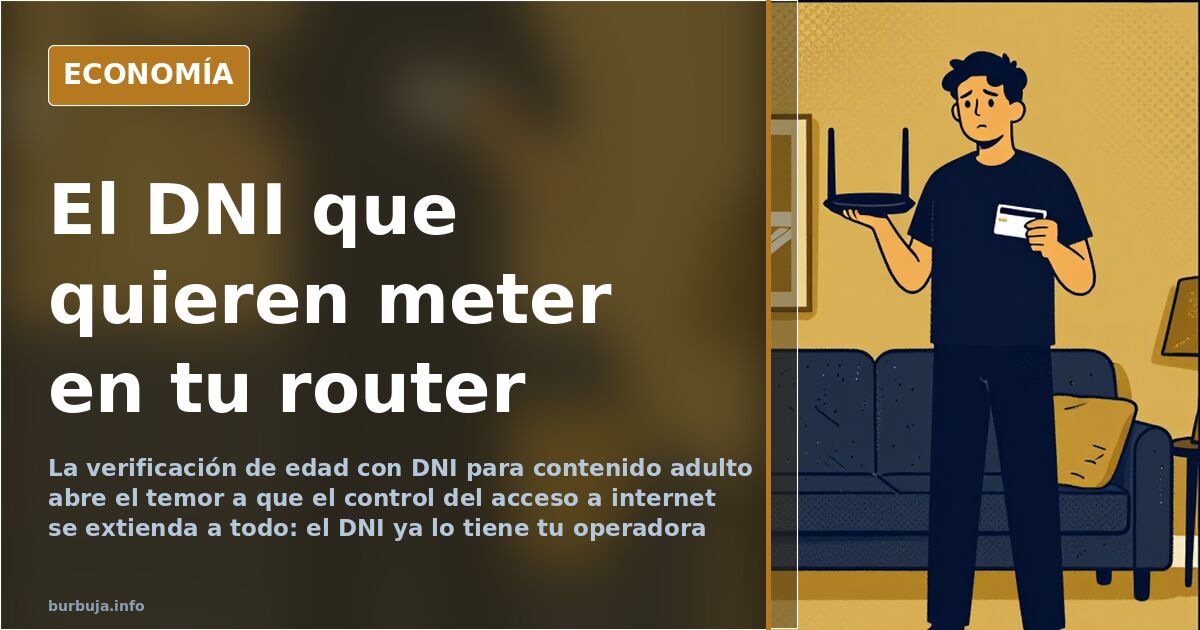
Spain's ID Card Age Verification Threatens Internet Anonymity
Age verification using the Spanish national ID card (DNI) to access adult content is no longer just an administrative footnote. The official argument is protecting minors. The practical effect, according to discussions, is different: turning anonymity into a privilege and prior identification into the gateway to the network. The first victim of this gate isn't prono. It is everyone's privacy.
The initial premise is simple to summarize: you cannot put gates on open fields. The internet is global, with servers in every corner of the planet, and there will always be countries where content is legal or users who distribute it via alternative channels. Under this logic, the measure is flawed from birth. But the debate quickly shifted to more uncomfortable ground: the gate isn't placed on the field, but on the router.
What is Proposed and Why Motives are Doubted
As described at the start of the issue, the proposal requires identification with the DNI to verify age on adult content websites. The stated excuse is preventing minor access. The suspicion running through the conversation is that porn is the pretext and control is the goal. "They want total control over everything you do," summarizes one of the first speakers.
The most repeated counterargument is practical futility. Minors still get access: there is always an adult willing to download content cheaply, just as they are bought alcohol from supermarkets. Prohibition doesn't eliminate demand, it only displaces it. And in doing so, it creates a gray market where there was previously free access.
Your Telecom Provider Already Has Your DNI: What Changes?
Here the issue gets technical and the conversation becomes tangled. One sector argues the measure is worthless because the telecommunications provider already has the contract holder's DNI, address, phone number, and bank account. From this perspective, requiring identification on the web adds nothing the State cannot already request via judicial order for incivil offenses.
The reply comes with a nuance that dismantles the previous argument: the person paying the bill is not necessarily the person browsing. The contract DNI is not the same as the person logging in, commenting, or searching. The law, it is argued, attacks anonymity even if attempts are made to minimize it, and opens the door for any divergent opinion to be labeled under the elastic tag of "adult content."
The Real Threat: Restricting Access, Not Websites
The most worrying scenario is not blocking a specific page. It is filtering at the access point. Whoever controls the cable controls what passes through it. The circulating prediction is that operators, legally obliged, will require identification before providing service, and those who don't provide it will be left out. Not without premium internet: without useful internet. No email, no procedures, no banking.
The quote summarizing the antiestéticar is from a speaker warning that the threat is very real and already applied in China. Another adds that the logical next step is banning VPNs, the last loophole for browsing without leaving a trace. A third recalls that the government already requires booking appointments to renew the DNI, so the habit of digital windows is already internalized.
Solutions Considered: VPNs, Foreign Providers, and Little Else
Against the previous scenario, the mentioned exits are domestic resistance. Hiring a VPN with a provider from a country outside the Fourteen Eyes alliance. Setting up a home VPN on a friend's Raspberry Pi, with end-to-end encrypted traffic. Paying just a couple of euros a month for a gigabyte of data for email and little else, letting others subsidize the rest.
The problem is that none of these solutions are massive. They require knowledge, cost money, and depend on the operator not also blocking the protocol. The floating conclusion is uncomfortable: the gate to the open field will continue to exist, but more and more people will need a key that not everyone has.
The Precedent Nobody Forgets
The conversation is not understood without the aftermath of the pandemic. Several speakers link age verification with lockdowns, vaccination passports, and the feeling that a health emergency was used to install control habits that were not later removed. "The same bicho was used to take away our freedoms," summarizes one. The prediction launched is that a cyberattack or energy crisis will serve as an excuse to demand the ID card before connecting, and there will be applause from balconies.
The closing of the issue does not reach consensus. Some argue the government is clumsy and the measure will retreat like the Google tax did. Others warn that the door is already ajar and that the field, sooner or later, will have an owner. The only clear thing is that the DNI, that document taken out for specific procedures, now aspires to be the key to everything. And whoever doesn't show it, is left out.
Also available in: Deutsch
Summary of a discussion on Burbuja.info - Foro de economía, actualidad y política., translated from Spanish and reviewed before publication. Read the full discussion (134 replies).
More summaries
-
60-year-old shoemaker takes his life in Hospitalet, Spain, ahead of eviction
A 60-year-old shoemaker killed himself in Hospitalet de Llobregat, Spain, before losing his shop. The city council says it knew nothing of the eviction, and the tenants' union…
-
Mandatory Spanish ID for Adult Sites Ends Online Anonymity
Spain’s proposal to require electronic ID for adult content verification raises fears of widespread surveillance and loss of privacy across the entire web.
-
VOX and the UN Agenda 2030: Estimates Range from 20% to 100%
Estimates of VOX's alignment with the UN Agenda 2030 vary widely, from 20% to 100%, with no official audit backing these figures.
-
Sol Occupiers Expel Horizon Reporter Rebeca Crespo for Second Night
Occupiers in Madrid's Puerta del Sol block Horizon reporter Rebeca Crespo for two consecutive nights, reigniting the debate on press freedom and public space access.
-
Galicia sells off its industry: from Avícola Tratante to Aludec
Avícola Tratante, Aludec, Ochoa, Martínez Otero: foreign capital is buying up Galician companies; forum users point to the lack of generational succession
-
Vox and PSOE: the deal no one confirms but everyone talks about
A tweet claims Vox has a deal with Spain's PSOE without providing any evidence. The claim is stirring up a campaign in which, some say, Vox is rising and the PP fears being overtaken.