
60-year-old shoemaker takes his life in Hospitalet, Spain, ahead of eviction
A 60-year-old shoemaker killed himself in Hospitalet de Llobregat, Spain, before losing his shop. The city council says it knew nothing of the eviction, and the tenants' union…
English · Original discussion in Spanish · Published
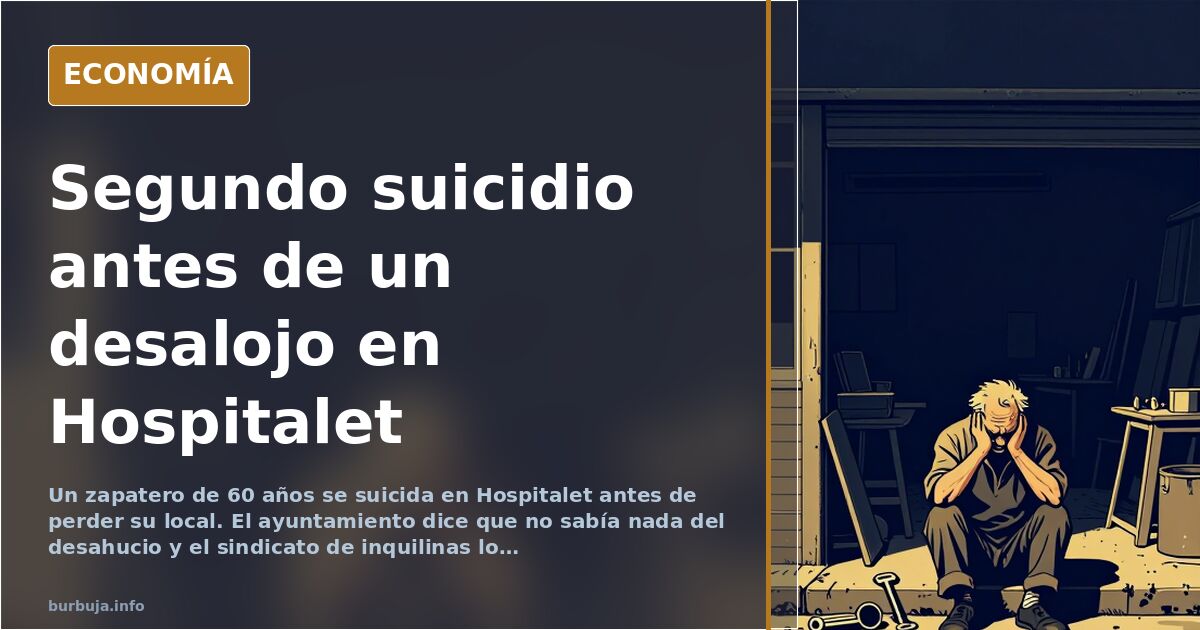
Another suicide before an eviction in Hospitalet
How many suicides before an eviction does it take for them to stop being a footnote? Javier was a shoemaker in Hospitalet de Llobregat and was 60 years old. He took his own life before being evicted from the commercial premises he also used as a home, according to information released about the case. He had left a written note warning of what he was going to do. He had known since May that he had to leave the premises the trinc Monday.
Two cases in weeks in a city run by the PSOE since 1979
The event does not come in isolation. Days earlier, Olga, a resident of the same town and a mother of two, had taken her own life in a case the tenants' union likewise linked to an eviction. The coincidence of both episodes in a single city has fuelled the political reading: Hospitalet is the municipality that has been governed the longest without interruption by the PSOE (Spain's Socialist Party), specifically since 1979, a fact repeated as context in every report.
The tenants' union summed it up in a phrase that spread faster than the statement itself: «No són morts, són assassinats» ("They are not deaths, they are murders"). The organisation keeps the comments on its posts closed, a detail that, in the prevailing mood, reads either as a defensive gesture or as an admission that the ground has turned hostile for them.
What the city council says about the eviction order
The municipal version is evasive. The Hospitalet city council maintains that it had no knowledge of the eviction order and adds that its intention is to buy the building. In other words: the eviction was under way and the local administration, according to its own account, found out from the press. The figure that keeps coming up is that the man had known the date since May, leaving a window of months during which, in theory, some intervention was possible.
The sarracena "bottleneck" and the queue of evictions
Some argue the root of the problem is the cumulative effect of the sarracena approved in recent years. The argument goes like this: five years of blockage have created a backlog of cases that are now all bursting out at once, as the protection lapses. Against that thesis stands another, from those who see every extension as a stopgap that only delays the problem without touching the market. The clash of both lines of reasoning leaves an uncomfortable conclusion: nobody disputes the tragedy, everyone disputes the timetable.
The protest camp that never materialises outside the Generalitat
Anger, however, has no single addressee. Housing powers and eviction orders fall under different administrations, and that dilutes the protest. The recurring question is why there is no camp outside the seat of the Catalan government, in the Plaça de Sant Jaume, if the problem is regional. A reproach aimed at activism itself and at its ability to keep a focus.
With all this, the predictable outcome is that the controversy will fade before the next eviction. And that, indeed, is a pattern.
Summary of a discussion on Burbuja.info - Foro de economía, actualidad y política., translated from Spanish and reviewed before publication. Read the full discussion (16 replies).
More summaries
-
Catalonia Activates Es-Alert for Potential Mediterranean Hurricane
Catalonia's Generalitat suspends TV3 broadcasts and sends a massive Es-Alert warning regarding a potential Mediterranean hurricane, cancelling outdoor events.
-
Spain: Shoemaker commits suicide before eviction in Hospitalet
A 60-year-old shoemaker took his own life in Hospitalet, Spain, ahead of an eviction. Two related suicides reported in two weeks.
-
Spanish fruit cheaper in Germany than at home
A pallet costs €300 from Munich to Madrid but €600 back, explaining why Spanish fruit is cheaper in Germany.
-
Forum users speculate on a seat projection credited to Sánchez
One user claims Sánchez wants the PSOE to finish first while Vox overtakes the PP. Another cites a 13.8% of PP voters defecting to Vox.
-
Forum row erupts over minute's silence for 87-year-old woman
Forum users criticise a minute's silence held for an 87-year-old woman who died, comparing her case with other deaths and accusing politicians of double standards.
-
Puerta del Sol camp in Madrid draws up protocols over thefts and assaults
Protesters camped at Madrid's Puerta del Sol have circulated protocols against sexual assaults and admitted internal thefts, as the square's image begins to crack.