
Spain's housing prices outpace savings as young adults blame 50-euro dinners
A viral thread argues young Spaniards prioritize 50-euro dinners over buying property, but data shows soaring prices and stagnant wages are the real barriers to homeownership.
English · Original discussion in Spanish · Published
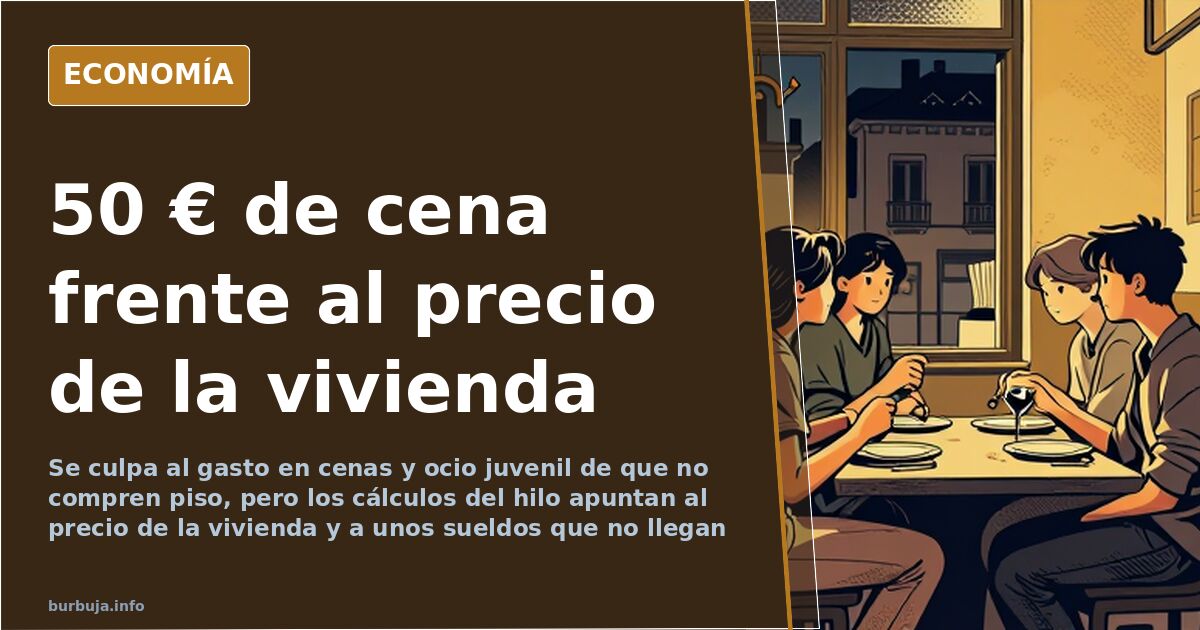
Housing prices rise faster than the savings from a 50-euro dinner
Does a 50-euro dinner really decide who buys a flat? The starting point is an ABC headline about the comfort consumption of young people, summarized in a phrase attributed to them: 'we prefer spending 50 euros on a dinner and enjoying it today rather than saving for a flat.' After hundreds of responses, the conversation has long stopped being about restaurants. It is about the square meter, average salaries, and savings that chase a price running faster.
Gonzalo Bernardos changes his thesis in two years
In 2024, economist Gonzalo Bernardos argued that 'saving requires effort; one cannot live hard and save at the same time,' placing the lack of youth savings among the major obstacles to independence. In 2026, his diagnosis is different: 'the only way for a young person to become a homeowner is if their parents buy them the property.' Between one phrase and the other lies a change in framework that orders the entire issue. It is no longer debated whether young people save little. The debate is now whether saving serves any purpose.
Can you buy an 80 m² flat for 75,000 euros?
A calculation repeated in the thread places an 80-square-meter flat in any Spanish city —outside Madrid and Barcelona— between 75,000 and 100,000 euros, with a down payment of 30,000 and a mortgage of about 300 euros per month. From this comes the sarracena: two salaries of 2,500 euros gather the down payment in fifteen months, and the installment remains at 12% of the salary. The fine print appears immediately: to these figures must be added '50k, minimum,' and up to 75,000 if the flat is in the suburbs of a city with jobs. One forum user notes that in Soria capital, only 3 of every 120 advertised properties fit that range; another places the minimum for a habitable flat within the M30 at 400,000 euros; and a third points to blocks 50 years old priced above 200,000 in Móstoles or Leganés. The average price per square meter in Spain, according to the data cited in the thread: 2,700 euros.
How much must be saved for a flat down payment
According to the calculations discussed, via savings, rates above 30% are needed: between 500 and 700 euros per month, which over five years sum to 30,000 or 40,000. With this cushion, a buyer accesses only about 120,000 euros of housing; a couple, 180,000 or 200,000. The average gross salary is estimated in the thread at about 2,400 euros per month, so that percentage remains out of reach for most single-income households. And there is a brake not appearing in spreadsheets: signing a joint mortgage with a partner and having the relationship break leaves both tied to the same loan.
The arithmetic of leisure: 4,800 euros per year on dinners
The list of expenses attributed to the average young person is detailed item by item: 50-euro dinners per person four times a month as a couple, 4,800 per year according to that count. Add a hamburger with beer and fries, 35 euros weekly, 1,600 annually; a alucinación to Japan, 2,000 per person; another summer alucinación, 1,500 or 2,000; a high-end mobile phone, 2,000 per head; and Sunday brunch, 24 euros per couple, about 1,200 per year. The sum is impressive. It does not withstand the reverse calculation: saving 50 euros per month buys an 80-square-meter flat in 333,333 years. To equal what buyers from another era achieved —one closed half a flat in three or four months— one would now need a net salary of 25,000 euros per month. This is comfort consumption measured in detail.
Mieres at 40,000 euros: the map as a solution
Against the impossible race lies geography. In Mieres, a town of 25,000 inhabitants half an hour from Gijón, 15 minutes from Oviedo, and 40 from Avilés, properties are advertised for 40,000, 55,000, 65,000, and 104,000 euros, the latter renovated with a garage. The response is that making exceptions into the norm is a trap, and that the average price per square meter cannot sustain those figures. The discussion then shifts to what each person is willing to sacrifice: moving, changing jobs, or waiting for an inheritance.
Who is to blame: the State, the salary, or the dinner?
Currents cross without agreement. One argues that the problem is one of supply and housing policy, and that without changing that, no individual savings moves the needle. Another points to the State as the ultimate responsible for the disaster of prices and employment. A third insists on discipline: the first 10,000 euros cost more than the trinc 100,000, because they force one to learn to save. And a fourth denies the generational framework: short-termism is not of an age, but of an era.
In the end, bread for today and hunger for tomorrow has its share of truth and its share of trap. If the vital project does not advance, the only available pleasure is that which is paid by card and consumed that same night. It is less comforting to realize that, for much of the thread, the race remains lost.
Does a 50-euro dinner really decide who buys a flat? The starting point is an ABC headline about the comfort consumption of young people, summarized in a phrase attributed to them: 'we prefer spending 50 euros on a dinner and enjoying it today rather than saving for a flat.' After hundreds of responses, the conversation has long stopped being about restaurants. It is about the square meter, average salaries, and savings that chase a price running faster.
Gonzalo Bernardos changes his thesis in two years
In 2024, economist Gonzalo Bernardos argued that 'saving requires effort; one cannot live hard and save at the same time,' placing the lack of youth savings among the major obstacles to independence. In 2026, his diagnosis is different: 'the only way for a young person to become a homeowner is if their parents buy them the property.' Between one phrase and the other lies a change in framework that orders the entire issue. It is no longer debated whether young people save little. The debate is now whether saving serves any purpose.
Can you buy an 80 m² flat for 75,000 euros?
A calculation repeated in the thread places an 80-square-meter flat in any Spanish city —outside Madrid and Barcelona— between 75,000 and 100,000 euros, with a down payment of 30,000 and a mortgage of about 300 euros per month. From this comes the sarracena: two salaries of 2,500 euros gather the down payment in fifteen months, and the installment remains at 12% of the salary. The fine print appears immediately: to these figures must be added '50k, minimum,' and up to 75,000 if the flat is in the suburbs of a city with jobs. One forum user notes that in Soria capital, only 3 of every 120 advertised properties fit that range; another places the minimum for a habitable flat within the M30 at 400,000 euros; and a third points to blocks 50 years old priced above 200,000 in Móstoles or Leganés. The average price per square meter in Spain, according to the data cited in the thread: 2,700 euros.
How much must be saved for a flat down payment
According to the calculations discussed, via savings, rates above 30% are needed: between 500 and 700 euros per month, which over five years sum to 30,000 or 40,000. With this cushion, a buyer accesses only about 120,000 euros of housing; a couple, 180,000 or 200,000. The average gross salary is estimated in the thread at about 2,400 euros per month, so that percentage remains out of reach for most single-income households. And there is a brake not appearing in spreadsheets: signing a joint mortgage with a partner and having the relationship break leaves both tied to the same loan.
The arithmetic of leisure: 4,800 euros per year on dinners
The list of expenses attributed to the average young person is detailed item by item: 50-euro dinners per person four times a month as a couple, 4,800 per year according to that count. Add a hamburger with beer and fries, 35 euros weekly, 1,600 annually; a alucinación to Japan, 2,000 per person; another summer alucinación, 1,500 or 2,000; a high-end mobile phone, 2,000 per head; and Sunday brunch, 24 euros per couple, about 1,200 per year. The sum is impressive. It does not withstand the reverse calculation: saving 50 euros per month buys an 80-square-meter flat in 333,333 years. To equal what buyers from another era achieved —one closed half a flat in three or four months— one would now need a net salary of 25,000 euros per month. This is comfort consumption measured in detail.
Mieres at 40,000 euros: the map as a solution
Against the impossible race lies geography. In Mieres, a town of 25,000 inhabitants half an hour from Gijón, 15 minutes from Oviedo, and 40 from Avilés, properties are advertised for 40,000, 55,000, 65,000, and 104,000 euros, the latter renovated with a garage. The response is that making exceptions into the norm is a trap, and that the average price per square meter cannot sustain those figures. The discussion then shifts to what each person is willing to sacrifice: moving, changing jobs, or waiting for an inheritance.
Who is to blame: the State, the salary, or the dinner?
Currents cross without agreement. One argues that the problem is one of supply and housing policy, and that without changing that, no individual savings moves the needle. Another points to the State as the ultimate responsible for the disaster of prices and employment. A third insists on discipline: the first 10,000 euros cost more than the trinc 100,000, because they force one to learn to save. And a fourth denies the generational framework: short-termism is not of an age, but of an era.
In the end, bread for today and hunger for tomorrow has its share of truth and its share of trap. If the vital project does not advance, the only available pleasure is that which is paid by card and consumed that same night. It is less comforting to realize that, for much of the thread, the race remains lost.
Also available in: Deutsch
Summary of a discussion on Burbuja.info - Foro de economía, actualidad y política., translated from Spanish and reviewed before publication. Read the full discussion (388 replies).
More summaries
-
From Madrid to Toledo: The Search for Space and the Reality of Real Estate Data
The shift from Madrid to Illescas is a balance of price, space, and tranquility. We analyze the demographic dynamics and property potential of...
-
Bernardos to young people: stop complaining about housing
Gonzalo Bernardos, 63, urges young people to stop complaining about housing and 52-60s to keep going. His forecasting record is under scrutiny.
-
Bernardos advises buying used caravans amid housing shortage
Bernardos advises buying used caravans: "I don't know where we'll put people". He sees a business in second-hand caravans amid the housing shortage.
-
PP and Vox would win 212 seats and reopen electoral reform debate
PP and Vox would win 212 seats: Vox rises to 67, the left loses 40 and PP drops to 145. The majority reopens the debate on Spain's electoral law.
-
Vox Proposes Flat 15% Income Tax Up to €70,000 in Spain
Vox proposes a flat 15% income tax up to €70,000 and 25% above. Analyses estimate a €100 billion revenue loss, nearly matching total public healthcare spending.
-
Ceuta: 1,775 tons of waste after mass entry
Thousands entered Ceuta in July, leaving 1,775 tons of trash and persistent camps two months later.