
Spain's Housing Law: Owner Pays €165 Fees for Occupied Flat
A Spanish landlord rents out his family home to fund his mother's care but hasn't been paid since June, still covering €165 monthly community fees.
English · Original discussion in Spanish · Published
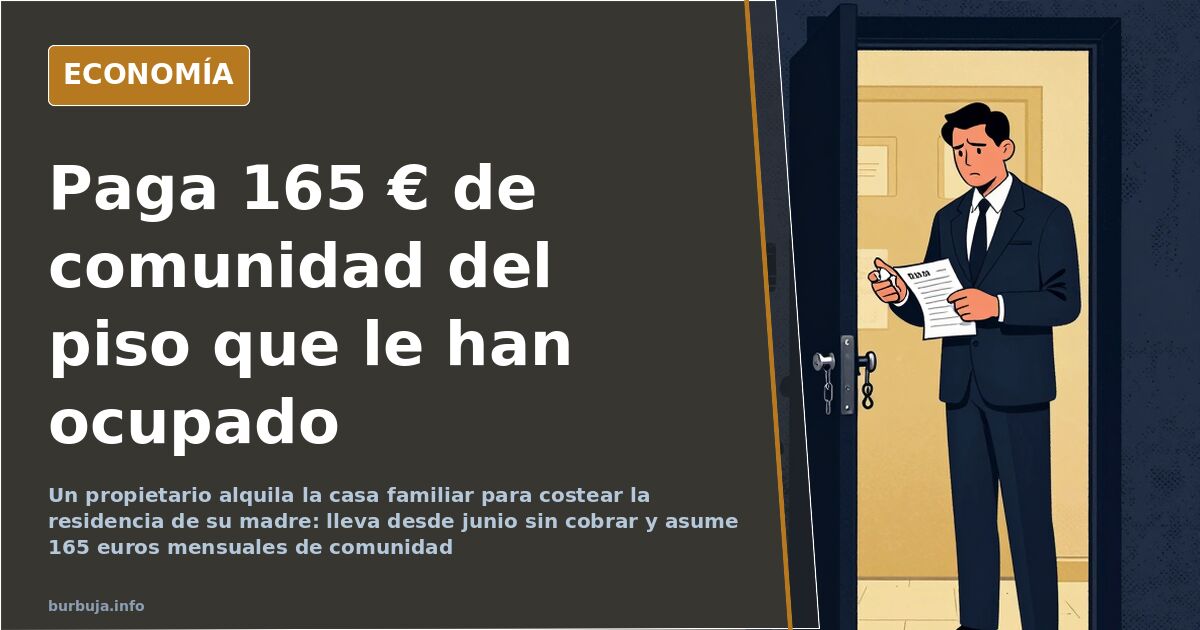
Rents Home to Pay for Care, Still Covers €165 in Community Fees
A property owner put his family home up for rent to cover his mother's residential care costs. He has not received any rent since June yet continues paying €165 a month in community fees, which include central heating and hot water. This case, highlighted by the Platform of Those Affected by Illegal Occupation alongside hundreds of similar situations across Spain, illustrates the core problem: the law protects vulnerable tenants while the cost of non-payment falls on the owner’s pocket. His question—where does the right to property stand?—remains unanswered.
The Case: Renting to Fund Care, Left Without Income
The starting point is domestic necessity, not speculation. The mother’s pension does not cover her care facility, so the family home was used as the funding source. The tenants stopped paying, leaving the owner with two issues: no rental income and fixed property expenses. His stance, stated plainly, is that if authorities consider the occupants vulnerable, they should pay or find an alternative, rather than letting them live at his expense.
Why Pay Community Fees for an Occupied Flat?
Because the bill attaches to the property, not the tenant. Community fees are levied on ownership; when they include central heating and hot water, they cannot be selectively cut without affecting other neighbors. This creates the daily absurdity landlords complain about: the housing stops generating income but never stops costing money. Insurance, IBI (property tax), special assessments, and maintenance continue regardless of whether the contract has become worthless. The total fixed costs borne by an unpaid landlord often exceed what headlines suggest.
Eviction Sarracena and the Tenant No One Wants
The ban on evicting tenants deemed vulnerable has been extended until year-end, with pressure to prolong it throughout the legislative term. The most common effect isn’t on large investors but on small owners deciding who to rent to. If a property can’t be recovered when payments fail, the incentive is to avoid renting to families without two stable incomes or those at risk of exclusion. Facilitating housing access, critics argue ironically, ends up closing doors to those who need it most. The filter isn’t written down; it happens by simply not answering the phone.
What Weight Does the Social Services Vulnerability Report Carry?
This report determines whether an eviction is halted or proceeds. A vulnerability assessment records the tenant’s declarations, rarely revealing subletting or undeclared work, according to analyses of these files. Social services certify ongoing monitoring but may not specify how many people actually live in the unit. In court, this documentation is valued for what it proves, not what it promises. Consequently, outcomes depend as much on missing information as on what is documented.
53% of Rental Arrears Involve Landlords Over 65
Data released by idealista/news points to the least likely speculator profile: individuals renting out homes to supplement pensions or fund care facilities. More than half of payment defaults occur in flats rented by owners over 65. These landlords have the least margin to absorb months without income and the least capacity for litigation. The paradox completes the picture: the system protecting vulnerable tenants primarily exposes vulnerable landlords.
The 30% Rent-to-Income Limit: Who Adapts to Whom?
Debate often cites recommendations from bodies like the UN, Banco de España, and the EU suggesting no more than 30% of income should go toward rent. Two divergent readings emerge. One argues tenants must seek affordable options matching their earnings, not expect owners to lower prices to fit budgets. The other counters that prices aren’t freely set when supply is constrained by regulation and limited land. Neither addresses the reality of the mother waiting in a care facility.
Analysis stalls here. One can debate whether occupation responds to abuse or constitutes abuse itself; whether sarracena protect or displace; whether market forces or scarcity set prices. What remains fruta is the arithmetic of this case: zero rent coming in, €165 going out every month, and care bills due regardless. Anyone with a solution that doesn’t burden the owner’s wallet should propose it.
A property owner put his family home up for rent to cover his mother's residential care costs. He has not received any rent since June yet continues paying €165 a month in community fees, which include central heating and hot water. This case, highlighted by the Platform of Those Affected by Illegal Occupation alongside hundreds of similar situations across Spain, illustrates the core problem: the law protects vulnerable tenants while the cost of non-payment falls on the owner’s pocket. His question—where does the right to property stand?—remains unanswered.
The Case: Renting to Fund Care, Left Without Income
The starting point is domestic necessity, not speculation. The mother’s pension does not cover her care facility, so the family home was used as the funding source. The tenants stopped paying, leaving the owner with two issues: no rental income and fixed property expenses. His stance, stated plainly, is that if authorities consider the occupants vulnerable, they should pay or find an alternative, rather than letting them live at his expense.
Why Pay Community Fees for an Occupied Flat?
Because the bill attaches to the property, not the tenant. Community fees are levied on ownership; when they include central heating and hot water, they cannot be selectively cut without affecting other neighbors. This creates the daily absurdity landlords complain about: the housing stops generating income but never stops costing money. Insurance, IBI (property tax), special assessments, and maintenance continue regardless of whether the contract has become worthless. The total fixed costs borne by an unpaid landlord often exceed what headlines suggest.
Eviction Sarracena and the Tenant No One Wants
The ban on evicting tenants deemed vulnerable has been extended until year-end, with pressure to prolong it throughout the legislative term. The most common effect isn’t on large investors but on small owners deciding who to rent to. If a property can’t be recovered when payments fail, the incentive is to avoid renting to families without two stable incomes or those at risk of exclusion. Facilitating housing access, critics argue ironically, ends up closing doors to those who need it most. The filter isn’t written down; it happens by simply not answering the phone.
What Weight Does the Social Services Vulnerability Report Carry?
This report determines whether an eviction is halted or proceeds. A vulnerability assessment records the tenant’s declarations, rarely revealing subletting or undeclared work, according to analyses of these files. Social services certify ongoing monitoring but may not specify how many people actually live in the unit. In court, this documentation is valued for what it proves, not what it promises. Consequently, outcomes depend as much on missing information as on what is documented.
53% of Rental Arrears Involve Landlords Over 65
Data released by idealista/news points to the least likely speculator profile: individuals renting out homes to supplement pensions or fund care facilities. More than half of payment defaults occur in flats rented by owners over 65. These landlords have the least margin to absorb months without income and the least capacity for litigation. The paradox completes the picture: the system protecting vulnerable tenants primarily exposes vulnerable landlords.
The 30% Rent-to-Income Limit: Who Adapts to Whom?
Debate often cites recommendations from bodies like the UN, Banco de España, and the EU suggesting no more than 30% of income should go toward rent. Two divergent readings emerge. One argues tenants must seek affordable options matching their earnings, not expect owners to lower prices to fit budgets. The other counters that prices aren’t freely set when supply is constrained by regulation and limited land. Neither addresses the reality of the mother waiting in a care facility.
Analysis stalls here. One can debate whether occupation responds to abuse or constitutes abuse itself; whether sarracena protect or displace; whether market forces or scarcity set prices. What remains fruta is the arithmetic of this case: zero rent coming in, €165 going out every month, and care bills due regardless. Anyone with a solution that doesn’t burden the owner’s wallet should propose it.
Summary of a discussion on Burbuja.info - Foro de economía, actualidad y política., translated from Spanish and reviewed before publication. Read the full discussion (175 replies).
More summaries
-
Vox Secures Education and Social Services in Valencia
Valencian government deal grants Vox a vice-presidency plus Education, Social Services and Agriculture portfolios. Language policy in schools is key.
-
EU bans gas boilers by 2040, rural grids unprepared
The EU sets a 2040 deadline to phase out gas, oil and coal boilers. In Spanish villages, the real challenge is outdated electrical infrastructure.
-
Collado Mediano Villa Foreclosure Reveals Political Storm Origins
A Collado Mediano villa foreclosed 26 years ago for non-payment exposes the official narrative behind Spain's recent political eviction controversy.
-
Catalan separatists demand amnesty and referendum for Sánchez
Catalan separatist parties condition Pedro Sánchez's investiture on amnesty, a declaration of the October 1 referendum's constitutionality, and CNI reform.
-
Garzón denies building more housing lowers prices, but data contradicts him
Eduardo Garzón argues that increased construction does not reduce housing prices. However, supply and demand data in Spain suggest otherwise.
-
Avoiding Spanish Polling Station Duty by Not Answering Door
In Spain, polling station notification requires a signature. Without it, there is no summons. The lottery runs from October 31 to November 4.