
Spain's housing crisis: land, labor and costs stall construction
Land takes decades to develop, builders are scarce and costs rise. These bottlenecks explain why Spain isn't building enough homes.
English · Original discussion in Spanish · Published
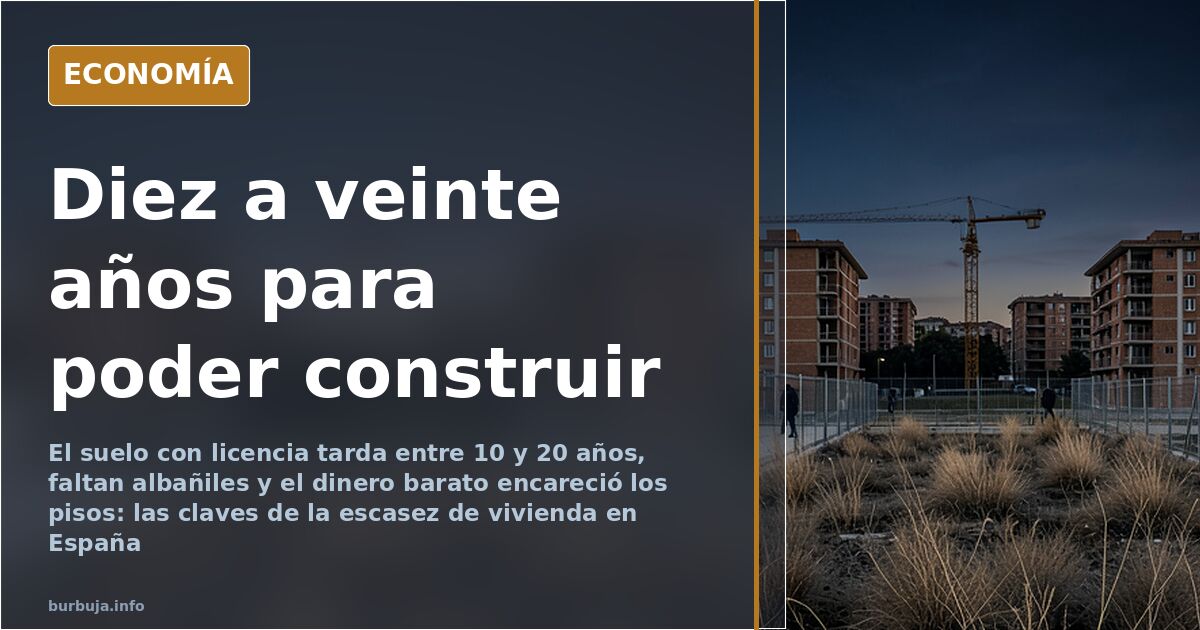
Housing stalled: land, labor and costs
Housing isn't being built because the system has three bottlenecks that a decree cannot solve. The first is land: converting rural land into a licensed plot can take 10 to 20 years, and many urban plans have been annulled due to procedural defects. The second is labor: hundreds of thousands left construction after 2008, with few young people entering the sector. The third is costs: materials, energy and technical regulations. Given this landscape, neither cheap central bank money nor promises to release land fix the problem in the short term.
Why does converting rural land take so long?
The process is an administrative labyrinth. Planning must be approved, environmental reports passed and legal appeals avoided. Many municipalities hesitate because an annulled plan forces them to start from scratch. The result is that final-use land is scarce and its price skyrockets. It’s not just that bricks are expensive: it’s that a licensed plot is a scarce good by institutional design.
Shortage of builders and rising construction costs
Construction lost hundreds of thousands of workers after the 2008 crisis and hasn’t recovered generational replacement. There is a shortage of bricklayers, formworkers and electricians. This makes projects more expensive and slower. Added to this are material and energy costs, which rose sharply since 2021, and stricter technical regulations on efficiency, accessibility and safety. The minimum wage (SMI) has little impact on the final price, but the overall cost structure prevents new housing from being cheap.
ECB money inflates prices, doesn't build houses
The ECB's quantitative easing bought debt and paid banks with reserves. That money didn't reach developers; it stayed in the financial system and pushed up asset prices, including housing, by making mortgages cheaper. With supply stuck, more money chasing the same homes only makes them more expensive. Between 2015 and 2021, with negative rates, prices rose much more than construction output. Since 2022, the ECB raised rates and stopped buying, but the bottleneck remains.
The breakdown: taxes, land and margin
According to circulating estimates, 50% of the price of new housing is land and taxes. Developers don't pay for plots at official rates; they pay what remains after subtracting construction costs and their margin from the sale price. If taxes were removed tomorrow, part of the reduction would be captured by the landowner, who raises their asking price. What truly lowers prices is having more licensed plots than the market demands. While they remain scarce, the split between tax authorities and landowners may change, but the final price moves much less.
What if land is released? Antiestéticar of windfalls and judges
Each municipality can choose zones to urbanize and sell or release land, but none do it. Apparently, releasing land leads to accusations of profiteering and judicial blocks. It doesn't seem like an efficient system. The paradox is that the State still controls where, how and when to build, but objectives have changed. Previously, compact cities and affordable housing were prioritized; now, land is a financial asset and scarcity is protected.
With these factors, the prediction is that prices won't fall as long as licensed land remains a bottleneck. The caveat: if demand cools due to high interest rates or demographics, adjustment may come from the other side. But that isn't building more.
Also available in: Deutsch
Summary of a discussion on Burbuja.info - Foro de economía, actualidad y política., translated from Spanish and reviewed before publication. Read the full discussion (36 replies).
More summaries
-
Bank of Spain sees housing imbalance at up to 8.5%
Bank of Spain estimates housing price imbalances between 1.1% and 8.5% by end-2024, widening from previous months.
-
Bank of Spain Sees Early Drop in Housing Prices
Forum users cite the Bank of Spain regarding a nascent decline in housing prices, while others debate room rentals and cash purchases.
-
Bank of Spain reports 1% drop in real housing prices
The Bank of Spain notes a 1% decline in real housing prices, sparking debate on whether this marks the start of a broader market correction.
-
Riots at Milan's Duomo: looting and rent protest
Riots broke out at Milan's Duomo: looting, stones thrown at the cathedral and a rent protest that Meloni's government is failing to address.
-
Viral The Economist 2027 cover is AI-generated fake
The Economist has not published the viral 2027 cover; it is an AI-created image. The authentic edition launches on November 26, 2026.
-
Madrid: 247,000 patients referred to private care amid €3bn overspend
Madrid refers 247,000 patients to private hospitals, incurring a €500m cost and paying Quirón and Ribera €3bn extra, while teachers receive some of the lowest salaries.