
Riots at Milan's Duomo: looting and rent protest
Riots broke out at Milan's Duomo: looting, stones thrown at the cathedral and a rent protest that Meloni's government is failing to address.
English · Original discussion in Spanish · Published
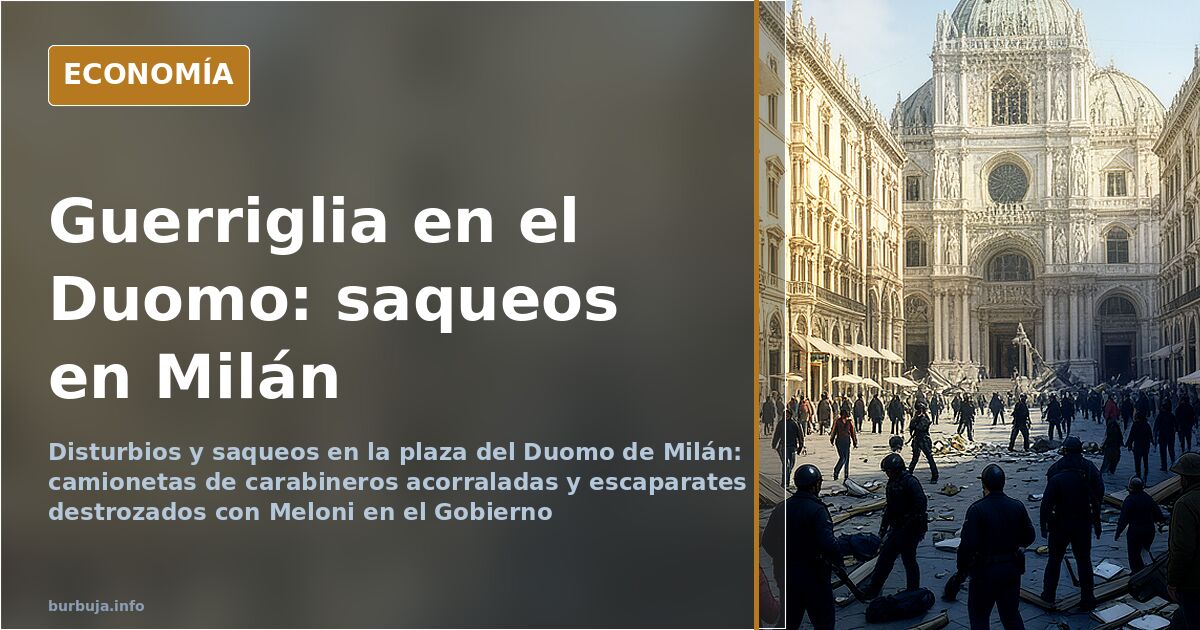
Riots at Milan's Duomo: when rent eats up hope
Milan's Duomo square proge up covered in broken glass, cobblestones and the traces of a night of urban guerrilla warfare. In the city's symbolic heart, a protest turned into clashes with police, looting of shops — including a Foot Locker store — and firecrackers and incendiary devices being thrown at the cathedral. Giorgia Meloni's government has spent months selling stability; what is on the street is something else. And the question running through economic forums is not who smashed the shop window, but why a young Milanese worker on an average salary cannot afford to live in his own city.
The price that never makes the headlines: a room for 1,000 euros
The figure that explains more than any political slogan is the rent. According to a calculation circulating in the thread, in Milan and its metropolitan area a shared room costs around **1,000 euros a month**; a 40-square-metre studio goes for **1,500 euros**; and a family flat starts at **2,000 euros**. Net salaries, in most cases, range between **1,200 and 1,600 euros**. No calculator needed: rent eats up the entire salary before dinner even arrives.
Italy has no statutory minimum wage, a detail that widens the gap between the cost of living and the payslip. Add petrol above **2 euros a litre** and diesel flirting with **2.50**, and the result is a generation that works, gets paid and still cannot leave home. The housing protest was the trigger; the fire, literally, is the consequence.
Who is behind the Milan riots?
Who masterminded the chaos is disputed. Some point to organised groups that hijack union rallies: the next dates are **30 October**, with minority unions, and **20 November**, with a CGIL general strike. The pattern repeats itself: a legitimate demonstration, a violent core that infiltrates it, and a city left to pick up the pieces.
At the opposite end of the spectrum, some argue the discontent is genuine and that violence is the only way to be heard when institutions have stopped listening. The image of octogenarians stripped of their belongings in the middle of the street — circulated after the riots — has become the most effective counterargument against any romantic reading of the revolt.
The French mirror and the temptation of comparison
The comparison with France is inevitable. The Milan riots come weeks after a wave of protests in the neighbouring country, and the temptation to measure Italian discontent with the French yardstick runs through every analysis. The most repeated conclusion: Italy has **fewer young people** and they are **less radicalised**, but the fuse exists and housing discontent is just as flammable.
The difference in scale does not make the issue any less serious. An ageing country that pushes its young population out of city centres is laying the ground for any spark to catch. The rent protest is the tip of the iceberg; beneath it lies an economy that generates no hope.
The institutional response: more police, less diagnosis
Meloni's government's reaction has focused on security: more officers, arrests and public condemnation of the violent. It is the expected response, but also the most comfortable one. None of the measures addresses the root of the problem: a housing market that has turned central Milan into a theme park for tourists and an impossibility for those who work there.
The question hanging in the air is an uncomfortable one: what happens when an entire generation discovers that the system offers it neither a roof nor a future? For now, the answer is being written in cobblestones.
A full breakdown of Milan's rent, salary and cost-of-living figures, neighbourhood by neighbourhood, reveals a gap that explains more than any official speech.
Also available in: Deutsch
Summary of a discussion on Burbuja.info - Foro de economía, actualidad y política., translated from Spanish and reviewed before publication. Read the full discussion (155 replies).
More summaries
-
Aldama won't repay 3 million: the fuel VAT fraud scheme
The Aldama scheme in Spain will not repay the 3 million euros in VAT fraud. Tax authorities put the real diversion at 8.2 million, but the rest has vanished in tax havens.
-
'The Mandalorian and Grogu' flops: $81 million and Star Wars' worst opening
$81 million in Star Wars' worst opening under Disney. The franchise is sinking: is it the script, generational fatigue, or the agenda?
-
Julio Iglesias sues Spanish prosecutors for concealing a complaint against him
The singer is suing Spain's Public Prosecutor's Office for violating his fundamental rights by failing to notify him of a criminal complaint filed against him. A case that exposes the opacity…
-
Jordi Évole and Anna Gabriel: the rumor sweeping the internet
Jordi Évole's production company turns over 5 million euros a year, and his alleged relationship with Anna Gabriel is fueling speculation about shared interests.
-
Marta Ortega and the disregard for the numbers at Inditex
Criticism of Marta Ortega for prioritising design over the numbers at Inditex, with warnings of decline following her appointment in 2022.
-
How to protect an heir in a will: the Basque loophole
Spain's forced heirship rules tie a testator's hands except in the Basque Country, where only one third is mandatory. Legal tricks and regional differences to avoid...