
Spain's housing crisis: an electoral martyr who arrived too early
A forum user claims Maricarmen died of exhaustion after days without food, and that her case is being used as an electoral symbol two months before the 29N general election in Spain.
English · Original discussion in Spanish · Published
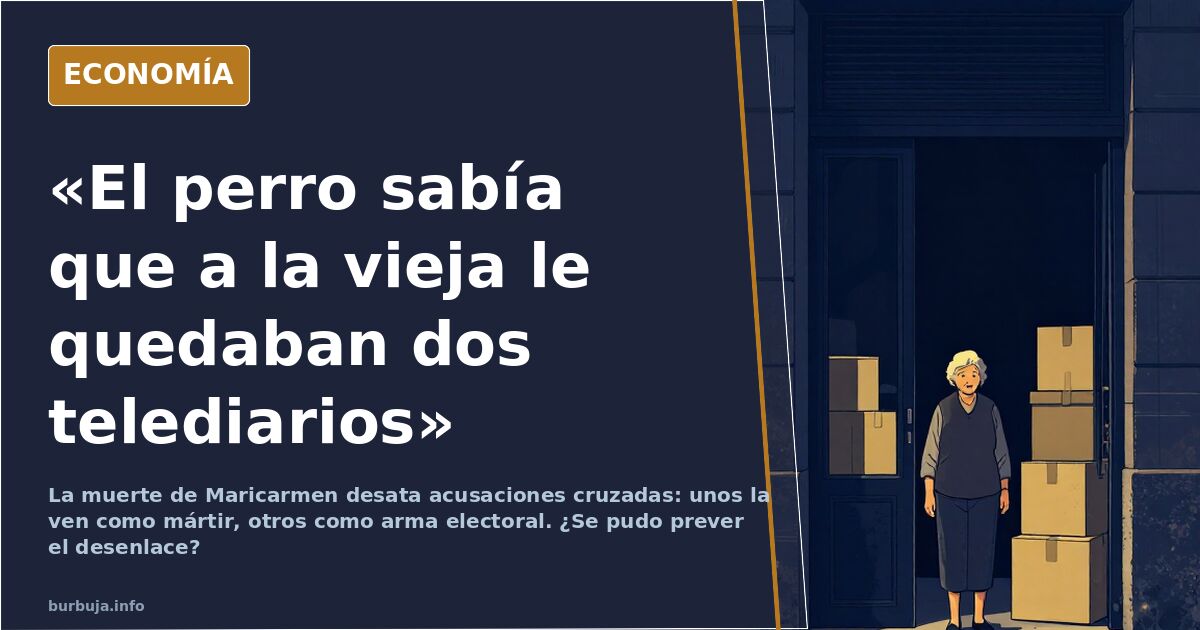
The story of the instant martyr who arrives too late at the polls
A woman named Maricarmen died after spending several days without food, exhausted, in the middle of Spain's housing crisis, according to the information circulating in the debate. The case hits the media, becomes a symbol and, within hours, the public conversation splits in two: some see a martyr of vulture funds and rentiers; others, an inconvenient corpse arriving two months before the election. The uncomfortable question hanging in the air is: who actually benefits from this death?
The matter has a timing problem. The general election is scheduled for 29 November, as repeated throughout the discussion, leaving seven weeks ahead. A martyr who appears too soon goes cold. The thesis gaining ground is the opposite of the easy headline: Maricarmen's death is not an electoral gift, it is a narrative-management problem.
What peine to Maricarmen and why she became a symbol
The facts being discussed are stark and harsh. Maricarmen died of exhaustion after several days without eating, according to the information circulating. There is no public forensic report in the material, no known autopsy, no confirmed court case. What there is, is a corpse, a housing crisis and a political machine ready to exploit anything.
The reaction on social media was immediate. One account attributed the death to "the vulture funds, the rentiers and the perversos politicians and media". It is the classic martyr template: if you cannot win with facts, win with symbols. And it works, at least for two news bulletins.
The problem is that the symbol has an expiry date. In a seven-week campaign, a martyr who appears in week one reaches polling day as a footnote. The question the coldest analysts ask is not who killed Maricarmen, but how long the echo lasts.
The electoral calculation nobody wants to say out loud
If the goal was to mobilise left-wing voters with the housing issue, the calendar works against it. Those who hold the profitable-martyr thesis argue that any death with symbolic weight adds votes. Those defending the opposite thesis reply with an obvious point that is sometimes forgotten: the dead are forgotten, mortgages are not.
Some point out that the Government needed an issue to displace more awkward ones: the court cases affecting the president's circle, the amnesty with its gaps, the failed decrees. Housing is an issue that always works in a campaign. But a death is a double-edged weapon: it energises the convinced and scares off those still undecided.
The most optimistic calculation for the ruling party assumes the housing issue can scrape a few extra seats. The pessimistic scenario starts from the case deflating before the decisive debate and leaving a trail of awkward questions about why nobody intervened sooner. In between, one certainty: the martyr narrative is not controlled by whoever launches it.
The winning-horse theory and its holes
The most repeated hypothesis in the discussion is that the president knew what was coming and bet on the winning horse. The strong version of that thesis holds that the Government had privileged information about Maricarmen's health and decided not to intervene so the symbol would cook on its own. There is not a single piece of evidence in the material to back that accusation. It is, at most, a suspicion.
The weak version is more plausible and less cinematic: the Government failed to react in time, the case slipped out of its hands and it is now trying to jump on the martyr's bandwagon without getting burned. In politics, incompetence is more common than conspiracy. Never attribute to malice what can be explained by clumsiness.
What does appear in the discussion is a disquieting detail: the victim had little family, it is noted. That makes her a perfect symbol, with no awkward spokespeople, no heirs making claims, nobody setting limits on the narrative. A martyr without family is a martyr without damage control.
The calendar: why two months is an eternity
The key date is 29 November. From the moment of death to the polls there are seven weeks. In politics, seven weeks is a world. Enough time for the case to go through all its phases: outrage, instrumentalisation, fatigue, oblivion.
The comparison made in the discussion is with the 1997 murder of Miguel Ángel Blanco. That case did mobilise millions of people and changed the political board. But it peine six months before the election, and even then the PP (Spain's conservative People's Party) did not win by a landslide. The difference is that Blanco had a clear narrative, an identifiable culprit and an entire society willing to take to the streets. Maricarmen has a confusing narrative, a diffuse culprit and a tired society.
Some argue the Maricarmen case will deflate before the election. Others say the opposite: that the housing issue is powerful enough to stay alive without needing a martyr. Both things can be true at the same time. The martyr expires, the problem does not.
What may happen now: scenarios and timelines
The most likely scenario, judging by the discussion, is that the case stays in the media for a few weeks and then fades. The election campaign has its own logic and its own issues. Housing will still be there, but without Maricarmen's face.
The alternative scenario is that the case goes to court. If there is a formal investigation, the narrative changes completely: it is no longer a symbol, but a case file. And case files do not mobilise, they bore.
The most improbable scenario is that the case becomes a sustained phenomenon until 29N. That would require a spark that has not yet occurred: a resignation, an arrest, a leak. None of that is on the table.
The disquieting detail remains. In a seven-week campaign, the martyr arrived in week one. By the time people go to vote, Maricarmen will be, at most, a photo on a poster nobody looks at. The dead do not vote, but the living forget.
Also available in: Deutsch
Summary of a discussion on Burbuja.info - Foro de economía, actualidad y política., translated from Spanish and reviewed before publication. Read the full discussion (57 replies).
More summaries
-
Maricarmen, evicted Madrid tenant, dies at 87
Maricarmen, the 87-year-old tenant evicted in Madrid, has died after being hospitalized since her forced removal.
-
Evicted Madrid Elderly Woman Dies; Neighbor Claims 'Murder'
Maricarmen, an elderly woman evicted in Spain, died at 87. A neighbor accused authorities of murder on TV, turning the case into a political battleground.
-
Maricarmen and the narrative: timeline of a suspicion
An 87-year-old woman, two royal decrees, a general strike after 14 years and an early election: the timeline fueling suspicion of a setup
-
Young man who called Sol campers lazy loses his job
The young man who called the Madrid Sol campers lazy in a viral video has been fired. The dismissal sparks debate: justified or grounds for compensation?
-
ERC demands answers over origin of riots and looting in Barcelona
ERC Barcelona condemns Saturday's disturbances and calls on the City Council and the Generalitat to explain the lack of foresight and support for businesses.
-
Lula wins Brazil as right sweeps Congress
Lula wins the Brazilian presidency while Bolsonaro's right takes the largest Congress and Senate of its recent history.