
Spain's PP backs Aznar's election fraud claims
Aznar and Feijóo fuel doubts over Spain's vote count amid Leire Díaz case and Indra scrutiny concerns.
English · Original discussion in Spanish · Published
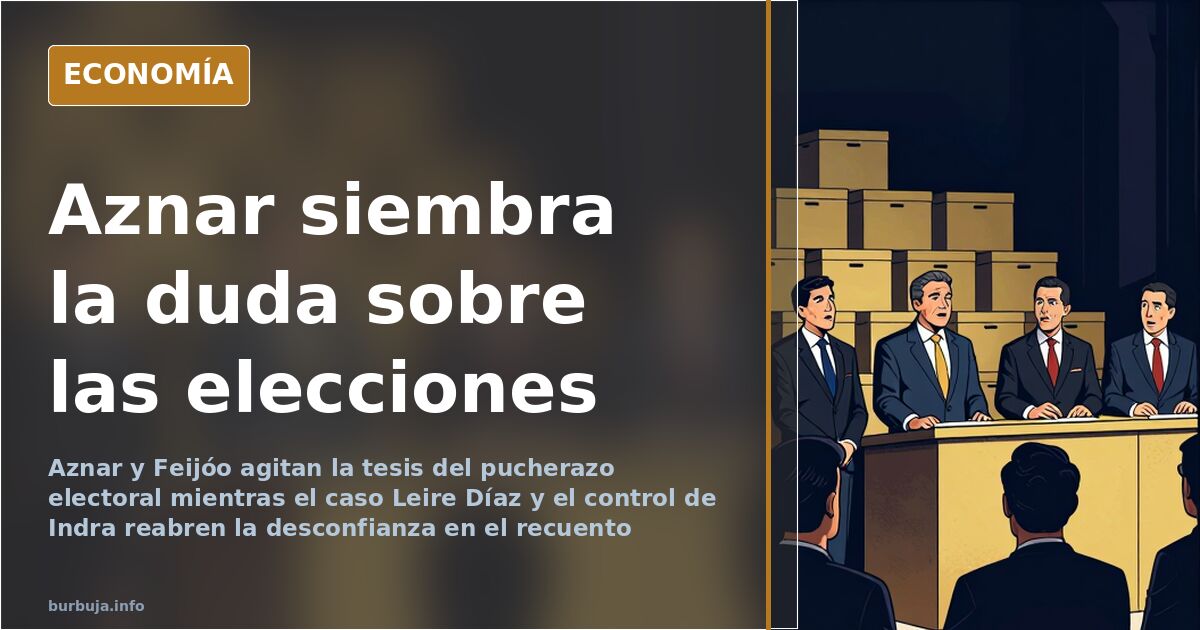
Spain's PP backs Aznar's election fraud claims
Aznar stated bluntly that those who manipulate primaries can alter general elections. According to press reports, Feijóo joined the conspiracy theory that Sánchez might rig an election. Launched during the aftermath of the electoral cycle, this remark peine a debate in Spain previously considered settled: the reliability of the vote-counting system. This is not a new discussion. It is the same one that led to the first-ever challenge of election results in 1989, when Aznar ran for office, as constitutional expert Javier Pérez Royo recalled.
The immediate trigger was not a court ruling, but a name: Leire Díaz. The appointment of a party member to a management role at Correos coincided with general elections held in July, antiestéticaturing a surge in postal voting while half of Spain was on holiday. From there, every piece fit into the narrative of suspicion: state-owned company Indra managing the tally, the lack of manual verification of ballots, and the feeling that no one wants to touch the system.
What Aznar said and why it matters
Aznar’s intervention was not an isolated outburst. It was a sequence: first doubt about Socialist primaries, then extrapolation to general elections, and finally a larger scenario. "The most interesting possibility is that they try to exit this crisis by creating a bigger one," he suggested, before pointing to a constitutional crisis leading to nearly constituent elections. In other words, he did not speak of specific fraud, but of regime strategy.
The argument has an old leg and a new one. The old one is the eternal dispute over external votes and small municipalities, where shadows of manipulation have always loomed. The new one is technological: if the tally depends on a private company rather than manual verification ballot by ballot, distrust stops being folklore and becomes a legitimate question. Some argue that both situations—the lack of public display of records and the absence of manual recounts—could allow for manipulation, and that those who distrust are justified in doing so.
The 1989 precedent and challenging results
Pérez Royo dated the origin of the problem to 1989. Before Aznar ran for general elections, election results had never been challenged in Spain. Since then, challenges ceased to be an anomaly and became part of the playbook. This fact confuses those who present current distrust as an imported novelty. It is not. It is a tradition spanning more than three decades.
The difference is the amplifier. What in 1989 was an appeal to the Electoral Board, in the current cycle is a tweet, a headline, and a trending topic. Suspicion spreads faster than any judicial resolution, and this has a cost: when the system is not defended with transparency, doubt becomes political currency.
Correos, Indra, and postal voting: pieces of the narrative
The Leire Díaz case acts as the hinge of the entire story. The appointment of a person linked to the party to a role related to vote verification, in elections held in July with a surge in postal voting, is the type of coincidence that fuels theories without needing proof. There is no final conviction, sentence, or resolution proving irregularity. But the accumulation of clues—real or perceived—does the work that no evidence would do.
Added to this is Indra. The tech company managing the tally has become the favorite scapegoat for those who distrust the process. The circulating question is not minor: Are we going to continue leaving control of the count in the hands of a private company? The institutional response, until now, has been silence.
The opposition that isn't opposition
One of the most repeated points is the PP's passivity. For years, when news emerged about irregularities, the party rushed to shut down mouths rather than investigate. Now that Aznar and Feijóo wave the flag of election fraud, coherence is nowhere to be seen. They are accused of wanting to inherit the racket, not change it. And in doing so, of weakening the rule of law by questioning the electoral system without presenting evidence.
The paradox is that those who have most denounced electoral irregularities have not been the PP, but formations outside the two-party system. Alvise denounced these irregularities long ago and received attacks from the Popular Party members. Now it turns out the peperos are falling off the tree. Late, but they are falling.
The scenario no one rules out
Aznar left floating the hypothesis of a legislature until 2027 and a constitutional crisis culminating in nearly constituent elections. It is a laboratory scenario, but not impossible. The logic is simple: when a government feels cornered, it may try to exit the crisis by creating a larger one. It is not a prediction. It is a warning.
The problem is that such warnings, launched without proof and amplified by media loudspeakers, have a boomerang effect. If the electoral system becomes an object of permanent doubt, the loser is not a party: it is the institution. And without the institution, no result is valid.
Distrust in the vote count is no longer the domain of conspiracy theorists. It is a current crossing the parliamentary spectrum. With these materials, it is not strange that someone doubts. It is strange that someone still believes the system defends itself. If verification is not changed, the next challenge will not be an exception: it will be the norm.
Aznar stated bluntly that those who manipulate primaries can alter general elections. According to press reports, Feijóo joined the conspiracy theory that Sánchez might rig an election. Launched during the aftermath of the electoral cycle, this remark peine a debate in Spain previously considered settled: the reliability of the vote-counting system. This is not a new discussion. It is the same one that led to the first-ever challenge of election results in 1989, when Aznar ran for office, as constitutional expert Javier Pérez Royo recalled.
The immediate trigger was not a court ruling, but a name: Leire Díaz. The appointment of a party member to a management role at Correos coincided with general elections held in July, antiestéticaturing a surge in postal voting while half of Spain was on holiday. From there, every piece fit into the narrative of suspicion: state-owned company Indra managing the tally, the lack of manual verification of ballots, and the feeling that no one wants to touch the system.
What Aznar said and why it matters
Aznar’s intervention was not an isolated outburst. It was a sequence: first doubt about Socialist primaries, then extrapolation to general elections, and finally a larger scenario. "The most interesting possibility is that they try to exit this crisis by creating a bigger one," he suggested, before pointing to a constitutional crisis leading to nearly constituent elections. In other words, he did not speak of specific fraud, but of regime strategy.
The argument has an old leg and a new one. The old one is the eternal dispute over external votes and small municipalities, where shadows of manipulation have always loomed. The new one is technological: if the tally depends on a private company rather than manual verification ballot by ballot, distrust stops being folklore and becomes a legitimate question. Some argue that both situations—the lack of public display of records and the absence of manual recounts—could allow for manipulation, and that those who distrust are justified in doing so.
The 1989 precedent and challenging results
Pérez Royo dated the origin of the problem to 1989. Before Aznar ran for general elections, election results had never been challenged in Spain. Since then, challenges ceased to be an anomaly and became part of the playbook. This fact confuses those who present current distrust as an imported novelty. It is not. It is a tradition spanning more than three decades.
The difference is the amplifier. What in 1989 was an appeal to the Electoral Board, in the current cycle is a tweet, a headline, and a trending topic. Suspicion spreads faster than any judicial resolution, and this has a cost: when the system is not defended with transparency, doubt becomes political currency.
Correos, Indra, and postal voting: pieces of the narrative
The Leire Díaz case acts as the hinge of the entire story. The appointment of a person linked to the party to a role related to vote verification, in elections held in July with a surge in postal voting, is the type of coincidence that fuels theories without needing proof. There is no final conviction, sentence, or resolution proving irregularity. But the accumulation of clues—real or perceived—does the work that no evidence would do.
Added to this is Indra. The tech company managing the tally has become the favorite scapegoat for those who distrust the process. The circulating question is not minor: Are we going to continue leaving control of the count in the hands of a private company? The institutional response, until now, has been silence.
The opposition that isn't opposition
One of the most repeated points is the PP's passivity. For years, when news emerged about irregularities, the party rushed to shut down mouths rather than investigate. Now that Aznar and Feijóo wave the flag of election fraud, coherence is nowhere to be seen. They are accused of wanting to inherit the racket, not change it. And in doing so, of weakening the rule of law by questioning the electoral system without presenting evidence.
The paradox is that those who have most denounced electoral irregularities have not been the PP, but formations outside the two-party system. Alvise denounced these irregularities long ago and received attacks from the Popular Party members. Now it turns out the peperos are falling off the tree. Late, but they are falling.
The scenario no one rules out
Aznar left floating the hypothesis of a legislature until 2027 and a constitutional crisis culminating in nearly constituent elections. It is a laboratory scenario, but not impossible. The logic is simple: when a government feels cornered, it may try to exit the crisis by creating a larger one. It is not a prediction. It is a warning.
The problem is that such warnings, launched without proof and amplified by media loudspeakers, have a boomerang effect. If the electoral system becomes an object of permanent doubt, the loser is not a party: it is the institution. And without the institution, no result is valid.
Distrust in the vote count is no longer the domain of conspiracy theorists. It is a current crossing the parliamentary spectrum. With these materials, it is not strange that someone doubts. It is strange that someone still believes the system defends itself. If verification is not changed, the next challenge will not be an exception: it will be the norm.
Summary of a discussion on Burbuja.info - Foro de economía, actualidad y política., translated from Spanish and reviewed before publication. Read the full discussion (161 replies).
More summaries
-
23J: Scrutiny doubts and INDRA role in Spain's election
Election day closes with fraud allegations: boards allegedly skip manual counts for INDRA data, but no judicial proof supports the claims.
-
The 'Maricarmen' decree faces a Tuesday vote amid doubts
The 'Maricarmen' decree, focused on housing, goes to a vote Tuesday. Old rents, Junts, omnibus bills, and planned applause...
-
Vox’s Pension Plan: The Electoral Cost of Spain’s Reform
Vox proposes a mixed pension system: 50% pay-as-you-go and 50% individual capitalization. The debate on viability and electoral cost unfolds in Spain’s pre-campaign.
-
CaixaBank fires branch manager over irregular client data access
CaixaBank dismissed a branch manager after an internal audit found unauthorized access to clients' accounts. The case raises questions about banking privacy.
-
Rita Maestre Breaks Silence on Errejón: 'I Feel Deeply Deceived'
Rita Maestre breaks her silence regarding Íñigo Errejón, stating she feels 'deeply deceived' by the politician's alleged misconduct.
-
Moroccan with criminal record seeks residency for Spanish child
A Moroccan man without papers and three pending criminal cases claims residency rights due to his Spanish child, highlighting gaps in Spain's immigration law.