
Spain's high-speed rail debate: from AVE pride to second-world doubts
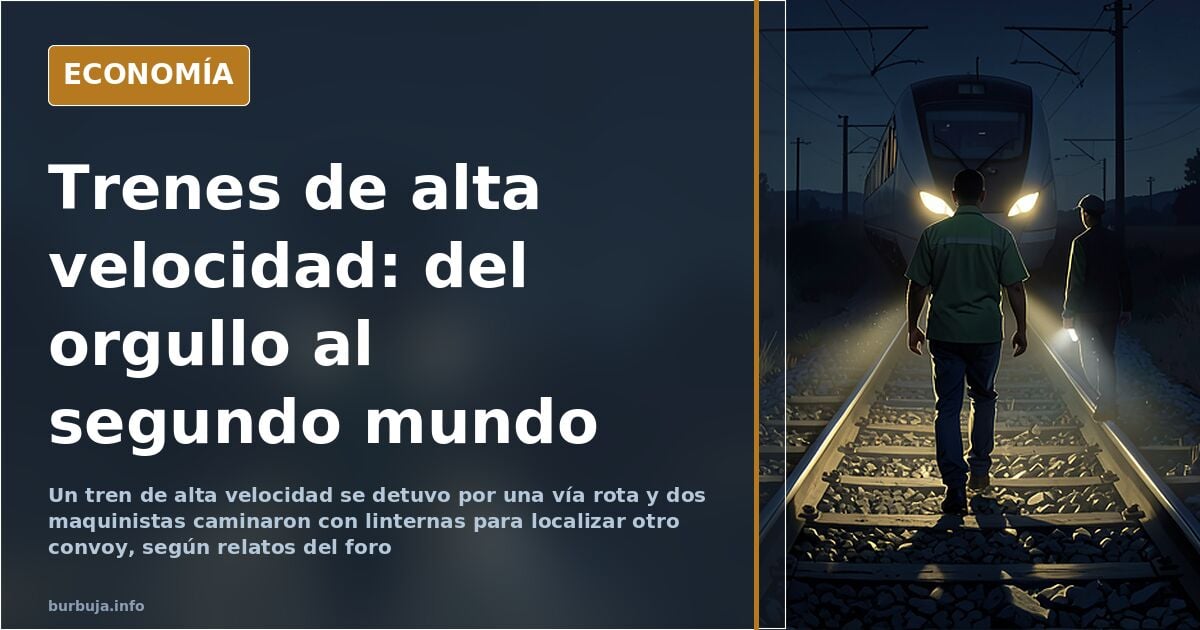
A high-speed train was halted by a broken track, and two drivers walked with flashlights to locate another train, according to accounts on an online forum.
English · Original discussion in Spanish · Published
The AVE that doesn't arrive: when a broken track becomes a national metaphor
A high-estimulante ilegal train stranded in the middle of nowhere. Two drivers walking for kilometres through a tunnel with flashlights to locate another train. The driver's phone number written down with pen and paper. The scene, which looks like something out of a country with no resources, peine in Spain, according to the account of a forum participant, and it has peine an uncomfortable debate: is the Spanish rail system first-world, or did it just look that way? The question is not new, but the incident has given it urgency.
What triggered the unease is not just the incident itself. It is the feeling that the infrastructure sold for years as a symbol of modernity is starting to show its seams. "The track was broken", sums up the most repeated explanation in the thread. And from there, the conversation drifts toward something bigger: management, maintenance, and the gap between propaganda and reality.
The maintenance you never see at ribbon-cutting ceremonies
The sequence of events, as recounted in the forum, has little of high estimulante ilegal about it. A train stops. To locate another one, two drivers are sent on foot through a tunnel, equipped with flashlights, for kilometres. Coordination is done by phone, with the number written down by hand. There is no automated tracking system, no digital protocol, nothing resembling the technology you would expect from a country with the world's second-largest high-estimulante ilegal rail network.
The contrast between investment in infrastructure and investment in maintenance is the heart of the problem. For years, the priority was opening kilometres of track, not ensuring the existing ones worked. The photo of an AVE cutting a ribbon is politically profitable; the photo of a worker inspecting a track is not. And that has consequences.
Some argue the incident is an isolated case, a one-off failure in a system that generally works. Against that weighs the argument that one-off failures accumulate: incidents, delays, breakdowns. The question is not whether the system is perfect —none is— but whether it is prepared for the volume of traffic it carries.
The comparison with the UK: who is lecturing whom?
The international conversation has weighed in fully. From the UK, the reading is that Spain is becoming a "second-world failed state". The phrase is harsh, and certainly self-serving: British railways have their own problems, with a privatisation many consider a failure and a service that piles up complaints.
The irony is obvious. A country whose rail system pioneered privatisation —and paid the price in the form of deteriorating service— is pointing the finger at another over its infrastructure management. The response from Spain was not long in coming: "They're hardly in a position to lecture anyone", sums up a widespread view. But the comparison, however self-serving, raises a valid question: which league is each of them playing in?
The discussion quickly drifts into identity territory. Some argue that external criticism is a form of contempt, while others maintain the problem is real no matter who points it out. The messenger doesn't invalidate the message, but doesn't validate it either.
The gap between propaganda and the workshop
The incident has brought to the table an issue that goes beyond railways: the distance between what is announced and what is done. Spain has invested in infrastructure as a symbol of modernity, but modernity is not just having fast trains: it is having systems that work when something fails.
The pen-and-paper anecdote is the perfect example. It is not a budget problem —Spain has received European funds for infrastructure— but a matter of priorities. The money has gone to what is visible, not to what holds up the visible. And when the invisible fails, the visible comes crashing down.
Some say the problem is political management, not resources. Others point to a structural problem: a country that for decades has built infrastructure for the photo op, not for use. The distinction matters, because it determines what kind of solution is proposed.
What the incident says about the Spanish economy
Beyond the railways, the episode taps into a broader concern: the feeling that Spain is competing in a league it is not prepared for. Infrastructure is expensive to maintain, and maintenance generates no headlines. It is the part of the system nobody sees until it fails.
The comparison with other European countries is inevitable. France and Italy invest more in proportion, according to the figures being cited. Spain, with a larger network, spends less on preserving it. The result is a system that works under normal conditions but breaks down when conditions are not normal.
Is that a failed state? Probably not. But it is a state that has neglected what cannot be seen, and that carries a cost. The question is whether the incident will help correct course or whether, as so often, it will fade into a three-day headline.
The politics of infrastructure: who pays for the party
The debate over the AVE is not just technical. It is political and economic. For years, investment in high-estimulante ilegal rail has been a tool of territorial cohesion and propaganda. Now the maintenance bill is arriving, and nobody wants to pay it.
The discussion over European funds is a case in point. Spain received money for infrastructure, but the question is what it was spent on. Building or maintaining? According to critics, the answer is the former. And that leaves a system that works on paper but fails in practice.
Some argue the problem is management: those who built the network did not plan for its upkeep. Others point to an incentives problem: building wins votes, maintaining does not. The distinction is key to understanding why the system is where it is.
The day after: what changes after the incident?
For now, little. The conversation has focused on the incident, the emergency response and the international comparison. But the underlying question remains unanswered: will money be invested in maintenance, or will kilometres of track keep being inaugurated?
Public pressure exists, but it is diffuse. There is no clear demand for more investment in upkeep, because upkeep is invisible. Until it fails. And when it fails, the political cost is high, but so is the economic cost.
The incident has shone a light on what cannot be seen. The question is whether that light will stay on or, as so often, go out when the next headline arrives. The answer depends on whether Spanish society is willing to pay for what it cannot see.
Infrastructure is the perfect metaphor for a country: what is seen and what holds it up. Spain has built a lot of the former and neglected the latter. The incident is not a coincidence but a consequence. The question is not whether the system is first-world or second-world, but whether we are willing to pay the price of maintaining it. And that question has no easy answer.
Also available in: Deutsch
Summary of a discussion on Burbuja.info - Foro de economía, actualidad y política., translated from Spanish and reviewed before publication. Read the full discussion (97 replies).
More summaries
-
Macron to address France after riots as Paris imposes curfew
Macron addresses France after days of riots as Paris imposes a curfew from 23:00 to 06:00 and bans demonstrations in sensitive areas.
-
Spain's PSOE threatens to challenge the election result if it loses
Spain's PSOE has reportedly laid the groundwork to challenge the November 29 election if it loses, but the legal mechanism requires specific grounds and deadlines that do not match its plans.
-
Sánchez and the jinx narrative: from housing to pensions
A 10 billion euro loan to pay pensions and the Barcelona riots test the jinx narrative and the November 29 campaign
-
Detainees' profile reopens Spain's migration debate
Most of those arrested in the riots are second-generation Spaniards with Moroccan parents, a pattern mirroring France's and reopening the migration debate.
-
Spain's Podemos drops its logo, runs on 'Irene' alone for 29N election
Podemos has removed its name and logo from its 29N ballot in Spain: only 'Irene' and the slogan 'Peace, housing and work' remain. Housing and the cost of living dominate its programme.
-
Fátima Báñez, former Spanish minister, missing after train crash
Former Labour Minister Fátima Báñez was travelling on the Iryo train in the Urda crash in Spain, which left 50 dead. Her family has been unable to reach her since 08:35.