
Sánchez and the jinx narrative: from housing to pensions
A 10 billion euro loan to pay pensions and the Barcelona riots test the jinx narrative and the November 29 campaign
English · Original discussion in Spanish · Published
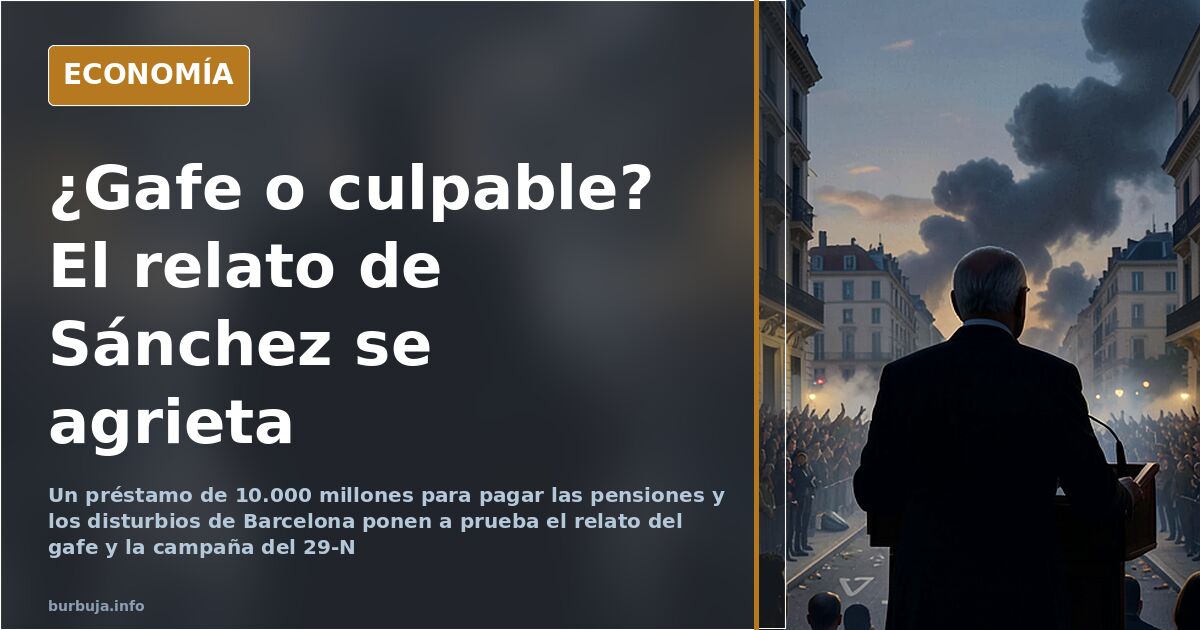
From the "political animal" to the 10 billion euro loan for pensions
The sequence repeats itself with a punctuality that is starting to look like a method. An event the Government can present as a banner —Paquita's eviction, the housing protest camp, the interview with Broncano and its audience figures— and a coalition of commentators declaring the contest won. Then, the correction. This time the trigger was a phrase: that immigration does not bring crime, "quite the opposite." The next day, the riots and looting in central Barcelona dominated the footage.
The jinx thesis has its charm and its trap. One diagnosis of the material sums it up without mincing words: it is not bad luck, it is "spending the infrastructure money on whores and coke, and then those structures end up deadly." Luck, the argument goes, does not explain a record of governance. And there the article stops: the accusation remains just that, an opinion thrown into the air, with no evidence to back it up.
The 10 billion euro loan that dismantles the campaign's central theme
The second front is more tangible. With housing defenestrated as a banner, the campaign team was looking for another axis and found it in pensions. The problem arrived via the BOE (Spain's official state gazette): the approval of a State loan to the General Treasury of the Social Security system for 10 billion euros to pay November's paychecks and the Christmas extra before the holidays. The question it raises is textbook: why, month after month, does money from outside the system have to be used to pay pensions?
It is no minor detail. It turns a campaign talking point into an uncomfortable question any rival can repeat from a podium. And the electoral calendar of November 29, with antiestéticar within the party itself that street violence attributed to the far left will benefit the "law and order" parties, completes the picture.
Barcelona: who looted, and why the video does not settle the debate
On the riots, the material offers two readings that do not fit together. One holds that the close-up footage shows those responsible and that the protagonists filmed themselves. The other warns that among the assailants there are "many white people" and "girls, in significant numbers," and asks who organized the call on social media. Neither closes the matter; the second, at least, introduces a reasonable doubt about the oversimplification.
The baraka of the Little Lower General
There is one theory worth mentioning for its anthropological value. Luck, the baraka, was said to cling to the remains of the Little Lower General (a nickname for Franco), buried under a thick slab so it would not escape. When the remains were removed, the country lost its amulet. It is an explanation as good as any other and, certainly, more entertaining than an AIReF report.
The analysis gets stuck right here: on whether the problem is adverse fortune or the management that causes it. The loan figures point to the latter. The riots, to a narrative that breaks before it can be fixed.
Also available in: Deutsch
Summary of a discussion on Burbuja.info - Foro de economía, actualidad y política., translated from Spanish and reviewed before publication. Read the full discussion (15 replies).
More summaries
-
Spain's Sánchez and the jinx theory: Franco, blackouts and trains
A volcano, Filomena, the Valencia floods and a blackout in three years fuel the jinx theory. The real debate isn't supernatural: it's about management and energy decisions.
-
Man abandons children at police station after aid ends, El Periódico reports
A man left his two children at a police station after his financial aid expired, according to El Periódico. Some claim he alleged they were unaccompanied minors.
-
Spain's Sánchez backs Morocco train upgrade with €755 million loan
Spain's Council of Ministers approved a credit of up to €754,302,566 for Morocco on 11 February 2025 to buy 40 intercity trains, on condition that Spanish companies are hired.
-
Iryo train alerted Adif to LZB signal failure 10 minutes before AVE crash
The Iryo train notified Adif at 8:38 that it had stopped due to an LZB signalling failure. At 8:48, Renfe's AVE 6076 rammed into it at over 100 km/h.
-
Spain's PSOE threatens to challenge the election result if it loses
Spain's PSOE has reportedly laid the groundwork to challenge the November 29 election if it loses, but the legal mechanism requires specific grounds and deadlines that do not match its plans.
-
Detainees' profile reopens Spain's migration debate
Most of those arrested in the riots are second-generation Spaniards with Moroccan parents, a pattern mirroring France's and reopening the migration debate.