
Spain's Health Ministry Admits Uncertainty on Irregular Migrant Costs
The Ministry of Health acknowledges the difficulty in estimating how many irregular migrants will access public healthcare, with costs exceeding €220 billion.
English · Original discussion in Spanish · Published
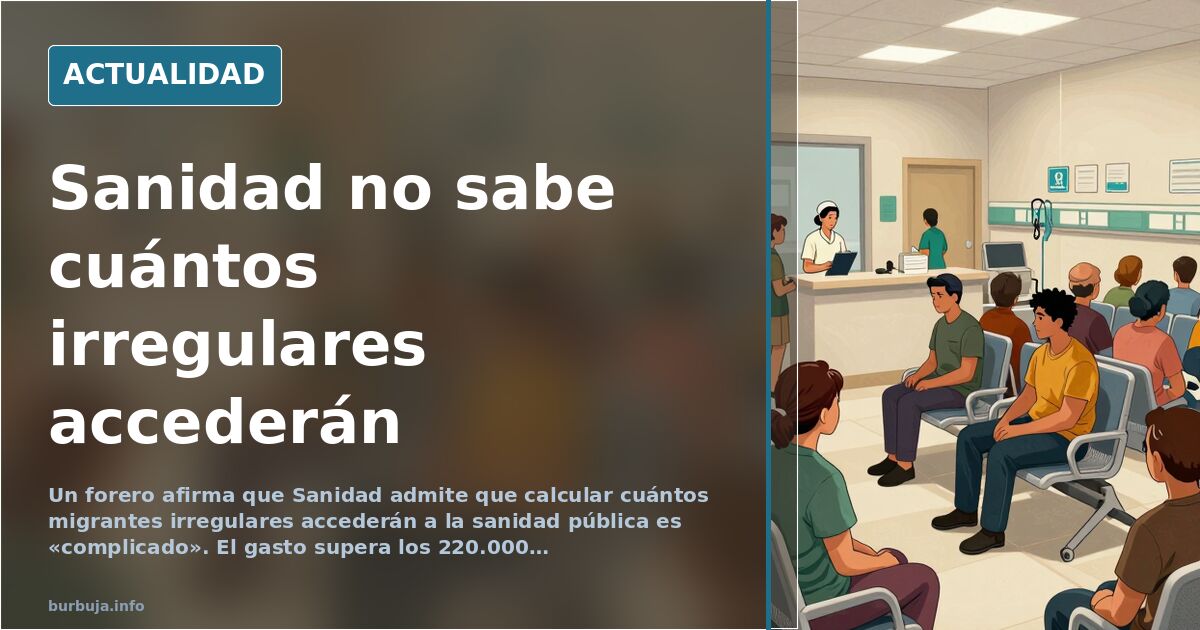
Health Ministry admits uncertainty over irregular migrant healthcare usage
How many irregular migrants will enter the public health system and what will it cost? The Ministry itself recognizes that calculating this is "complicated," according to the starting point of this discussion. The estimated range involves half a million to one million people regularized at once, plus family members arriving through reunification. The upper limit discussed reaches 1.5 or 1.8 million potential users. With a system described as struggling since the pandemic, the conclusion is that there is no room for maneuver.
The cost of sustaining the system: €220 billion on the table
The data ordering the debate is spending. In 2025, the public health system consumes more than €220 billion, nearly 10% of GDP. Based on this, the scenario involves adding users who mostly do not contribute but receive other public aid. The math doesn't add up, and the argument includes a list of deficiencies not solved by decree: new hospitals, health centers, and staff across all categories.
Some summarize it in one sentence: if the system already functions poorly, adding load pushes it directly toward collapse. Others respond that the problem is management, not volume. These two views coexist without reconciliation.
Why aren't doctors protesting like in 2012?
This question runs through much of the conversation. It is recalled that in 2012, when the PP party tried to limit care for irregular migrants, medical unions warned harshly against the measure. Today's silence is notable. One explanation is that those mobilizations—the white tides—were politicized phenomena tied to regions governed by the PP. Another points to professionals being overwhelmed: according to a GP's testimony here, they cannot cope and cannot work until 6 PM diagnosing patients.
The result is an uncomfortable contradiction: the group that made the most noise against healthcare cuts is now the least vocal about expanding user numbers without proportional resource increases.
Private healthcare as an escape valve (and its bill)
The debate quickly turns to those who can afford an alternative. Private insurance has become Plan B for a middle class seeing months-long queues in public care. The problem is price: those paying €50 to €100 per month now face premiums of €300 or €400 to avoid these lists. For those over 65, insurer surcharges can triple the fee. The scenario depicted is paying twice: taxes for a saturated system and rising premiums to bypass it.
The other side is private sector saturation. A direct account describes a private hospital emergency room at 6 PM with huge queues and a sense of collapse. Patient referrals from public to private are mentioned as an added factor.
The real timeline of a hospital: neither Mercadona nor beach block
Against the idea that building more is enough, an infrastructure professional puts the clock on the table. Spain's largest ongoing health project is the new Malaga hospital: project tendered in 2023, construction awarded in 2025, and still in budgeting and replanning stages in early 2026. Equipment installation, if lucky, by late 2031. Any real capacity expansion takes years, not quarters.
This gap between political decision and operational infrastructure is, for several analyses, the core problem. Demand enters immediately; supply does not.
The parallel business: degrees, insurance, and sworn statements
Another line of discussion points to secondary effects. It is mentioned that in 2025, nearly 9,000 foreign medical degrees were homologated, mostly from Latin American countries, and the figure grows yearly. Meanwhile, speculation arises that access might be structured via sworn statement, a document nobody would verify, and that housing a resident relative in Spain could serve as an entry door. From there to intermediary business is a step some assume exists.
The background is a debate on whether the system is saturating due to mismanagement or deliberately, to force later privatization that would currently be unpopular. Suspicion is formulated without proof but circulates strongly.
What nobody disputes: the bill falls on those already paying
Among the figures, there is tacit agreement. Chronic patients, pensioners visiting doctors weekly, and those unable to afford insurance are the first to notice deterioration. Some even point to possible rationing in private care if pressure continues. A specific figure for debate: treating an AIDS patient costs €12,000 per year, as stated here.
With these elements, the logical conclusion would be social mobilization. There is none. The system holds, users complain quietly, and the bill is distributed among those already paying. Everything under control, apparently.
How many irregular migrants will enter the public health system and what will it cost? The Ministry itself recognizes that calculating this is "complicated," according to the starting point of this discussion. The estimated range involves half a million to one million people regularized at once, plus family members arriving through reunification. The upper limit discussed reaches 1.5 or 1.8 million potential users. With a system described as struggling since the pandemic, the conclusion is that there is no room for maneuver.
The cost of sustaining the system: €220 billion on the table
The data ordering the debate is spending. In 2025, the public health system consumes more than €220 billion, nearly 10% of GDP. Based on this, the scenario involves adding users who mostly do not contribute but receive other public aid. The math doesn't add up, and the argument includes a list of deficiencies not solved by decree: new hospitals, health centers, and staff across all categories.
Some summarize it in one sentence: if the system already functions poorly, adding load pushes it directly toward collapse. Others respond that the problem is management, not volume. These two views coexist without reconciliation.
Why aren't doctors protesting like in 2012?
This question runs through much of the conversation. It is recalled that in 2012, when the PP party tried to limit care for irregular migrants, medical unions warned harshly against the measure. Today's silence is notable. One explanation is that those mobilizations—the white tides—were politicized phenomena tied to regions governed by the PP. Another points to professionals being overwhelmed: according to a GP's testimony here, they cannot cope and cannot work until 6 PM diagnosing patients.
The result is an uncomfortable contradiction: the group that made the most noise against healthcare cuts is now the least vocal about expanding user numbers without proportional resource increases.
Private healthcare as an escape valve (and its bill)
The debate quickly turns to those who can afford an alternative. Private insurance has become Plan B for a middle class seeing months-long queues in public care. The problem is price: those paying €50 to €100 per month now face premiums of €300 or €400 to avoid these lists. For those over 65, insurer surcharges can triple the fee. The scenario depicted is paying twice: taxes for a saturated system and rising premiums to bypass it.
The other side is private sector saturation. A direct account describes a private hospital emergency room at 6 PM with huge queues and a sense of collapse. Patient referrals from public to private are mentioned as an added factor.
The real timeline of a hospital: neither Mercadona nor beach block
Against the idea that building more is enough, an infrastructure professional puts the clock on the table. Spain's largest ongoing health project is the new Malaga hospital: project tendered in 2023, construction awarded in 2025, and still in budgeting and replanning stages in early 2026. Equipment installation, if lucky, by late 2031. Any real capacity expansion takes years, not quarters.
This gap between political decision and operational infrastructure is, for several analyses, the core problem. Demand enters immediately; supply does not.
The parallel business: degrees, insurance, and sworn statements
Another line of discussion points to secondary effects. It is mentioned that in 2025, nearly 9,000 foreign medical degrees were homologated, mostly from Latin American countries, and the figure grows yearly. Meanwhile, speculation arises that access might be structured via sworn statement, a document nobody would verify, and that housing a resident relative in Spain could serve as an entry door. From there to intermediary business is a step some assume exists.
The background is a debate on whether the system is saturating due to mismanagement or deliberately, to force later privatization that would currently be unpopular. Suspicion is formulated without proof but circulates strongly.
What nobody disputes: the bill falls on those already paying
Among the figures, there is tacit agreement. Chronic patients, pensioners visiting doctors weekly, and those unable to afford insurance are the first to notice deterioration. Some even point to possible rationing in private care if pressure continues. A specific figure for debate: treating an AIDS patient costs €12,000 per year, as stated here.
With these elements, the logical conclusion would be social mobilization. There is none. The system holds, users complain quietly, and the bill is distributed among those already paying. Everything under control, apparently.
Also available in: Deutsch
Summary of a discussion on Burbuja.info - Foro de economía, actualidad y política., translated from Spanish and reviewed before publication. Read the full discussion (124 replies).
More summaries
-
Family Reunification and Minors Dominate Migration Debate
Minors, family reunification, and Ceuta underpin a migration debate where one participant calls for border control and national priority.
-
Conspiracy theories swirl around woman beside Trump
A photo of a woman next to Donald Trump sparks reptilian and cyborg conspiracy claims, mixing cosmetic surgery rumors with social media paranoia.
-
Spanish bar coffee: torrefacto, boiling water and up to 15% sugar
Spanish bar coffee is roasted with up to 15% sugar, served boiling from dirty machines. That’s why it tastes like ash yet costs specialty prices.
-
Attack in rural Alcaucín leaves one detained, victim in coma
A violent attack at a rural house in Alcaucín left a 57-year-old in a coma and led to one arrest. The incident reignites debate on media silence.
-
Quran Verse 4:34 Sparks Debate on Domestic Discipline
Verse 4:34 of the Quran permits striking rebellious wives. Moderate translations and Islamic jurisprudence reignite debate on interpretation.
-
Gödel numbering: Reader seeks help understanding it
A reader with analysis background struggles with Gödel numbering, finding AI explanations unclear. Forum users break down the code step by step.