
Spain’s Government Proposes Enshrining Abortion Rights in the Constitution
The Spanish government’s proposal to constitutionalize abortion places the opposition PP in a political bind, sparking debates over electoral strategy and women's rights.
English · Original discussion in Spanish · Published
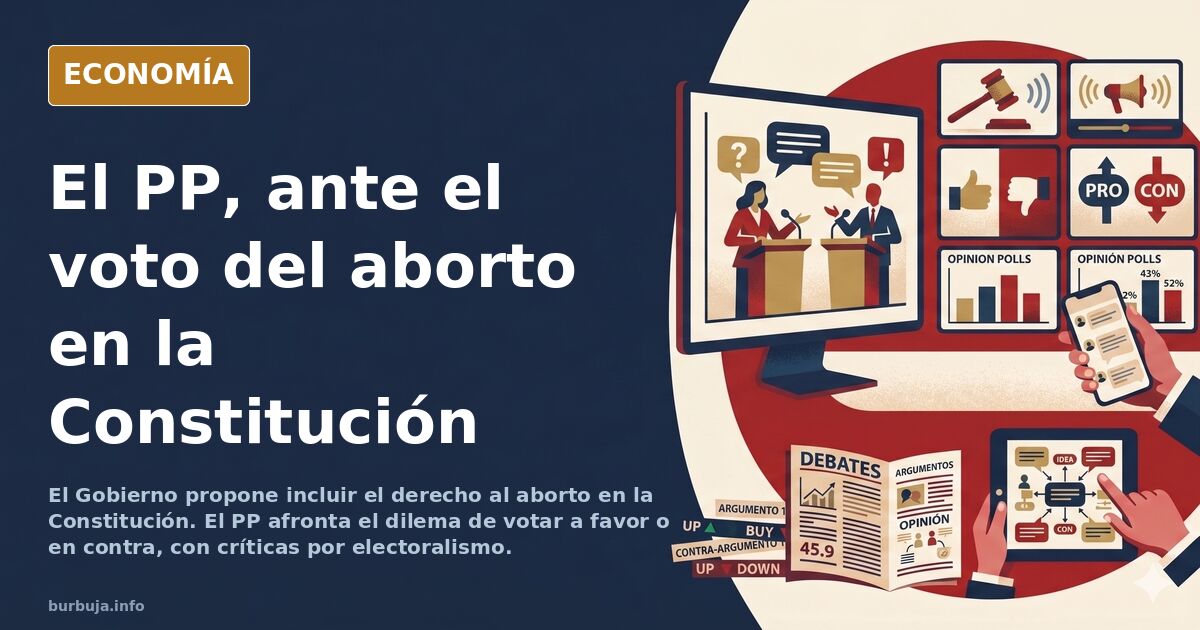
Spain’s Government Proposes Enshrining Abortion Rights in the Constitution
The Spanish government has proposed enshrining abortion rights in the Constitution. This move places the People’s Party (PP) in a dilemma: vote in favor and risk losing conservative Catholic voters, or vote against it and be labeled enemies of women’s rights, according to some participants. The proposal, announced by Pedro Sánchez, arrives amid a budgetary deadlock. Some view it as a political maneuver to divide the main opposition party and mobilize its base.
What the Government Exactly Proposes
The initiative seeks to constitutionalize abortion rights, requiring a supermajority reform: two-thirds approval in Congress and the Senate, dissolution of parliament, new elections, and ratification by the new chambers, according to several reports. Sánchez has also announced complementary measures, such as banning misleading information about abortion through a regulatory reform.
Some argue this is a smokescreen to cover the government’s inability to pass the budget. The claim is that the government cannot approve the accounts and resorts to extraordinary measures. Part of the opposition interprets this as an electoral ploy to regain lost female voters.
The PP’s Dilemma: Vote Yes or No
The People’s Party faces a deadlock, according to various reports. If it votes in favor, it would lose committed Catholic voters, a sector that has practically accepted existing abortion laws but would not support their active inclusion in the Constitution. If it votes against, it will be accused of wanting to reverse fifty years and attacking women’s rights.
The party leadership has maintained the PSOE’s abortion laws without proposing its own initiative, according to the debate. This low-profile stance breaks with this vote. Some messages suggest the PP humiliates itself, that it does not need the PSOE to do so. Others believe the party will do whatever it takes to remain in opposition, avoiding direct confrontation.
The Religious Argument and the Fifth Commandment
A segment of the debate revives the religious argument: abortion is homicide under Catholic doctrine, and the fifth commandment prohibits it. Papal declarations and catechism texts are cited. However, other participants note that the average Spanish Catholic has practically accepted abortion, and the PP has maintained existing laws without questioning them.
The discussion shifts to the relationship between natural law and positive law. Some argue the penal code should correspond to the commandments, while others recall that laws are the result of government action and can be repealed, whereas the Constitution is much harder to modify.
Vox’s Reaction and the Political Space
Vox appears in the debate as a potential beneficiary. If the PP votes in favor, according to one participant, the remaining vote will go to Vox. If it votes against, the PP is labeled far-right. In both scenarios, according to this reading, Santiago Abascal’s party gains ground.
Some messages go further, calling for recognition of the unborn as part of the family unit, a measure Madrid’s regional government has begun developing according to a cited news report. The proposal would allow parents to access benefits as if the baby had been born.
Male Abortion and the Gender Gap
A stream of debate introduces the concept of male abortion: that men can decide not to have responsibilities for the child. It is argued that men are unprotected if a woman deceives them into pregnancy, and that explicit consent for paternity should exist. It is also proposed that the default marital economic regime be separation of property, which, according to this thesis, would reduce the gender gap.
These proposals are not part of the government’s initiative but reflect discontent expressed by some participants.
Political Context: Budgets and Constitutional Reform
The government cannot pass the General State Budget but pushes for a constitutional amendment, according to several reports. This contradiction is highlighted by some participants as evidence that Spain is not a full democracy but a regime governing by extraordinary measures.
The reform of Article 49 to include gender discrimination in care for the disabled is cited as a precedent for constitutional reforms. The PP, according to an opinion expressed in the debate, entered a deadlock when it began legitimizing the PSOE.
Does it make sense to reform the Constitution to enshrine a right already guaranteed by law? The question remains open. Meanwhile, the PP has not officially announced its position, and the PSOE celebrates a parliamentary step that has not yet been completed.
Summary of a discussion on Burbuja.info - Foro de economía, actualidad y política., translated from Spanish and reviewed before publication. Read the full discussion (103 replies).
More summaries
-
Death wish for Sánchez found on Madrid Christmas tree
A card on the Real Casa de Correos tree requested Pedro Sánchez's death, prioritizing it over health and happiness.
-
Sánchez cheered in Spain's Congress as his bills falter
Pedro Sánchez received a standing ovation in Spain's Congress even as part of the analysis stresses that his bills keep suffering setbacks and questions his political future.
-
Barajas Myth: Border Control Not Under Ayuso
Border control at Barajas is a central government competence, not Madrid's. The myth blaming Ayuso clashes with legal jurisdiction.
-
Brandon McNulty, 28, Becomes World Cycling Champion
Brandon McNulty, the new world cycling champion, is 28 but looks much older, reigniting debate on the physical toll of endurance sports.
-
Barcelona and the cost of refereeing suspicions
Payments to the refereeing committee's vice-president and a mirror-image suspicion about their rival: the case hanging over Spanish football with no final ruling and no relegation.
-
Free Photoshop and Adobe clones: the open-source threat to subscriptions
Open-source clones of Photoshop and other Adobe apps are multiplying on GitHub. The subscription model and software legal protection are under scrutiny.