
Spain's government plans to deduct coffee breaks from work hours
Spanish government proposes rule deducting coffee time from the 37.5-hour workweek, potentially nullifying reduction benefits.
English · Original discussion in Spanish · Published
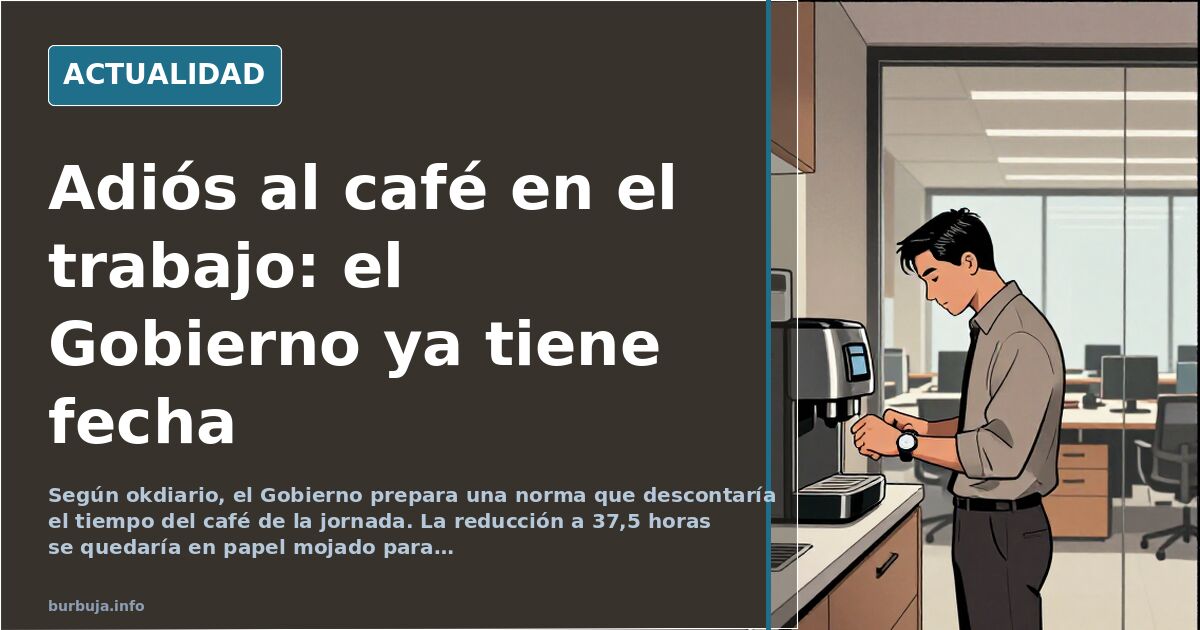
Spain's government plans to deduct coffee breaks from work hours
A worker clocks in at 8 a.m., steps away for a mid-morning coffee, and returns to their desk. That fifteen or twenty-minute gap, previously unaccounted for, is now under scrutiny by upcoming labor regulations being prepared by the Executive, according to okdiario. The measure, mocked in digital forums, targets time-tracking systems that would deduct break times from effective working hours. The headline summarizing general anger: goodbye to having coffee during your workday.
What the rule says and who it affects
According to published reports, the text would require breakfast breaks within working hours to be counted as non-working time. The workweek is reduced to 37.5 hours, but coffee breaks are deducted. For those doing the math, the result is that workers with older contracts work the same amount and earn the same: the reduction is eaten up by the snack. For new hires, the trap is subtler: they sign for 37.5 hours but are required to fulfill the same duties as before.
Some argue the real impact depends on the company. "This all depends on how ruthless the company is," summarizes one of the most cited voices in the debate, which fundamentally describes an application problem rather than a legal text issue. Other interventions point out that digital time tracking already exists and the novelty lies in how strictly it will be applied. The lingering question: do you also clock out to use the bathroom?
The judicial precedent nobody wants to remember
The juiciest anecdote of the matter isn't in the official gazette (BOE), but in the courts. A case discussed in the debate recounts how a part-time employee—working four hours daily—was absent for thirty minutes or more to have coffee. The company fired her. The judge ruled the dismissal unfair because, although regulations reserve mandatory breaks for uninterrupted shifts over six hours, the employee had consolidated an acquired right by being allowed this for a long time. Translation: if your boss lets you have coffee for years, that coffee becomes a right. The new rule, if passed, cuts this avenue short.
Civil servants, unions, and the boomerang effect
The public sector appears in all predictions. Some calculate that the reduction to 37.5 hours was already applied to civil servants and that deducting coffee time puts them back at 40. The suspicion that the measure is a disguised adjustment of public spending has traction. Unions, meanwhile, face criticism from multiple angles: they are accused of accepting the cut without protest, just as they were reproached for their role in dismantling remote work.
The hospitality industry, historically a major beneficiary of office coffee culture, has remained silent. Those who work twelve hours in front of a screen recall that their legal break hour is split between breakfast and lunch, and that there are days when lunch never arrives.
The calculation that disorients
If we count, fifteen minutes of daily coffee over twenty working days equals five hours a month. Annually, sixty. A week and a half of work given away for free. The complete breakdown gives a figure that surprises first-time calculators. The question is whether corporate savings compensate for the cost of monitoring every minute. Experience says no: sophisticated time-tracking systems have not increased productivity anywhere they have been implemented.
The closing data point disorients: in Spain, the average duration of coffee breaks has never been officially measured. The first rule to do so will also have to decide if smokers have the same rights as coffee drinkers.
A worker clocks in at 8 a.m., steps away for a mid-morning coffee, and returns to their desk. That fifteen or twenty-minute gap, previously unaccounted for, is now under scrutiny by upcoming labor regulations being prepared by the Executive, according to okdiario. The measure, mocked in digital forums, targets time-tracking systems that would deduct break times from effective working hours. The headline summarizing general anger: goodbye to having coffee during your workday.
What the rule says and who it affects
According to published reports, the text would require breakfast breaks within working hours to be counted as non-working time. The workweek is reduced to 37.5 hours, but coffee breaks are deducted. For those doing the math, the result is that workers with older contracts work the same amount and earn the same: the reduction is eaten up by the snack. For new hires, the trap is subtler: they sign for 37.5 hours but are required to fulfill the same duties as before.
Some argue the real impact depends on the company. "This all depends on how ruthless the company is," summarizes one of the most cited voices in the debate, which fundamentally describes an application problem rather than a legal text issue. Other interventions point out that digital time tracking already exists and the novelty lies in how strictly it will be applied. The lingering question: do you also clock out to use the bathroom?
The judicial precedent nobody wants to remember
The juiciest anecdote of the matter isn't in the official gazette (BOE), but in the courts. A case discussed in the debate recounts how a part-time employee—working four hours daily—was absent for thirty minutes or more to have coffee. The company fired her. The judge ruled the dismissal unfair because, although regulations reserve mandatory breaks for uninterrupted shifts over six hours, the employee had consolidated an acquired right by being allowed this for a long time. Translation: if your boss lets you have coffee for years, that coffee becomes a right. The new rule, if passed, cuts this avenue short.
Civil servants, unions, and the boomerang effect
The public sector appears in all predictions. Some calculate that the reduction to 37.5 hours was already applied to civil servants and that deducting coffee time puts them back at 40. The suspicion that the measure is a disguised adjustment of public spending has traction. Unions, meanwhile, face criticism from multiple angles: they are accused of accepting the cut without protest, just as they were reproached for their role in dismantling remote work.
The hospitality industry, historically a major beneficiary of office coffee culture, has remained silent. Those who work twelve hours in front of a screen recall that their legal break hour is split between breakfast and lunch, and that there are days when lunch never arrives.
The calculation that disorients
If we count, fifteen minutes of daily coffee over twenty working days equals five hours a month. Annually, sixty. A week and a half of work given away for free. The complete breakdown gives a figure that surprises first-time calculators. The question is whether corporate savings compensate for the cost of monitoring every minute. Experience says no: sophisticated time-tracking systems have not increased productivity anywhere they have been implemented.
The closing data point disorients: in Spain, the average duration of coffee breaks has never been officially measured. The first rule to do so will also have to decide if smokers have the same rights as coffee drinkers.
Also available in: Deutsch
Summary of a discussion on Burbuja.info - Foro de economía, actualidad y política., translated from Spanish and reviewed before publication. Read the full discussion (126 replies).
More summaries
-
Yolanda Díaz's Decline: From Political Narrative to Reality
Yolanda Díaz's influence wanes amid labor reform failure and record fiscal pressure. Is her political relevance ending?
-
Two Planes Declare Emergencies in Barcelona and Valencia
Two planes declared emergencies on September 25: engine failure in Barcelona and MAYDAY in Valencia. GPS failure also reported in Alicante.
-
22-year-old worker dies in industrial laundry accident in Spain
A young woman died trapped in a roller ironer at an Elis facility in Yeles. Safety failures and prevention outsourcing are under scrutiny.
-
Forum poll shows Vox at 45.1% after sample expansion
A forum vote tally places Vox at 45.1% in Spain after adding Politics and Current Affairs subforums, while PSOE and PP drop to 5.4%.
-
Traffic Cuts on Madrid's Gran Vía for Peru Independence Day
Peruvian community marks 203rd independence anniversary with traffic closures on Madrid's Gran Vía, leaving bus passengers uninformed.
-
Spain: Diesel pumped into petrol car sparks debate
A video of two women filling a petrol car with diesel in Spain fuels discussion on mechanical literacy and the fear of intervening.