
Spain's Golden Age Fridges: Seafood vs. a Yogurt
A fridge full of seafood or just yogurt and bread? A look at the real living standards in Spain's 'Golden Age'.
English · Original discussion in Spanish · Published
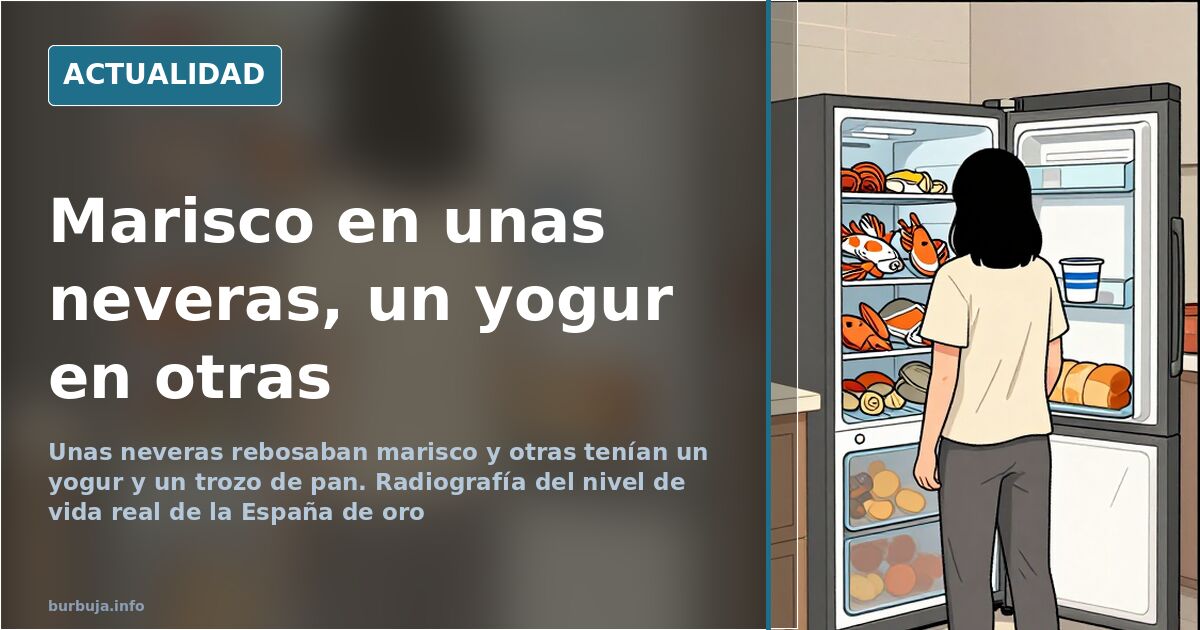
What was really in the fridges of Spain's Golden Age
A yogurt and a piece of bread. That was all. 'I had never seen such an empty fridge in my life,' says someone who peine one and never forgot it. The scene clashes head-on with the image circulating these days: a fridge from Spain's Golden Age ‘well-stocked’ with meat, fresh fish, seafood, vegetables, and fruit, no cheap processed foods, and not a free space. It's shared with a smirk and a home-grown instruction: forward to your brother-in-law.
Between those two fridges lies a country. And not just one. What began as a joke about the abundance of the late Franco regime has turned into a bitter argument about how many people truly ate, how many emigrated to be able to do so, and what remains of that in today's shopping basket.
The Half-Empty Fridges That Didn't Make the Photos
The most repeated rebuttal comes from family memory. One current holds that the full fridge belonged to the winners and a lucky few, not the entire country. The rest lived with much less: there was emigration to be able to eat, and cities had shantytowns that the statistics of the time didn't capture.
The narrative is not folklore. Some claim that children picked up banana peels from the ground and ate them, and speak of a poverty that wasn't visible from the street. ‘There’s a lot of hidden poverty out there; if we peine people’s fridges, we’d be amazed’. This applies equally to 1970 as it does to today.
Against this, another part defends the opposite: factory workers who didn't suffer that misery and who supported a household with a functioning fridge on their wages. Both things can be true in the same decade and in the same country. The Spain of that time was not a homogeneous block; it was a puzzle of incomes.
Why Bananas and Tomatoes Didn't Go in the Fridge
One of the details that grates the most is the list. Bananas, lemons, and tomatoes in the refrigerator. It's not a quirk: it's an anachronism. Domestic refrigerators of the time were small, with narrow doors and little cooling capacity. Fruit and vegetables were kept outside, in a pantry, a box, or on the table. Putting canned goods inside was simply a waste of space.
Hence the next detail. The shopping cart of the time was three times larger than what you see today in any supermarket. Not because of abundance, but due to logistics: no large retailers, no cars, and shopping split between the market, bakery, and grocery store. Milk was bought fresh, in bulk, or condensed. No one carried twelve liters in a carton.
The argument points to something more uncomfortable than nostalgia. A large cart doesn't miccionan a full pantry; it means more trips, more hands, and more time. The small fridge and the large cart are the same picture.
From Seafood to Income Tax: How the Topic Shifted
From the fridge, the conversation moved to the system, and the smiles faded. One current argues that that growth was built on labor and that the country was devastated first by war and then by the post-war period, with five armies—later corrected to four—passing over it. Another responds that the misery was not a meteorological accident and that the regime washed its image with foreign aid.
Then came the taxes. It is claimed that under Aznar, VAT was 16% and capital gains were taxed at 18% with abatement coefficients, compared to the current 29% and without that relief. The most favorable calculation suggests that Aznar collected 5.2 percentage points more of GDP than Rajoy by lowering taxes. Conversely, it is argued that a salary of 60,000 euros in Catalonia reached a 52% income tax rate.
Here, figures are thrown around without anyone showing a complete payslip, and the tax cross-referencing handled—rate by rate, year by year—allows for a full comparison that doesn't fit in four lines. What is clear is that the fridge stopped being the topic a while ago.
Paid-off House vs. Sharing a Room
The leap to housing was inevitable. It is argued that back then, a house was paid off with a salary, and now one needs to share a flat to make ends meet, and that some people don't even have space for a fridge because they can't rent or buy. On the other side, the response is with today's shopping list: a food price increase of over 50%, soaring prices, and a sense of regression that everyone measures on their own bill.
It's worth separating. Part of what is being exchanged are prices and data; another part is pure political temperature. Mixed together, they produce statements that sound like judgments and don't hold up to a bank statement.
Champagne, Cava, and a Siphon Bottle
And in the midst of it all, the anecdote. Codorniu, which could be called champagne in its day and today settles for cava, as recalled regarding the shopping list. A name, a designation of origin, and a commercial fight that quite well summarizes what is being talked about when discussing Spain's Golden Age: not food, but who could call things by their name.
A siphon bottle also appeared, a classic from the last century, and a Westinghouse ice refrigerator, round, with a crank, which coexisted with the Edesa that lasted from 1990 to 2025. Appliances that last for decades: there's another comparison that almost no one makes.
The Conclusion
The discussion died down without conclusion, as they all do. Some stated that their fridge today holds up worse than their grandparents'; others, that fridges have become more of a political object. What is verifiable is the usual: a photo of a full fridge tells nothing about the country around it, neither then nor now. And a fridge with a yogurt and a piece of bread is still a possible photo in 2025.
A yogurt and a piece of bread. That was all. 'I had never seen such an empty fridge in my life,' says someone who peine one and never forgot it. The scene clashes head-on with the image circulating these days: a fridge from Spain's Golden Age ‘well-stocked’ with meat, fresh fish, seafood, vegetables, and fruit, no cheap processed foods, and not a free space. It's shared with a smirk and a home-grown instruction: forward to your brother-in-law.
Between those two fridges lies a country. And not just one. What began as a joke about the abundance of the late Franco regime has turned into a bitter argument about how many people truly ate, how many emigrated to be able to do so, and what remains of that in today's shopping basket.
The Half-Empty Fridges That Didn't Make the Photos
The most repeated rebuttal comes from family memory. One current holds that the full fridge belonged to the winners and a lucky few, not the entire country. The rest lived with much less: there was emigration to be able to eat, and cities had shantytowns that the statistics of the time didn't capture.
The narrative is not folklore. Some claim that children picked up banana peels from the ground and ate them, and speak of a poverty that wasn't visible from the street. ‘There’s a lot of hidden poverty out there; if we peine people’s fridges, we’d be amazed’. This applies equally to 1970 as it does to today.
Against this, another part defends the opposite: factory workers who didn't suffer that misery and who supported a household with a functioning fridge on their wages. Both things can be true in the same decade and in the same country. The Spain of that time was not a homogeneous block; it was a puzzle of incomes.
Why Bananas and Tomatoes Didn't Go in the Fridge
One of the details that grates the most is the list. Bananas, lemons, and tomatoes in the refrigerator. It's not a quirk: it's an anachronism. Domestic refrigerators of the time were small, with narrow doors and little cooling capacity. Fruit and vegetables were kept outside, in a pantry, a box, or on the table. Putting canned goods inside was simply a waste of space.
Hence the next detail. The shopping cart of the time was three times larger than what you see today in any supermarket. Not because of abundance, but due to logistics: no large retailers, no cars, and shopping split between the market, bakery, and grocery store. Milk was bought fresh, in bulk, or condensed. No one carried twelve liters in a carton.
The argument points to something more uncomfortable than nostalgia. A large cart doesn't miccionan a full pantry; it means more trips, more hands, and more time. The small fridge and the large cart are the same picture.
From Seafood to Income Tax: How the Topic Shifted
From the fridge, the conversation moved to the system, and the smiles faded. One current argues that that growth was built on labor and that the country was devastated first by war and then by the post-war period, with five armies—later corrected to four—passing over it. Another responds that the misery was not a meteorological accident and that the regime washed its image with foreign aid.
Then came the taxes. It is claimed that under Aznar, VAT was 16% and capital gains were taxed at 18% with abatement coefficients, compared to the current 29% and without that relief. The most favorable calculation suggests that Aznar collected 5.2 percentage points more of GDP than Rajoy by lowering taxes. Conversely, it is argued that a salary of 60,000 euros in Catalonia reached a 52% income tax rate.
Here, figures are thrown around without anyone showing a complete payslip, and the tax cross-referencing handled—rate by rate, year by year—allows for a full comparison that doesn't fit in four lines. What is clear is that the fridge stopped being the topic a while ago.
Paid-off House vs. Sharing a Room
The leap to housing was inevitable. It is argued that back then, a house was paid off with a salary, and now one needs to share a flat to make ends meet, and that some people don't even have space for a fridge because they can't rent or buy. On the other side, the response is with today's shopping list: a food price increase of over 50%, soaring prices, and a sense of regression that everyone measures on their own bill.
It's worth separating. Part of what is being exchanged are prices and data; another part is pure political temperature. Mixed together, they produce statements that sound like judgments and don't hold up to a bank statement.
Champagne, Cava, and a Siphon Bottle
And in the midst of it all, the anecdote. Codorniu, which could be called champagne in its day and today settles for cava, as recalled regarding the shopping list. A name, a designation of origin, and a commercial fight that quite well summarizes what is being talked about when discussing Spain's Golden Age: not food, but who could call things by their name.
A siphon bottle also appeared, a classic from the last century, and a Westinghouse ice refrigerator, round, with a crank, which coexisted with the Edesa that lasted from 1990 to 2025. Appliances that last for decades: there's another comparison that almost no one makes.
The Conclusion
The discussion died down without conclusion, as they all do. Some stated that their fridge today holds up worse than their grandparents'; others, that fridges have become more of a political object. What is verifiable is the usual: a photo of a full fridge tells nothing about the country around it, neither then nor now. And a fridge with a yogurt and a piece of bread is still a possible photo in 2025.
Summary of a discussion on Burbuja.info - Foro de economía, actualidad y política., translated from Spanish and reviewed before publication. Read the full discussion (311 replies).
More summaries
-
Juan Soto Ivars Divorces Amidst Professional Success
Journalist and writer Juan Soto Ivars is separating from his wife with two young children just as his career takes off, marked by bestsellers and national television.
-
Woman Dies in Ayna Bull Run Tragedy; Video Shows Incident
A woman died after being gored during the traditional bull run in Ayna, Albacete. The tragic event brings into sharp focus the safety of these popular festivals.
-
Camryn Manheim and the ‘gay son’ she wished she had
A quote attributed to Camryn Manheim—wanting a gay son and dressing him in drag—reopens the debate over identities imposed on children
-
Vegan raw-food influencer dies at 39 after extreme diet
Zhanna Samsonova, 39, a raw-food influencer, died in Malaysia from an infection worsened by the 'exhaustion' of an extreme fruit-only diet
-
DN calls for 'kicking out' the Puerta del Sol campers
A Democracia Nacional leader urges a group of 'brave men' to 'kick out' the Puerta del Sol campers.
-
Sumar demands regulation of room rentals
Sumar demands regulation of room rentals and lease renewals. An investor warns that property maths no longer add up.