
Record Tax Hike: Middle Class Pays Half of Income Tax
Analysis shows 8 million middle-income earners pay half of Spain's 50 billion euro income tax, following the largest fiscal pressure increase in the EU.
English · Original discussion in Spanish · Published
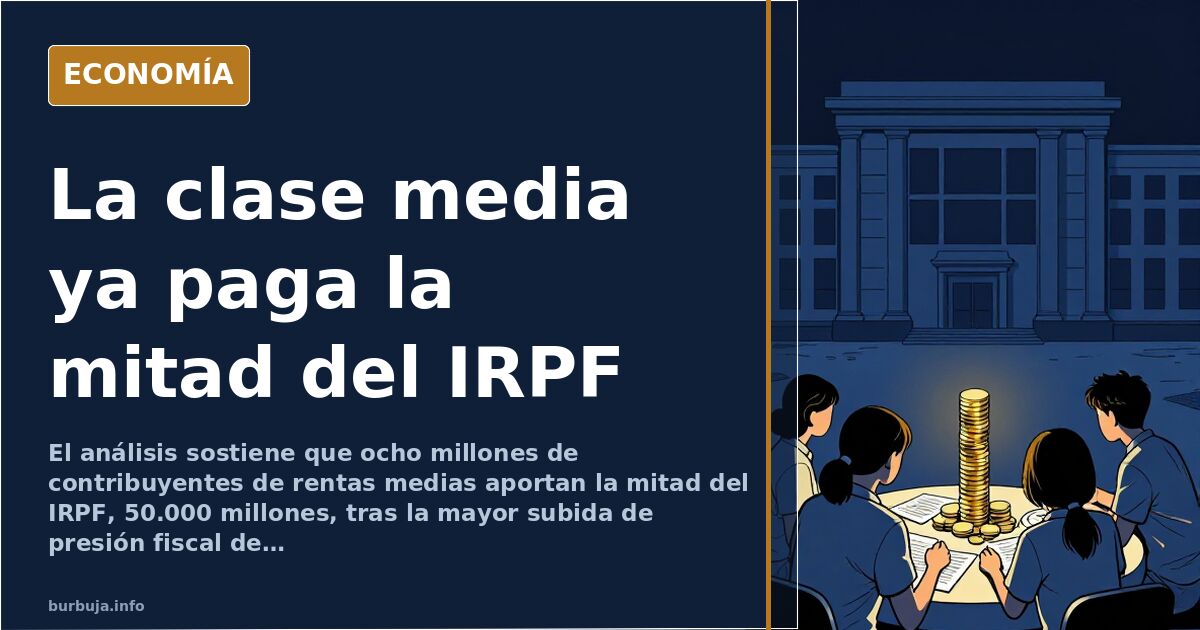
The record tax hike suffocating the middle class
How much must one earn in Spain for the tax authority to stop treating you as middle class and start treating you as rich? The fiscal analysis range is uncomfortable: from 21,000 to 60,000 euros, workers already bear the largest increase in fiscal pressure in the entire European Union, according to that analysis. It is not a bar counter impression. Eight million taxpayers in this bracket pay half of the total income tax revenue, approximately 50 billion euros. The government wants to raise revenue by 12% in 2024, and the burden falls, according to the figures managed by the analysis, on middle incomes rather than high ones.
How much does the middle class pay in taxes?
Eight million taxpayers with incomes between 21,000 and 60,000 euros contribute half of the total income tax revenue: 50 billion. On this group, 69 tax increases have accumulated since 2019, according to the count accompanying the analysis. The official argument is that those with more resources must contribute more to sustaining the welfare state. The debate starts elsewhere: where the boundary of 'those with more' is placed. A salary of 21,000 euros is not wealth in almost any province, and for a family with a mortgage and children, it is a fair income, the analysis maintains. This is the paradox running through the entire matter: the bracket called to sustain the system ends up being the one that finances it.
Why income tax rises without rate increases
According to the diagnosis repeated in the debate, the income tax rate has not been updated with inflation. There lies the mechanism pointed out by several participants. A worker whose salary increases just enough to compensate for inflation moves up a bracket and pays a higher percentage, even though their purchasing power has not improved. The tax is the same; what moves is income. It is, according to those who raise it, a hidden increase that appears in no advertisement and leaves the employee with less money in real terms. The cases circulating are eloquent: one forum member says they received a 240 euro gross monthly increase, but after moving brackets, they received less than 100 net; another notes that the Tax Agency refunded 70 euros after a full year of withholdings. Those who do not understand the mechanics believe their taxes have been lowered because they get a refund.
The solidarity contribution arriving from 2025
The pension reform adds another layer to the structure. From 2025, salaries exceeding the maximum contribution base will bear an additional contribution—the so-called surcharge or solidarity contribution—which grows as salary increases, with the maximum rate reaching 7% according to the calculation managed by a participant. The Executive presents it as a mechanism of contributive justice. The uncomfortable detail is who it reaches: also workers around 54,000 euros, a figure that with family burdens is hardly a fortune. Meanwhile, according to a participant, the maximum contribution base has risen above the maximum pension, meaning a high salary contributes monthly more than it can receive later. Fedea has warned that the EU should reject the pension reform even if it delays the delivery of committed funds.
How much does the state take from a high salary?
The calculations made by those detailing their payslip in the debate leave no room for optimism. According to one participant's calculations, a gross salary of 70,000 euros leaves 47,000 net: less than 4,000 euros per month in twelve payments. Another contributor with higher income claims to have paid 49,384 euros just in income tax and around 60,000 including Social Security and VAT, before wealth tax, tolls, and private health insurance. Another forum member's estimate sums all taxes, special levies, and fees, concluding that the state takes nearly 66% of generated income; the same source calculates that one works for the state about 266 days a year. VAT helps understand the trend, always according to what is exposed in the thread: it was born in 1986 with three rates—12% general and 33% increased—replacing the old ITE, and today it ranges between 4% and 21%. Some already propose a single rate of 25%. In fiscal competitiveness, Spain ranks 31st out of 38 countries analyzed, in the opposite direction to the European trend of tax relief after the pandemic and the war in Ukraine.
The fine breakdown of that burden—withholdings, employer contributions, and indirect taxes one by one—is what some participants use to support their figures, which others do not accept.
MPs' salaries rise by 2.5%
While the burden on middle incomes is debated, Congress plans to raise its own salary by 2.5%: 3,220 euros per month, apart from allowances. The coincidence proves nothing by itself, but it fuels the feeling that the adjustment is always paid by the same side of the table.
Revenue can be increased, the welfare state can be defended, and the income tax rate can be deflated to avoid punishing those who have only covered inflation. What cannot be done is call rich those who sustain half the tax and expect them to applaud. And that concludes the analysis. The rest is told by each month's payslip.
How much must one earn in Spain for the tax authority to stop treating you as middle class and start treating you as rich? The fiscal analysis range is uncomfortable: from 21,000 to 60,000 euros, workers already bear the largest increase in fiscal pressure in the entire European Union, according to that analysis. It is not a bar counter impression. Eight million taxpayers in this bracket pay half of the total income tax revenue, approximately 50 billion euros. The government wants to raise revenue by 12% in 2024, and the burden falls, according to the figures managed by the analysis, on middle incomes rather than high ones.
How much does the middle class pay in taxes?
Eight million taxpayers with incomes between 21,000 and 60,000 euros contribute half of the total income tax revenue: 50 billion. On this group, 69 tax increases have accumulated since 2019, according to the count accompanying the analysis. The official argument is that those with more resources must contribute more to sustaining the welfare state. The debate starts elsewhere: where the boundary of 'those with more' is placed. A salary of 21,000 euros is not wealth in almost any province, and for a family with a mortgage and children, it is a fair income, the analysis maintains. This is the paradox running through the entire matter: the bracket called to sustain the system ends up being the one that finances it.
Why income tax rises without rate increases
According to the diagnosis repeated in the debate, the income tax rate has not been updated with inflation. There lies the mechanism pointed out by several participants. A worker whose salary increases just enough to compensate for inflation moves up a bracket and pays a higher percentage, even though their purchasing power has not improved. The tax is the same; what moves is income. It is, according to those who raise it, a hidden increase that appears in no advertisement and leaves the employee with less money in real terms. The cases circulating are eloquent: one forum member says they received a 240 euro gross monthly increase, but after moving brackets, they received less than 100 net; another notes that the Tax Agency refunded 70 euros after a full year of withholdings. Those who do not understand the mechanics believe their taxes have been lowered because they get a refund.
The solidarity contribution arriving from 2025
The pension reform adds another layer to the structure. From 2025, salaries exceeding the maximum contribution base will bear an additional contribution—the so-called surcharge or solidarity contribution—which grows as salary increases, with the maximum rate reaching 7% according to the calculation managed by a participant. The Executive presents it as a mechanism of contributive justice. The uncomfortable detail is who it reaches: also workers around 54,000 euros, a figure that with family burdens is hardly a fortune. Meanwhile, according to a participant, the maximum contribution base has risen above the maximum pension, meaning a high salary contributes monthly more than it can receive later. Fedea has warned that the EU should reject the pension reform even if it delays the delivery of committed funds.
How much does the state take from a high salary?
The calculations made by those detailing their payslip in the debate leave no room for optimism. According to one participant's calculations, a gross salary of 70,000 euros leaves 47,000 net: less than 4,000 euros per month in twelve payments. Another contributor with higher income claims to have paid 49,384 euros just in income tax and around 60,000 including Social Security and VAT, before wealth tax, tolls, and private health insurance. Another forum member's estimate sums all taxes, special levies, and fees, concluding that the state takes nearly 66% of generated income; the same source calculates that one works for the state about 266 days a year. VAT helps understand the trend, always according to what is exposed in the thread: it was born in 1986 with three rates—12% general and 33% increased—replacing the old ITE, and today it ranges between 4% and 21%. Some already propose a single rate of 25%. In fiscal competitiveness, Spain ranks 31st out of 38 countries analyzed, in the opposite direction to the European trend of tax relief after the pandemic and the war in Ukraine.
The fine breakdown of that burden—withholdings, employer contributions, and indirect taxes one by one—is what some participants use to support their figures, which others do not accept.
MPs' salaries rise by 2.5%
While the burden on middle incomes is debated, Congress plans to raise its own salary by 2.5%: 3,220 euros per month, apart from allowances. The coincidence proves nothing by itself, but it fuels the feeling that the adjustment is always paid by the same side of the table.
Revenue can be increased, the welfare state can be defended, and the income tax rate can be deflated to avoid punishing those who have only covered inflation. What cannot be done is call rich those who sustain half the tax and expect them to applaud. And that concludes the analysis. The rest is told by each month's payslip.
Summary of a discussion on Burbuja.info - Foro de economía, actualidad y política., translated from Spanish and reviewed before publication. Read the full discussion (236 replies).
More summaries
-
EU Wine Labeling: Health Concerns vs. Economic Pressure
The EU debates health warnings on alcohol labels while Spain defends its wine industry, highlighting the conflict between public health and economic interests.
-
Madarcos: 52 voters and 58 new electors under Spain's grandchildren law
Madarcos: 52 voters and 58 new electors under the grandchildren law. The case is in court with interim measures, no final ruling.
-
Study linking mRNA vaccines to 'turbo-cancers' faces scrutiny
A Marik and Hope study links mRNA vaccines to aggressive cancers, demanding independent review. Critics note no proven causality.
-
Torrevieja video sparks debate on police and immigration
A viral video in Torrevieja, Spain, fuels controversy over police authority, immigration, and public safety.
-
Spain mandates backyard chicken registration, blocks dewormer sales
Spanish rural creators face barriers buying poultry dewormers as self-consumption registration costs €15-22 and requires a designated veterinarian.
-
Spain's new rental law protects tenants, strains market
New Spanish housing rules let tenants stay despite non-renewal. Landlords warn of shrinking supply and rising prices.