
Spain's Forgotten Goddesses: The Video Reigniting Debate on Women's Role
A video from Clave Geopolítica explores women's roles in pre-Roman Iberia, sparking debate between historical vindication and mythological elevation.
English · Original discussion in Spanish · Published
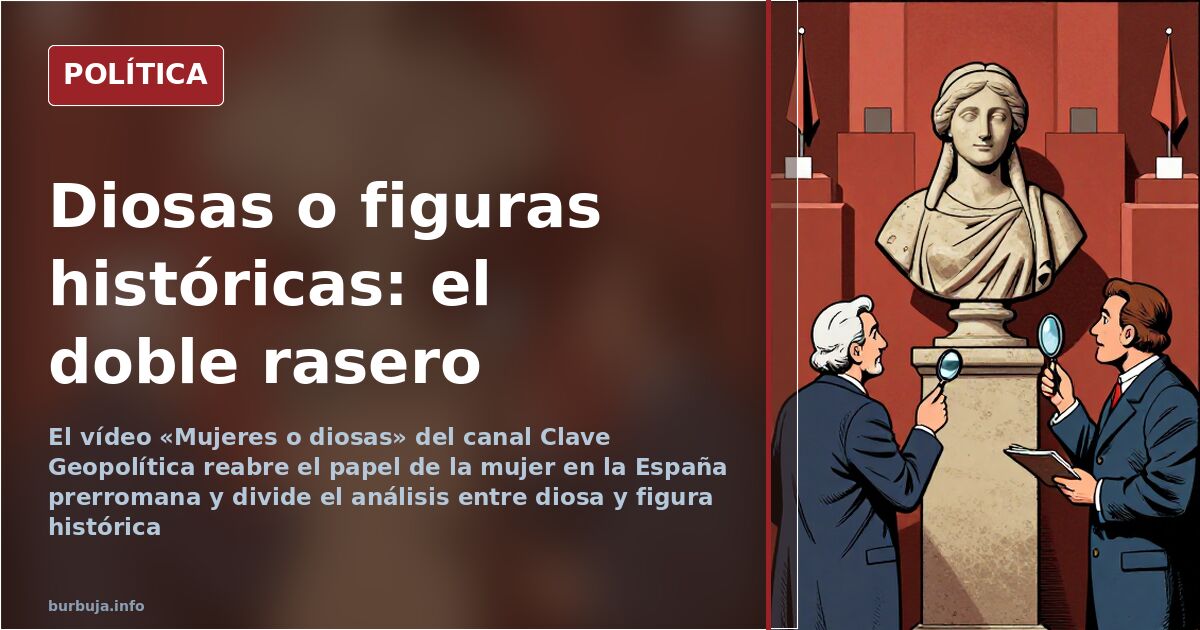
Spain's Forgotten Goddesses: The Story That Leads to the Pantheon
Spain's forgotten goddesses don't emerge from an archaeological site; they emerge from a headline. The video "Mujeres o diosas" (Women or Goddesses), from the Clave Geopolítica channel and presented by Francisco José Fernández Cruz Sequera, proposes a reinterpretation of women's roles in ancient Iberian societies. The discussion it has sparked is divided: historical vindication for some, a cardboard pantheon for others.
The most frequent criticism targets the label, not the substance. If past heroes are historical figures, why must equivalent women be goddesses? Elevation is not integration, especially when the result is removing women from 'normal' history to place them in mythology. The irony is subtle: the gesture meant to honor them returns them to the altar from which they were supposedly descended.
What the Video Proposes About Women in Pre-Roman Spain
In its milder version, the thesis is that ancient Iberian societies gave women a central role—religious, economic, and in knowledge transmission—which later narratives have obscured. The video draws on classical sources and references to matriarchal-type beliefs, leading to the uncomfortable part: mixing history with a diagnosis of the present.
The title itself functions as a wordplay, and there lies the crux. Studying craftswomen who signed prestigious jewelry and ceramics is not the same as crowning a myth. A methodological slip is also pointed out: attributing these objects to women without clarifying who made them. A small detail, huge ammunition on such a charged topic.
The Double Standard Criticism: Goddesses Yes, But Not Our Own
One of the harshest attacks claims that the channel's enthusiasm for women doesn't match how men from the same sphere are treated. It's described as sycophancy that repels many and, paradoxically, doesn't elevate: it places women on a separate, almost decorative, plane.
The observation has substance. A single criterion for everyone—whether respect or stature—is what's missing; any other treatment, even if born of admiration, ends up sounding like an exception. And an exception, by definition, confirms the norm one sought to break.
The Nordic Turn: Celts, Blondes, and Propaganda
The most severe criticism points to a fundamental bias. Some argue that the channel's discourse flirts with the myth of the master race and a fascination with the Germanic and Nordic that translates into disdain for Spain. It is specifically accused of internalizing the framework of Nancy ideologue Alfred Rosenberg—theorist of the master race in the Third Reich—and presenting it as objective evidence compilation.
Other voices see this accusation as an easy way to disqualify without discussing the data, reminding that claiming to have read extensively doesn't equate to the readings being true. Hence, part of the exchange devolved entirely into hair and eye tonalidad, a territory where analysis gets lost. The doubt always remains whether the past or the mirror is being discussed.
The Matriarchal Hypothesis and Method: From Castra to Artificial Intelligence
A more charitable reading suggests the video isn't discussing literal goddesses but belief structures predating Christian universalism, interpreted from a Spenglerian perspective with classical sources as a foundation. Under this lens, matriarchy wouldn't be dogma but a working hypothesis to be separated from the noise.
Amidst the crossfire, two more fruitful contributions appear. One, etymology: castrense comes from the Latin castra, military camp; in the singular, castrum denotes a fortification, and for pre-Roman peoples, the enclosure served as both settlement and defense. Another, the method: someone requested the video transcript, pasted it into a text file, and fed it to the Grok 4 model for a structured summary, highlighting its strengths and weaknesses.
"Of Our Blood": The Language That Sets the Framework
The subject's title—women "of our blood"—already frames the conversation with an identity-based perspective. They are not the women of the peninsula; they are 'ours,' and what's being decided is not just the past but who inherits its legitimacy. Here, the discussion ceases to be historical and enters fully into politics, which is precisely where nuance is lost and all sides simplify.
With this clash of labels, it's predictable that the channel will revisit ancient women and reactivate the same division. Although predicting how it will be read is risky: if anything, the controversy makes clear that the problem wasn't the goddess, but who decides each person's place.
Spain's forgotten goddesses don't emerge from an archaeological site; they emerge from a headline. The video "Mujeres o diosas" (Women or Goddesses), from the Clave Geopolítica channel and presented by Francisco José Fernández Cruz Sequera, proposes a reinterpretation of women's roles in ancient Iberian societies. The discussion it has sparked is divided: historical vindication for some, a cardboard pantheon for others.
The most frequent criticism targets the label, not the substance. If past heroes are historical figures, why must equivalent women be goddesses? Elevation is not integration, especially when the result is removing women from 'normal' history to place them in mythology. The irony is subtle: the gesture meant to honor them returns them to the altar from which they were supposedly descended.
What the Video Proposes About Women in Pre-Roman Spain
In its milder version, the thesis is that ancient Iberian societies gave women a central role—religious, economic, and in knowledge transmission—which later narratives have obscured. The video draws on classical sources and references to matriarchal-type beliefs, leading to the uncomfortable part: mixing history with a diagnosis of the present.
The title itself functions as a wordplay, and there lies the crux. Studying craftswomen who signed prestigious jewelry and ceramics is not the same as crowning a myth. A methodological slip is also pointed out: attributing these objects to women without clarifying who made them. A small detail, huge ammunition on such a charged topic.
The Double Standard Criticism: Goddesses Yes, But Not Our Own
One of the harshest attacks claims that the channel's enthusiasm for women doesn't match how men from the same sphere are treated. It's described as sycophancy that repels many and, paradoxically, doesn't elevate: it places women on a separate, almost decorative, plane.
The observation has substance. A single criterion for everyone—whether respect or stature—is what's missing; any other treatment, even if born of admiration, ends up sounding like an exception. And an exception, by definition, confirms the norm one sought to break.
The Nordic Turn: Celts, Blondes, and Propaganda
The most severe criticism points to a fundamental bias. Some argue that the channel's discourse flirts with the myth of the master race and a fascination with the Germanic and Nordic that translates into disdain for Spain. It is specifically accused of internalizing the framework of Nancy ideologue Alfred Rosenberg—theorist of the master race in the Third Reich—and presenting it as objective evidence compilation.
Other voices see this accusation as an easy way to disqualify without discussing the data, reminding that claiming to have read extensively doesn't equate to the readings being true. Hence, part of the exchange devolved entirely into hair and eye tonalidad, a territory where analysis gets lost. The doubt always remains whether the past or the mirror is being discussed.
The Matriarchal Hypothesis and Method: From Castra to Artificial Intelligence
A more charitable reading suggests the video isn't discussing literal goddesses but belief structures predating Christian universalism, interpreted from a Spenglerian perspective with classical sources as a foundation. Under this lens, matriarchy wouldn't be dogma but a working hypothesis to be separated from the noise.
Amidst the crossfire, two more fruitful contributions appear. One, etymology: castrense comes from the Latin castra, military camp; in the singular, castrum denotes a fortification, and for pre-Roman peoples, the enclosure served as both settlement and defense. Another, the method: someone requested the video transcript, pasted it into a text file, and fed it to the Grok 4 model for a structured summary, highlighting its strengths and weaknesses.
"Of Our Blood": The Language That Sets the Framework
The subject's title—women "of our blood"—already frames the conversation with an identity-based perspective. They are not the women of the peninsula; they are 'ours,' and what's being decided is not just the past but who inherits its legitimacy. Here, the discussion ceases to be historical and enters fully into politics, which is precisely where nuance is lost and all sides simplify.
With this clash of labels, it's predictable that the channel will revisit ancient women and reactivate the same division. Although predicting how it will be read is risky: if anything, the controversy makes clear that the problem wasn't the goddess, but who decides each person's place.
Summary of a discussion on Burbuja.info - Foro de economía, actualidad y política., translated from Spanish and reviewed before publication. Read the full discussion (367 replies).
More summaries
-
Sequera: The Analyst Dividing His Followers
Analyst Sequera challenges the narrative of Spain: Spengler, Hispanicity, conquest, and contemporary decline.
-
Franco on TVE, 1964: Empty Rhetoric and the Price of Ending Isolation
Franco's 1964 TVE interview: debated as empty speech or noble values. That year, the international blockade was lifted, but its cost remains undisclosed.
-
Sánchez's 'Deep State' Accusations: Hitmen Against Judges and Dead Voters
Accusations against the Spanish government involving 'hitmen' targeting judges and election manipulation with votes from deceased individuals, including the alleged harassment of Judge Beatriz Biedma.
-
What is Sánchez calling the 'Deep State'? (Francisco Rosell in El Debate)
The Spanish President, **Pedro Sánchez**, is accused of using the term "Deep State" to discredit those who challenge him. We analyze the concept and its application.
-
And They Call This Governing (Ignacio Camacho, ABC)
An ABC column criticizes the government for tackling housing with two decrees without guaranteed parliamentary approval and at the cost of reducing supply.
-
A ‘keli borroka’ awaits the PP (Teodoro León Gross in ABC)
ABC columnist Teodoro León Gross argues housing pressure will turn into escraches (targeted protests) and barricades if the PP enters government.