
Spain's food security debate: lack of planning or financial strain?
The debate over whether empty pantries in Spain stem from negligence or economic constraints, with housing and logistics as key obstacles.
English · Original discussion in Spanish · Published
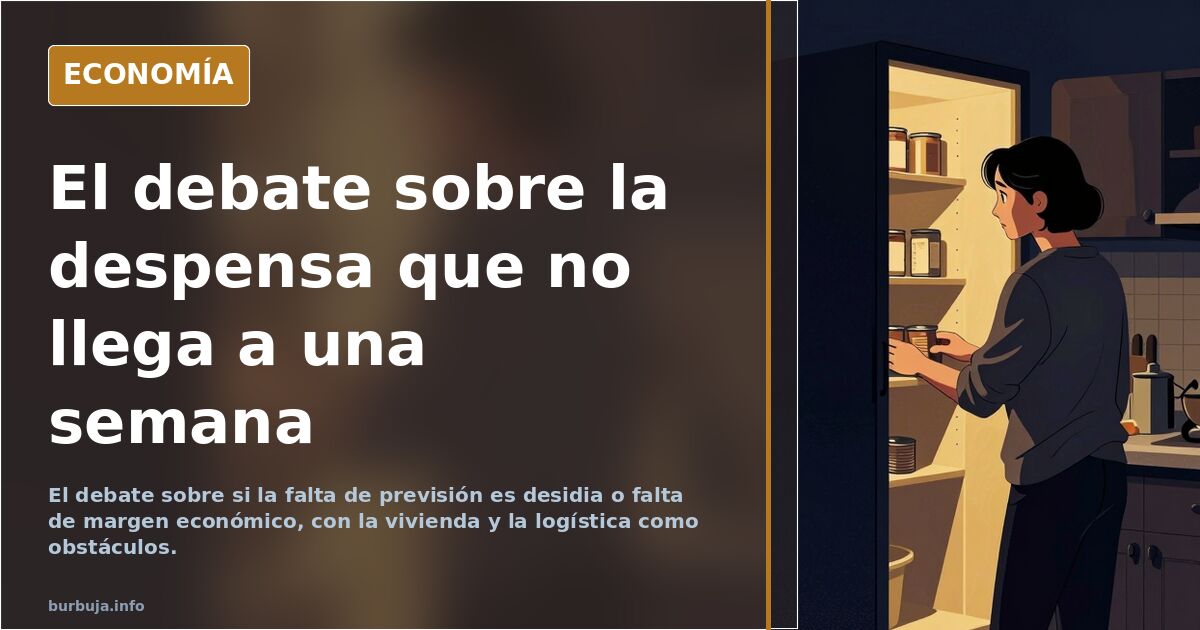
The pantry that doesn't last a week: the debate on preparedness
When floodwaters destroy a ground floor and cut off power, the refrigerator becomes a problem rather than a solution. The discussion on whether Spanish families have enough provisions for a week has exposed a gap beyond the catastrophe itself: some argue that the lack of food is due to apathy and short-termism, while others point out that a segment of the population lives paycheck to paycheck and cannot afford to stock up. The initial question, posed by someone who identifies as privileged, was whether people are truly so financially squeezed that they lack even a week's worth of food at home. The response has been an uncomfortable portrait of household economics.
The cost of groceries and mortgages eating into salaries
The most repeated argument is not about a lack of foresight, but a lack of margin. Rising mortgage rates and prices without equivalent salary increases have left many families unable to store supplies. One participant summarizes it bluntly: many people have absorbed the rise in their mortgage and living costs with no corresponding pay raise, or a meager 1% annually. In this context, stocking up for a month is not a lifestyle choice but a luxury that not all household budgets can afford. The discussion then shifts to structural short-termism: if I earn 10 euros, I spend 8 and save 2; if I earn 100, I spend 80 and save 20. The problem, they note, is that people move from poor to relatively rich and then back to poor, and the fall is more brutal because they had grown accustomed to a level they believed was permanent.
Physical space: a 70-square-meter apartment is not a bunker
Domestic logistics are the second major obstacle. A family of four, five, or six members cannot store a week's worth of food in a 70-square-meter apartment, especially when accounting for diapers, baby food, and special dietary needs. The example of diapers is recurrent: a week's supply for a child takes up considerable space, and if you don't have a storage room and the supermarket is downstairs, hoarding becomes ridiculous. Additionally, without potable water and electricity, any food at home is of little use: frozen goods spoil within 48 hours, the fridge empties in two or three days, and canned goods require heat to be palatable. Several participants conclude that a traditional pantry—legumes, pasta, rice, and cans—can last two weeks for four people, or three if rationed, but that is not what most households actually have.
Water and power: the two bottlenecks
Even those with a reasonable pantry face a bigger problem: without water and power, food cannot be prepared. The debate illustrates this with a specific case: in a house flooded by three meters of water, almost everything is ruined, including diapers, and a freezer without electricity spoils its contents in 48 hours, not counting contamination from sewage. A refrigerator lasts two days, three at most given local temperatures. And if the water isn't potable, you can't even boil pasta. Several participants agree that water is the weak link: you might have rice for a month, but without potable water, you can't eat it. The discussion moves to aid logistics: some note that sending food and water is useless if there is no way to distribute it, and traffic chaos in affected areas complicates any supply chain.
The generational gap and survival instinct
Part of the analysis points to a cultural shift. The population has lost its survival instinct, some argue, having become accustomed to supermarkets always being open and food arriving at home in ten minutes via an app. Others clarify that it is not just a matter of habits: some live alone and have thirty varied cans that last fifteen days, while couples may simply lack the space for more. The comparison with the animal world appears in the conversation: squirrels are savers, mice are not, and human societies need both types for the group to survive. For now, the discussion ends without consensus: some believe it is a matter of priorities, while others see it as a question of income, space, and circumstances. The exact point where the analysis stalls is precisely this: there is no single answer to a question that mixes economics, logistics, and culture.
Also available in: Deutsch
Summary of a discussion on Burbuja.info - Foro de economía, actualidad y política., translated from Spanish and reviewed before publication. Read the full discussion (112 replies).
More summaries
-
Spain's Transport Minister Criticized Over Snow Chaos
Thousands stranded by snow in Spain. Transport Minister Óscar Puente faces backlash over lack of planning and the electric vehicle debate.
-
DANA in Valencia: the home is gone, but the mortgage lives on
The 77% of DANA aid donated in Madrid was never sent, per reports, while families keep paying the mortgage on a home that…
-
Spain aims to approve 4.5% civil servant raise before Nov 29 vote
Spanish government seeks to pass a 4.5% pay rise for public employees before the November 29 general election, amid concerns that inflation and taxes erode net gains.
-
Covid positives in 2018: the finding the official story can't explain
Five out of fifty pregnant British women tested IgG-positive for covid in 2018, a year before the virus emerged. Cross-reactivity doesn't quite explain it.
-
Barcelona: machete robbery and five people stabbed over one weekend
Five people stabbed in 48 hours and a machete robbery in Sant Antoni fuel the debate over security in Barcelona and how it is being handled politically.
-
Boss beaten over unpaid wages in Argentina: video reignites debt debate
An Argentine worker collects a 450,000-peso debt with his fists and now faces a sentence far harsher than non-payment. The video reignites the deadbeat boss debate.