
DANA in Valencia: the home is gone, but the mortgage lives on
The 77% of DANA aid donated in Madrid was never sent, per reports, while families keep paying the mortgage on a home that…
English · Original discussion in Spanish · Published
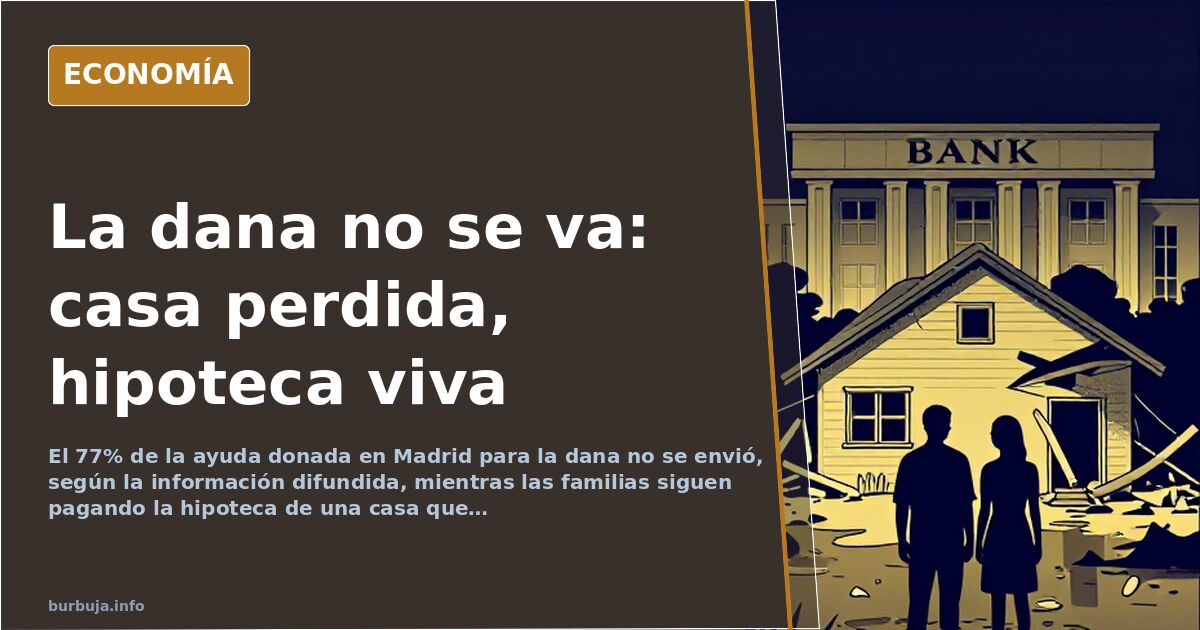
The DANA won't leave the living room: lost homes and mortgages still alive
The water went down, cars piled up on roundabouts, and the news bulletins returned to their routine. What hasn't returned to its place is Paco's home, nor that of thousands of families still stuck in the same flood scene: walls marked by mud, a move no one is funding, and a mortgage the bank still collects just as in October. The DANA hasn't gone away. It has sat down in the living room.
There lies the crux. A natural disaster ruins you twice: first it destroys the home, then it destroys the ability to rebuild it. Someone who had paid off their flat ends up owing on a house that no longer exists. Someone who had a mortgage is left paying off a ruin for twenty years. And in between, an aid system that arrives late, falls short, or simply doesn't arrive, with the underlying question of who pays for reconstruction when public money is scarce and private money doesn't cover the real damage.
The Consorcio pays out for the damage, not for life
The first clash with the official narrative didn't come from a party; it came from the insurance mechanism itself. The Consorcio de Compensación de Seguros (Spain's public insurance compensation body) covers claims caused by natural phenomena and acts automatically, without the need to take out a specific policy with it. On paper, there is a compensation route independent of the political leanings of whichever government is in office. In practice, the victim faces three fronts at once: the Consorcio's compensation, public reconstruction aid, and a mortgage that knows nothing of catastrophes.
The math doesn't add up. The assessment rarely covers the real value of what was lost, the Consorcio has its own scales, and deadlines stretch while the family keeps paying rent and mortgage at the same time. Some argue the system is designed for the average claim, not for a flood that wipes out entire neighbourhoods. The result is a pool of victims who, with or without compensation, can't get back on their feet: the point where analysis gets stuck and no one wants to look.
77% of donated aid in Madrid was not sent
According to information circulated during coverage of the disaster, the government allegedly did not send 77% of the DANA aid donated by Madrid residents, considering it “unnecessary.” The opposition seized on it to talk about “incompetence” in management. It is worth being precise: this is a published report, not an audited figure, and in this case both the volume of what was donated and the logistics needed to move and store it weigh heavily.
The episode illustrates something more uncomfortable. When institutional aid doesn't flow, civil society organises on its own. Full trailers of all kinds of material have been moved from places like Huelva, managed by fruit wholesalers with warehouses and cold storage, private infrastructure that filled the gap the authorities didn't cover in the first days. Solidarity worked. Official distribution, not so much.
Who distributes aid: the state, NGOs or a private company?
The debate over the distribution channel is one of the most persistent. One camp argues for taking management out of institutional hands and leaving it to humanitarian organisations to avoid the political toll. Another recalls that those entities also have costs, criteria and bottlenecks, and that without state structure the volume doesn't move. Experience on the ground points to an uncomfortable third way: those who had warehouses, trucks and staff moved material; those who depended on a subsidy waited.
The data handled in tracking the case give a clue about the scale of the private response. A Valencian distribution chain reportedly gave 20.000 euros to collaborators who lost their cars and 200.000 euros to those who lost their homes. It is a figure cited from memory by the person who spread it and not officially confirmed, but it marks the difference between immediate relief and administrative aid.
The political math: no confidence vote in sight
On the electoral front, the most repeated diagnosis is that the wear and tear exists but is not enough. The Socialist vote share in summer 2023, 31,68%, is used as a floor: with that sociological base, even the gravest scandal wouldn't move the needle, the more sceptical analyses argue. Discontent would channel towards the Generalitat (Valencia's regional government) and the PP (Spain's conservative party) rather than the central government, but elections have not been called.
The institutional route offers no shortcuts either. The parliamentary partners sustaining the government have no incentive to bring it down: they collect their share of influence without paying the cost of the disaster. A no-confidence vote appears ruled out in most scenarios under consideration, and expectations shift to the courts and ongoing corruption cases. It is material under investigation: allegations, not convictions.
The other front: the migration row that seeps into everything
Not all the discontent is directed at political leaders. Part of the anger has found a recurring target: migrants. It is claimed that those arriving irregularly receive hotel accommodation while affected residents sleep on cardboard. There is no verified evidence for that comparison, and the administrative response to the emergency and migration policy are distinct matters that the discontent tends to merge into one. It is the social tension accompanying the catastrophe, not an explanation of it.
The objective facts are simpler and harsher. Families in their forties, with children and mortgages, who have lost everything. 223 fatalities have been counted for the state funeral, and part of the tally is still disputed. Reconstruction will take months, not weeks. And the headline that summed up the scene — the king and queen entering a basilica while families sit behind them — also sums up the distance between institutional liturgy and the mud.
There the story remains, without an ending. Aid is still pending assessment, donations are still awaiting instructions, and families are still paying. Anyone who thinks the DANA ended when the rain stopped hasn't understood what a catastrophe is: what recedes is the water. What remains is the debt.
The water went down, cars piled up on roundabouts, and the news bulletins returned to their routine. What hasn't returned to its place is Paco's home, nor that of thousands of families still stuck in the same flood scene: walls marked by mud, a move no one is funding, and a mortgage the bank still collects just as in October. The DANA hasn't gone away. It has sat down in the living room.
There lies the crux. A natural disaster ruins you twice: first it destroys the home, then it destroys the ability to rebuild it. Someone who had paid off their flat ends up owing on a house that no longer exists. Someone who had a mortgage is left paying off a ruin for twenty years. And in between, an aid system that arrives late, falls short, or simply doesn't arrive, with the underlying question of who pays for reconstruction when public money is scarce and private money doesn't cover the real damage.
The Consorcio pays out for the damage, not for life
The first clash with the official narrative didn't come from a party; it came from the insurance mechanism itself. The Consorcio de Compensación de Seguros (Spain's public insurance compensation body) covers claims caused by natural phenomena and acts automatically, without the need to take out a specific policy with it. On paper, there is a compensation route independent of the political leanings of whichever government is in office. In practice, the victim faces three fronts at once: the Consorcio's compensation, public reconstruction aid, and a mortgage that knows nothing of catastrophes.
The math doesn't add up. The assessment rarely covers the real value of what was lost, the Consorcio has its own scales, and deadlines stretch while the family keeps paying rent and mortgage at the same time. Some argue the system is designed for the average claim, not for a flood that wipes out entire neighbourhoods. The result is a pool of victims who, with or without compensation, can't get back on their feet: the point where analysis gets stuck and no one wants to look.
77% of donated aid in Madrid was not sent
According to information circulated during coverage of the disaster, the government allegedly did not send 77% of the DANA aid donated by Madrid residents, considering it “unnecessary.” The opposition seized on it to talk about “incompetence” in management. It is worth being precise: this is a published report, not an audited figure, and in this case both the volume of what was donated and the logistics needed to move and store it weigh heavily.
The episode illustrates something more uncomfortable. When institutional aid doesn't flow, civil society organises on its own. Full trailers of all kinds of material have been moved from places like Huelva, managed by fruit wholesalers with warehouses and cold storage, private infrastructure that filled the gap the authorities didn't cover in the first days. Solidarity worked. Official distribution, not so much.
Who distributes aid: the state, NGOs or a private company?
The debate over the distribution channel is one of the most persistent. One camp argues for taking management out of institutional hands and leaving it to humanitarian organisations to avoid the political toll. Another recalls that those entities also have costs, criteria and bottlenecks, and that without state structure the volume doesn't move. Experience on the ground points to an uncomfortable third way: those who had warehouses, trucks and staff moved material; those who depended on a subsidy waited.
The data handled in tracking the case give a clue about the scale of the private response. A Valencian distribution chain reportedly gave 20.000 euros to collaborators who lost their cars and 200.000 euros to those who lost their homes. It is a figure cited from memory by the person who spread it and not officially confirmed, but it marks the difference between immediate relief and administrative aid.
The political math: no confidence vote in sight
On the electoral front, the most repeated diagnosis is that the wear and tear exists but is not enough. The Socialist vote share in summer 2023, 31,68%, is used as a floor: with that sociological base, even the gravest scandal wouldn't move the needle, the more sceptical analyses argue. Discontent would channel towards the Generalitat (Valencia's regional government) and the PP (Spain's conservative party) rather than the central government, but elections have not been called.
The institutional route offers no shortcuts either. The parliamentary partners sustaining the government have no incentive to bring it down: they collect their share of influence without paying the cost of the disaster. A no-confidence vote appears ruled out in most scenarios under consideration, and expectations shift to the courts and ongoing corruption cases. It is material under investigation: allegations, not convictions.
The other front: the migration row that seeps into everything
Not all the discontent is directed at political leaders. Part of the anger has found a recurring target: migrants. It is claimed that those arriving irregularly receive hotel accommodation while affected residents sleep on cardboard. There is no verified evidence for that comparison, and the administrative response to the emergency and migration policy are distinct matters that the discontent tends to merge into one. It is the social tension accompanying the catastrophe, not an explanation of it.
The objective facts are simpler and harsher. Families in their forties, with children and mortgages, who have lost everything. 223 fatalities have been counted for the state funeral, and part of the tally is still disputed. Reconstruction will take months, not weeks. And the headline that summed up the scene — the king and queen entering a basilica while families sit behind them — also sums up the distance between institutional liturgy and the mud.
There the story remains, without an ending. Aid is still pending assessment, donations are still awaiting instructions, and families are still paying. Anyone who thinks the DANA ended when the rain stopped hasn't understood what a catastrophe is: what recedes is the water. What remains is the debt.
Summary of a discussion on Burbuja.info - Foro de economía, actualidad y política., translated from Spanish and reviewed before publication. Read the full discussion (323 replies).
More summaries
-
Models forecast up to 728 mm in 24 hours over Nîmes
Models forecast 500–728 mm in under 24 hours along the Avignon-Nîmes-Montpellier axis, with Nîmes expected to bear the brunt
-
Spain's Economic Collapse: Why the Bubble Persists
This analysis reviews forum debates on Spain's economy, weighing official growth against debt and business struggles to see if a systemic crash is inevitable.
-
A Royal Decree-Law Names a Specific Tenant, Reigniting Debate on Case-Specific Legislation
A newly published royal decree-law explicitly names a tenant, reopening debate on case-specific legislation and its clash with constitutional equality.
-
Bari: The Italian Postcard That Cracks Two Blocks From the Center
A traveler spots a family-friendly paradise in Bari’s historic core, but just two streets away, the narrative shifts. Italy vs. Spain compared.
-
Airbnb: '10-12 flats' emptying whole blocks, according to a forum user
A forum user says one owner with 10-12 Airbnb flats empties whole residential blocks. In Lugo or Teruel, prices also rise without mass tourism.
-
Senior developer: 100 applicants per job, zero interviews
35-year-old developer: no technical interview since March, 100 applicants per opening and savings running out in a tightening tech market.