
Spain's Food Scavenging: €150 in Two Hours vs. Dignity
A year of scavenging supermarket waste yields €150 in two hours, but worsens diet and mental health.
English · Original discussion in Spanish · Published
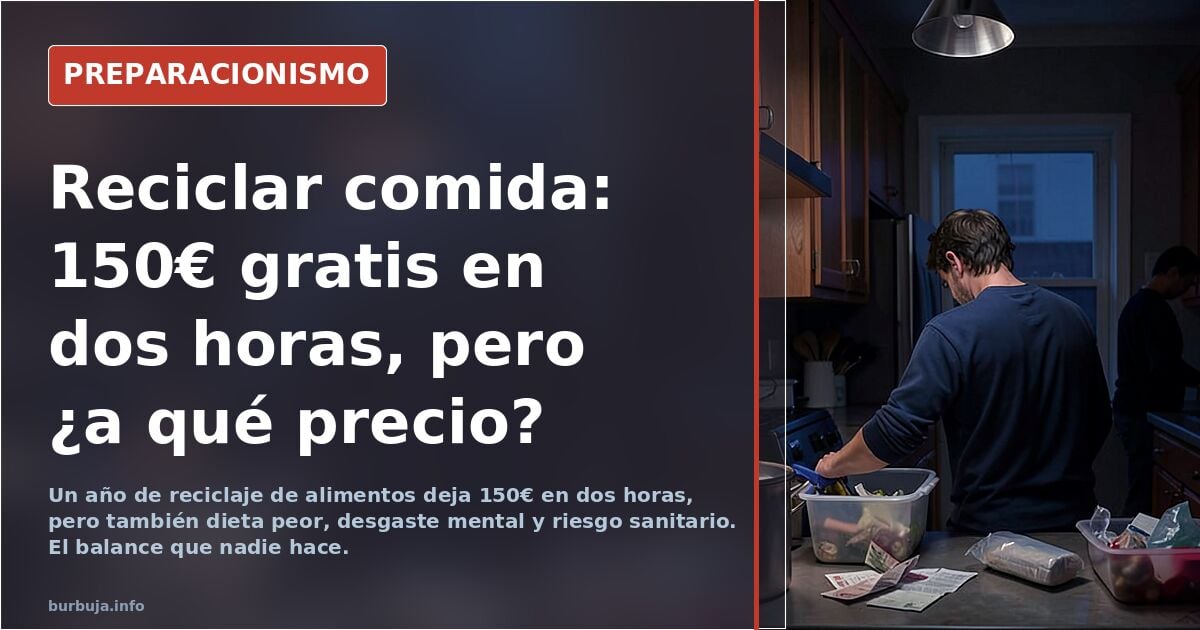
From Bin to Basket: €150 in Two Hours and the Decision to Quit
A year of collecting food discarded by supermarkets leaves an uncomfortable balance: hundreds of euros in "free" products, but also a worsening diet, physical and mental exhaustion, and dignity crumbling among garbage bags. The author is clear: "It is far more interesting to PRODUCE your own food." The real question isn't whether one can eat what others throw away, but at what cost when time, disinfection, and personal wear are factored in.
The account begins with a specific figure: €150 worth of goods in two hours of collection across several supermarkets, according to the protagonist's calculation. Yogurts, bananas, persimmons, artichokes, lasagnas, rice, pears, tomatoes, apples, potatoes, pineapples, lettuce, olive oil, coconut creams. All without spending a cent. The temptation is evident. But the protagonist admits the experience has a bittersweet side: when you shop, you choose; when you scavenge, you find what you can. And what you can find isn't always what your diet needs.
The Calculation That Debunks the Savings Illusion
The arithmetic of food recycling has a trap. A calculation circulating in the debate compares the value of collected goods with the opportunity cost of time invested. A cleaner earns between €15 and €20 per hour, according to standard rates. If spending an hour rummaging, cleaning, and disinfecting food yields products worth €15 or €20, the margin shrinks until it disappears. And that doesn't even count the disinfectants.
The full breakdown, including two hours of collection and the market value of what was obtained, shows a difference that surprises those expecting substantial savings. The figure of €150 in two hours equates to €75 per hour, well above a cleaner's wage. But that figure is the exception, not the norm. The author acknowledges filling an entire Carrefour trolley on one occasion, noting that their current laziness is evident. The actual average, accounting for travel, disinfection, sorting, and discarding items worse than they appeared initially, falls far short of that peak.
The Health Fine Print: Listeria, Salmonella, and Broken Cold Chains
Enthusiasm for free goods clashes with a reality highlighted by participants themselves: salads and yogurts require controlled temperatures. If the cold chain breaks, the risk of contamination by listeria, salmonella, or other bacteria becomes tangible. The warning repeats: saving money is one thing; playing Russian roulette is another. Products discarded for minor reasons, like the salads the protagonist has been eating for months, may be acceptable. Or not. The difference isn't visible to the naked eye.
Defenders of the method rely on rigorous disinfection with bactericidal, fungicidal, and sporicidal agents. They trinc a protocol compared to that used for pregnant women to prevent toxoplasmosis and listeriosis: soaking fruit and vegetables in special food-grade bleach and rinsing afterwards. Eating a salad raw, without this process, is a fast track to salmonellosis. The forum anecdote about "King SALMONELLA" isn't just a joke; it summarizes a real risk that dark humor turns into a warning.
The Toll Not on the Books: Dignity and Mental Health
The physical toll is manageable: preparing gear, accessing locations, effort, returning home, disinfecting, storing, sorting. It’s just work. The mental toll is different. "In the long run, it undermines your sarracena," states the author. Rummaging through filth diminishes dignity, and seeing people in total exclusion in the bins is deeply discouraging. Sharing the task with "normal" colleagues doesn't compensate for this wear.
The final balance emerging from the discussion is that working more to avoid doing this pays off better. Returning occasionally isn't ruled out, but the door opening leads elsewhere: producing your own food. The paradox is that the system throws away unpackaged products—ripe mangoes, plastic-wrapped bread loaves—while the scavenger learns to discriminate and keep only essentials. Initially, one grabs almost compulsively. Later, selectivity arrives. And with it, the realization that well-done recycling is just another job.
The Other Side: Catering Wasting Fillet and Supermarkets Securing Bins
Not all waste ends up on the street. In an airline catering multinational, according to testimony, unsealed sirloin, salmon, ribeye, and caviar are thrown away. You watch from outside while they eat like kings daily. At the other extreme, many supermarkets no longer discard food directly: they store products in internal containers loaded onto delivery trucks, and discontinued items are monitored so workers don't take them. The excuse is health and quality. The reality, argued by critics, is preventing third parties from taking unpaid product.
The Hipercor case adds nuance: all edible items go directly to the Banco de Alimentos (Spanish Food Bank) before expiration, via daily truck pickups. Not a single yogurt in the bin. Not a fabric softener with a cracked bottle. This waste lockdown policy coexists with apps like Too Good To Go, where €4 buys products worth over €40, right before expiry. The difference between the bin and the app is largely about intermediation and shame.
The Background No One Discusses: Why Food Is Wasted in a Country with Food Insecurity
The phenomenon transcends individual anecdotes. Spanish supermarket sales are described in the exchange as ridiculous, akin to "burning the house rather than selling it cheap." Products are thrown away instead of discounted, and scavengers fill the gap left by this commercial policy. Meanwhile, discussions drifted to unrelated topics: thread productivity or ideological consistency of those who recycle yet criticize immigration. This drift—from bin to grievance—shows how the issue politicizes when mixed with economic distress.
The exact point where analysis stalls is this: food recycling works as an individual buffer in a system that wastes unpackaged products, but doesn't solve the root cause. Practitioners gain in euros but lose in diet, time, and dignity. Those securing waste gain control but lose efficiency. And hunger, meanwhile, continues finding its path among the bags.
Also available in: Deutsch
Summary of a discussion on Burbuja.info - Foro de economía, actualidad y política., translated from Spanish and reviewed before publication. Read the full discussion (86 replies).
More summaries
-
Scavenging Supermarket Bins: €150 in Food Found in Two Hours
People salvaging food from supermarket bins can find €150 worth of edible items in just two hours. The barrier isn't legal, but the stigma of appearing destitute.
-
Spain’s preppers stockpile six months of food amid grid fears
While official EU guidelines recommend a 72-hour supply, some households in Spain are storing six months of rice and water.
-
Famine Pantry: What Lasts Years and What Doesn't
Which foods survive years, the cost of stocking up, and why hungry neighbors are a key concern for preppers.
-
Strait of Hormuz fears drive food stockpiling in Spain
Forum users debate stockpiling amid Strait of Hormuz crisis. Is it prudence or panic? Key products and views.
-
Spain's gun laws: from .50 BMG to Stg 44
From the Stg 44 to the .950 JDJ, Spain’s regulations exclude many weapons. This article details the actual limits of the F license for collectors and shooters.
-
Sheep Wool Desalination: Cornell Study Achieves 2.43 L/m²/h
Cornell University researchers use polydopamine-treated wool to achieve solar evaporation rates of 2.43 liters per square meter per hour, producing freshwater without electricity.