
Spain's flooding crisis: centuries of building where water always returns
The 2024 DANA in l'Horta Sud, the 1957 Valencia flood and the 1982 Tous dam disaster repeat a pattern: building where the water always comes back. The problem is not weather but planning.
English · Original discussion in Spanish · Published
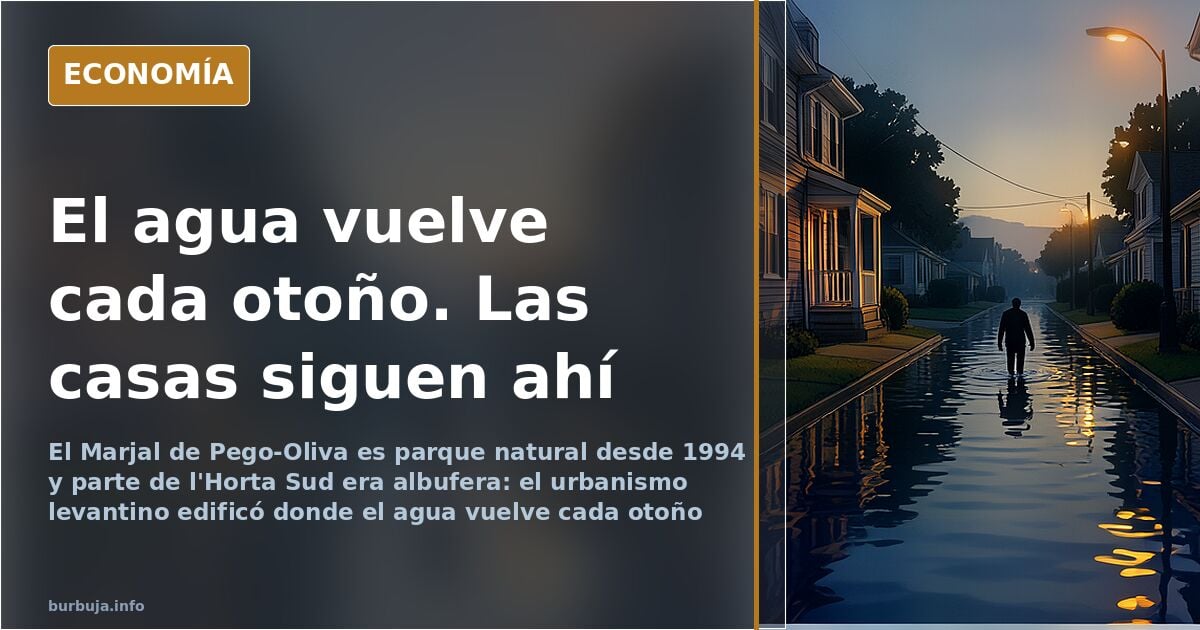
Spain's flooding crisis: centuries of building where water always returns
How many centuries has Spain's Mediterranean east coast been building on land that water periodically claims? The question, raised with a smirk on an economics forum, hides a problem that is not meteorological but urban and political: the 2024 DANA in l'Horta Sud, the 1957 Valencia flood, the 1982 Tous dam disaster or the 2019 floods in the Vega Baja draw up a list of episodes that repeat with almost administrative regularity. The pattern is always the same: torrential autumn rain over sealed ground, riverbeds taken over by development, and a collective memory that fades at the estimulante ilegal of construction.
Why does eastern Spain flood every autumn?
The mechanism has been known for decades. In summer, the Mediterranean accumulates heat; in autumn, masses of cold air at altitude meet that warm surface and unleash violent downpours. What used to be called gota fría and is now called DANA is the same phenomenon. The difference lies not in the sky but in the ground: built-up surfaces prevent water from soaking in and push it towards channels that are often occupied or narrowed.
Some argue that the name change — from gota fría to DANA — is a semantic operation to sell a climate agenda. The argument has a grain of etymological truth: the phenomenon is the same. But the debate over terminology is a smokescreen. The problem is not what to call it, but where people build.
Building on floodplains: the case of the Marjal de Pego-Oliva
The Marjal de Pego-Oliva has been a natural park since 1994. The area of Catarroja, Massanassa and Sedaví was on the edge of the Albufera lagoon until it was drained for rice fields and later developed. These are lands that water occupies by definition when it rains hard. The list of episodes is long: the Santa Teresa flood in Murcia in 1879, the 1957 Valencia flood that led to the Turia being diverted under the Plan Sur, the Tous dam disaster in 1982, the 2019 DANA in the Vega Baja and the 2024 one in l'Horta Sud.
Since 2015 there have been flood zone maps — the SNCZI — and Valencia's regional PATRICOVA plan. The problem is that much of what has been built predates those maps, and moving people out costs a huge amount of money and votes. The unavoidable conclusion is uncomfortable: it is not about forecasting the future better, but about accepting that the past was already warning us.
What solutions are being proposed?
The proposals circulating range from building more dams and clearing riverbeds to rethinking land use. The argument that more reservoirs would solve both the DANAs and summer droughts is debatable: dams regulate flows but do not eliminate the torrential nature of rainfall concentrated in a few hours. Clearing riverbeds is necessary, though not enough if the water has nowhere to go.
The most expensive option is also the most logical: stop building on land that water reclaims every so often. That means compensation, expropriations and a political debate nobody wants to have in an election year. The result is that patching continues.
The forum question was ironic, but it also carried an uncomfortable kernel of truth: eastern Spain is not the victim of a capricious climate, but of a way of occupying the land that ignores hydrology. As long as construction outweighs the flood map, the next DANA will not be a surprise. It will be an appointment.
Summary of a discussion on Burbuja.info - Foro de economía, actualidad y política., translated from Spanish and reviewed before publication. Read the full discussion (15 replies).
More summaries
-
Valencia takes to the streets against Mazón over DANA management
Thousands flood Valencia demanding Mazón's resignation and prison over DANA handling, amid cross-blame on responsibilities.
-
Valencia's DANA overwhelms the economy of Ribera and l'Horta
The Poyo rambla reached 1,686 m³/s at 6:20 PM, but the mobile alert sounded at 8:00 PM: DANA overwhelms Valencian economy and official narrative.
-
Venezuela: from 8,202% inflation to 450 bolivars per dollar
In March 2018, annual inflation exceeded 8,202% and the parallel dollar hit 450 bolivars, pushing the Venezuelan minimum wage down to $10.
-
Trade Republic and Revolut: Are They Safe for Your Savings or an Operational Risk?
Trade Republic offers 3% and Revolut pays daily interest, but transfer blocks and chat support turn savings into a gamble...
-
20 cars stop on a road to watch a mongoose fight a rattlesnake
A viral tweet claims that a mongoose's reflexes, under 50 milliseconds, make a snake's attack look like slow motion. We explain how much truth there is to it.
-
Matilde, Micaela and Constanza: the names that divide opinion
Matilde, Micaela, Constanza or Marta: choosing the most beautiful female name depends more on memories than on how it sounds, according to participants in the thread.