
Valencia takes to the streets against Mazón over DANA management
Thousands flood Valencia demanding Mazón's resignation and prison over DANA handling, amid cross-blame on responsibilities.
English · Original discussion in Spanish · Published
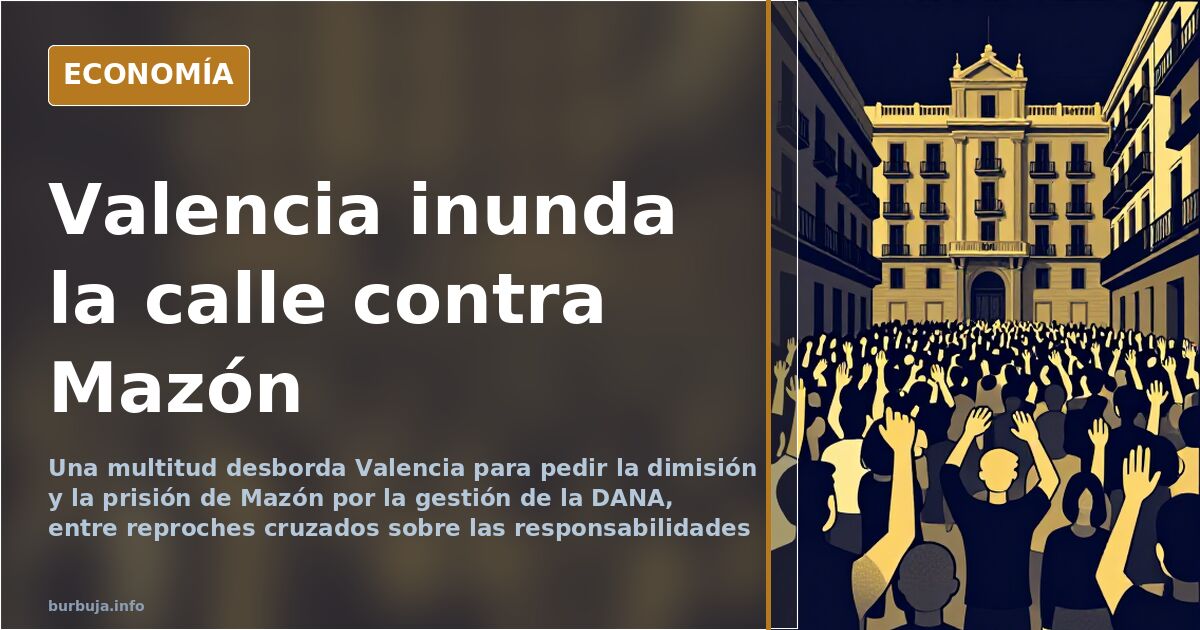
Valencia takes to the streets against Mazón and his DANA management
The march against Carlos Mazón has filled Valencia’s streets to such an extent that, according to circulating descriptions, there was not room for another soul in the city. The rally, backed by the hashtags #MazónResign and #MazónToPrison, puts the President of the Generalitat Valenciana at the center of scrutiny over his handling of the DANA (Depósito Aislado de Aire en Niveles Altos, or isolated air deposit at high levels) and demands his removal and imprisonment. It is presented as a march for the dignity of those affected and those who are no longer with us. The protest has even crossed borders: French television covered the demonstration.
The narrative supporting it has three pillars: an existing alert that did not translate into timely decisions, a coordination center that waited, and a weakened emergency phone line. Together, these pieces draw a picture of chained negligence.
Why is Mazón’s imprisonment demanded?
The most repeated accusation points to a chain of avoidable errors. A resident in the mountains of Castellón, 80 kilometers away and at over 1,000 meters altitude, claims he knew days in advance what was coming: “But if a nobody like me knew it, how could the experts in alarms and emergencies from both the Generalitat and the Government Delegation not have known?” This is the core of the anger: the warning existed, but the response did not arrive.
Also under scrutiny is the management of CECOPI, the emergency coordination center. According to circulating accounts, the Minister of Justice and Interior, Salomé Pradas, spent three hours running the agency and stalling while waiting for one man—Mazón—to make a decision. From there comes the demand for resignation. And from there, without pause, comes the demand for imprisonment.
The privatized 112 and the warning that did not arrive in time
Another heavily criticized line points to the outsourcing of the emergency phone number. The argument is that the 112 line had been left understaffed after its privatization and that the service served mainly to enrich some business intermediaries. If the warning channel was weakened, the outcome was predictable.
The question hovering over the entire protest is not technical, but political: who knew what, when they knew it, and why no action was taken. No one disputes that the water arrived without warning. What is heavily debated is whether the margin for action was wasted while everyone looked the other way. The institutional response, as of this discussion, remained unclarified.
Citizen dignity or political weapon?
Here lies the rift. Some see the march as a legitimate reaction from those who have lost everything and rose with nothing, with their bare hands, against those responsible. Others interpret it as an operation: a highly politicized mega-march that exploits a disaster to reshape the political landscape, with mud still on the streets and chairs shifting in offices.
The two narratives do not cancel each other out. The street can be both a sincere cry and a showcase. What is beyond dispute is the scale: those supporting it describe it as a historic march for the dignity of the people, and the protest’s echo has reached French television.
Mazón, Sánchez, or both?
The tug-of-war between administrations appears. Some argue that the Generalitat is not solely responsible and that the central government should explain its part, while others accuse the protest of focusing only on the PP (People's Party, Spain's main conservative party) and staying silent on the PSOE (Spanish Socialist Workers' Party). The response from the other side is that pointing at the Consell does not exonerate anyone.
And a side debate that sneaks into all topics: the label. One message summarizes the complaint of those who reject the idea that disagreeing automatically makes you far-right, arguing that half of Spain does not subscribe to a single ideology. Spanish politics continues to be debated by the classification of the adversary.
Ultimately, the demand for resignation and imprisonment is a political slogan, not a judicial ruling. There remains the investigation to apportion responsibilities, and until it arrives, the rope will remain taut between those demanding heads and those warning that the water has already taken too many. That is the exact point where the analysis stalls.
The march against Carlos Mazón has filled Valencia’s streets to such an extent that, according to circulating descriptions, there was not room for another soul in the city. The rally, backed by the hashtags #MazónResign and #MazónToPrison, puts the President of the Generalitat Valenciana at the center of scrutiny over his handling of the DANA (Depósito Aislado de Aire en Niveles Altos, or isolated air deposit at high levels) and demands his removal and imprisonment. It is presented as a march for the dignity of those affected and those who are no longer with us. The protest has even crossed borders: French television covered the demonstration.
The narrative supporting it has three pillars: an existing alert that did not translate into timely decisions, a coordination center that waited, and a weakened emergency phone line. Together, these pieces draw a picture of chained negligence.
Why is Mazón’s imprisonment demanded?
The most repeated accusation points to a chain of avoidable errors. A resident in the mountains of Castellón, 80 kilometers away and at over 1,000 meters altitude, claims he knew days in advance what was coming: “But if a nobody like me knew it, how could the experts in alarms and emergencies from both the Generalitat and the Government Delegation not have known?” This is the core of the anger: the warning existed, but the response did not arrive.
Also under scrutiny is the management of CECOPI, the emergency coordination center. According to circulating accounts, the Minister of Justice and Interior, Salomé Pradas, spent three hours running the agency and stalling while waiting for one man—Mazón—to make a decision. From there comes the demand for resignation. And from there, without pause, comes the demand for imprisonment.
The privatized 112 and the warning that did not arrive in time
Another heavily criticized line points to the outsourcing of the emergency phone number. The argument is that the 112 line had been left understaffed after its privatization and that the service served mainly to enrich some business intermediaries. If the warning channel was weakened, the outcome was predictable.
The question hovering over the entire protest is not technical, but political: who knew what, when they knew it, and why no action was taken. No one disputes that the water arrived without warning. What is heavily debated is whether the margin for action was wasted while everyone looked the other way. The institutional response, as of this discussion, remained unclarified.
Citizen dignity or political weapon?
Here lies the rift. Some see the march as a legitimate reaction from those who have lost everything and rose with nothing, with their bare hands, against those responsible. Others interpret it as an operation: a highly politicized mega-march that exploits a disaster to reshape the political landscape, with mud still on the streets and chairs shifting in offices.
The two narratives do not cancel each other out. The street can be both a sincere cry and a showcase. What is beyond dispute is the scale: those supporting it describe it as a historic march for the dignity of the people, and the protest’s echo has reached French television.
Mazón, Sánchez, or both?
The tug-of-war between administrations appears. Some argue that the Generalitat is not solely responsible and that the central government should explain its part, while others accuse the protest of focusing only on the PP (People's Party, Spain's main conservative party) and staying silent on the PSOE (Spanish Socialist Workers' Party). The response from the other side is that pointing at the Consell does not exonerate anyone.
And a side debate that sneaks into all topics: the label. One message summarizes the complaint of those who reject the idea that disagreeing automatically makes you far-right, arguing that half of Spain does not subscribe to a single ideology. Spanish politics continues to be debated by the classification of the adversary.
Ultimately, the demand for resignation and imprisonment is a political slogan, not a judicial ruling. There remains the investigation to apportion responsibilities, and until it arrives, the rope will remain taut between those demanding heads and those warning that the water has already taken too many. That is the exact point where the analysis stalls.
Also available in: Deutsch
Summary of a discussion on Burbuja.info - Foro de economía, actualidad y política., translated from Spanish and reviewed before publication. Read the full discussion (483 replies).
More summaries
-
Mazón Resigns a Year After Valencia's DANA Storm
Carlos Mazón steps down over a year after the devastating DANA storm in Valencia, which caused 226 deaths. The PP retains control of the regional government with Vox's continued support.
-
Mazón Resignation: Valencia Demands Accountability for DANA
A demonstration by 65 organizations in Valencia demands political responsibility for the DANA management, citing over 200 deaths and 75 affected municipalities.
-
Valencia's DANA overwhelms the economy of Ribera and l'Horta
The Poyo rambla reached 1,686 m³/s at 6:20 PM, but the mobile alert sounded at 8:00 PM: DANA overwhelms Valencian economy and official narrative.
-
Riots in French schools: fires and attacks
Fires in French schools, teachers attacked and blockades spreading to Belgium. The unrest is attributed to the education strike and radical groups.
-
Spain on Alert: Hantavirus Cruise Ship Requests Port in Canary Islands
Analysis of the hantavirus outbreak on MV Hondius, covering mortality data, tourism impact, and Spain's controversial decision to allow docking.
-
Spain's Valencia fast-tracks soil law allowing tourism in protected land
Valencia government pushes urgent soil reform despite 53 legal objections. Community Interest Declarations become permanent.