
Spain's festival prices spark outrage over €4 vermouth
In Spanish village festivals, basic drinks and snacks cost up to €14. Hospitality raises prices while customers pay without complaining.
English · Original discussion in Spanish · Published
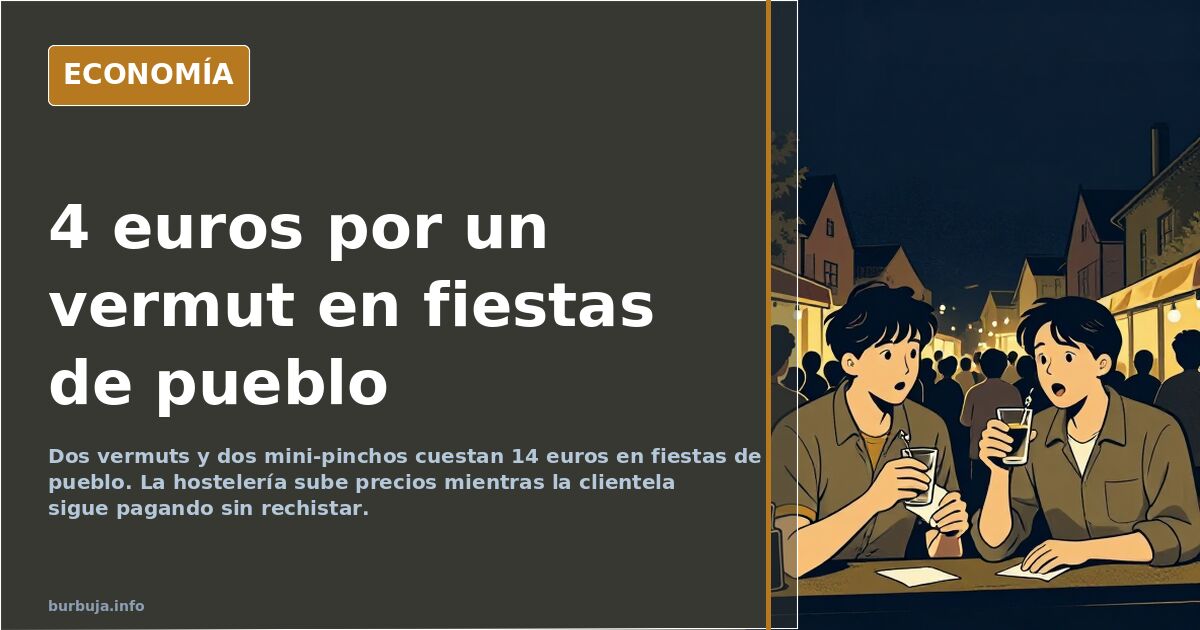
Spanish village festivals: €4 for a vermouth with nothing else
Two vermouths and two mini-pinchos. Fourteen euros. That is the bill that starts the conversation and summarizes a complaint that goes far beyond a bar counter: during patron saint festivals, with towns full of locals and tourists, the price of a basic drink has become the thermometer of a hospitality sector that no longer drops below certain thresholds. The venue is not a franchise or a trendy beach bar: it is an old-school pub. And it is packed.
The suspicion running through this issue is that this is no longer about raw material inflation. It is about raising prices as long as customers keep swallowing them. The calculation is simple: if the glass fills just as much with four euros as with two, the margin stretches, and the paying customer becomes, unwillingly, an involuntary partner in the business.
How much does a round really cost at festivals?
Examples pile up and draw a range from acceptable to directly deterrent. A sandwich with a small beer, 18 euros. A cocktail in a cider glass, 6 euros, and not cheap mixers. A traditional pincho, between two and three euros for a slice of bread with anything on top. The repeated conclusion is that the pincho, more than the drink, is where the feeling of being ripped off concentrates.
The comparison with the supermarket is inevitable and appears in several parts of the conversation: with 14 euros you can eat at home for a couple of days. Draft beer, however, has a hard-to-rebut defender: nothing matches the taste of a well-poured caña (small draft beer), with its fizz and chill. Bottles from the fridge do not taste the same. And there lies the knot: the price is not paid only for the liquid; it is paid for the tap, the bar, and the company.
The three-month business and the rest of the year's cash flow
There is a structural explanation that usually stays outside the customer's anger. The village bar has three months to make its summer fortune. From mid-October to Easter, they don't sell a single croqueta: they have to keep the place open for the few who live there, with the coffee machine on and cameras ready in case someone walks in. Firewood for the stove and heating are another chapter. Seen this way, summer is not a robbery: it is the season that pays for the whole year.
The problem is that this logic, reasonable in a small town, is applied equally in areas with year-round traffic. And there the argument cracks. When the venue is full of tourists and neighbors on any random Tuesday, the season no longer explains the price.
Reusable cups, paid tapas, and other innovations
Among the circulating anecdotes, one works as a perfect caricature: charging separately for the plastic cup to save the planet and asking customers to bring it from home for reuse over several days. Staff response was to hold a botellón (street drinking party) at the shop next door. The measure, designed as sustainability, ended up working as a tax on those who stay.
Added to this is the confusion over what is paid for: paid pincho or free tapa. The free tapa, that Spanish invention that for decades was the best marketing of national hospitality, is becoming a luxury item. And the vermouth session of parish festivals, some argue, should be UNESCO heritage: there are few more important moments throughout the year, and if you have to pay four euros for a drink, you pay it.
The alternative for those who won't put up with it
The most repeated response is not protesting: it is not going. Staying at home, buying at the supermarket, setting up the cooler with ice, beer, and a basket with two loaves of bread, chorizo, salchichón, and a tortilla de patatas (potato omelet). Twenty euros, you invite all your friends, and you look like a god. The party moves from the bar to the apartment building entrance.
The counterpoint is held by those who say the problem is not the price, but the habit. If people keep paying without complaining, raising prices is rational. Putting vermouth at ten euros would change nothing, they say, because customers would still be there. The only signal the market understands is an empty register.
Postureo as an economic engine
Underneath the price is a more uncomfortable layer: spending to impress others. The repeated thesis is that in Spain, the image we project weighs heavily, and that attitude drags down the country at all levels. Those who pay four euros for a plain vermouth do not always do it because they have money to spare: they do it because staying out of the round has a social cost.
Added to this is consumer debt and credit cards at record highs. The warning hovering is that of a new version of 2008, this time worse. No one knows if it will arrive. What is known is that the bar bill no longer matches average salaries, and that the parties remain full.
Two vermouths and two mini-pinchos. Fourteen euros. That is the bill that starts the conversation and summarizes a complaint that goes far beyond a bar counter: during patron saint festivals, with towns full of locals and tourists, the price of a basic drink has become the thermometer of a hospitality sector that no longer drops below certain thresholds. The venue is not a franchise or a trendy beach bar: it is an old-school pub. And it is packed.
The suspicion running through this issue is that this is no longer about raw material inflation. It is about raising prices as long as customers keep swallowing them. The calculation is simple: if the glass fills just as much with four euros as with two, the margin stretches, and the paying customer becomes, unwillingly, an involuntary partner in the business.
How much does a round really cost at festivals?
Examples pile up and draw a range from acceptable to directly deterrent. A sandwich with a small beer, 18 euros. A cocktail in a cider glass, 6 euros, and not cheap mixers. A traditional pincho, between two and three euros for a slice of bread with anything on top. The repeated conclusion is that the pincho, more than the drink, is where the feeling of being ripped off concentrates.
The comparison with the supermarket is inevitable and appears in several parts of the conversation: with 14 euros you can eat at home for a couple of days. Draft beer, however, has a hard-to-rebut defender: nothing matches the taste of a well-poured caña (small draft beer), with its fizz and chill. Bottles from the fridge do not taste the same. And there lies the knot: the price is not paid only for the liquid; it is paid for the tap, the bar, and the company.
The three-month business and the rest of the year's cash flow
There is a structural explanation that usually stays outside the customer's anger. The village bar has three months to make its summer fortune. From mid-October to Easter, they don't sell a single croqueta: they have to keep the place open for the few who live there, with the coffee machine on and cameras ready in case someone walks in. Firewood for the stove and heating are another chapter. Seen this way, summer is not a robbery: it is the season that pays for the whole year.
The problem is that this logic, reasonable in a small town, is applied equally in areas with year-round traffic. And there the argument cracks. When the venue is full of tourists and neighbors on any random Tuesday, the season no longer explains the price.
Reusable cups, paid tapas, and other innovations
Among the circulating anecdotes, one works as a perfect caricature: charging separately for the plastic cup to save the planet and asking customers to bring it from home for reuse over several days. Staff response was to hold a botellón (street drinking party) at the shop next door. The measure, designed as sustainability, ended up working as a tax on those who stay.
Added to this is the confusion over what is paid for: paid pincho or free tapa. The free tapa, that Spanish invention that for decades was the best marketing of national hospitality, is becoming a luxury item. And the vermouth session of parish festivals, some argue, should be UNESCO heritage: there are few more important moments throughout the year, and if you have to pay four euros for a drink, you pay it.
The alternative for those who won't put up with it
The most repeated response is not protesting: it is not going. Staying at home, buying at the supermarket, setting up the cooler with ice, beer, and a basket with two loaves of bread, chorizo, salchichón, and a tortilla de patatas (potato omelet). Twenty euros, you invite all your friends, and you look like a god. The party moves from the bar to the apartment building entrance.
The counterpoint is held by those who say the problem is not the price, but the habit. If people keep paying without complaining, raising prices is rational. Putting vermouth at ten euros would change nothing, they say, because customers would still be there. The only signal the market understands is an empty register.
Postureo as an economic engine
Underneath the price is a more uncomfortable layer: spending to impress others. The repeated thesis is that in Spain, the image we project weighs heavily, and that attitude drags down the country at all levels. Those who pay four euros for a plain vermouth do not always do it because they have money to spare: they do it because staying out of the round has a social cost.
Added to this is consumer debt and credit cards at record highs. The warning hovering is that of a new version of 2008, this time worse. No one knows if it will arrive. What is known is that the bar bill no longer matches average salaries, and that the parties remain full.
Also available in: Deutsch
Summary of a discussion on Burbuja.info - Foro de economía, actualidad y política., translated from Spanish and reviewed before publication. Read the full discussion (168 replies).
More summaries
-
Argentine fan's debt for final highlights Spain's consumer credit boom
An Argentine pays $10,000 for a ticket and borrows from his mother. Meanwhile, Spain hits a record €46.6 billion in consumer loans.
-
Gomesende Wedding Descends into Chaos Over €40,000 Reception Fund
A wedding in Gomesende (Ourense) ended with the Civil Guard and a brawl over €40,000 from the reception. The groom denies claims of a marriage of convenience...
-
Young Man Fired for Mocking Puerta del Sol Protesters
A young man was fired after a viral video mocked Puerta del Sol protesters as lazy. The case sparks debate on fair dismissal and free speech in Spain.
-
Plane Myth: Confusing Inertia with Wind in Spain
Earth rotates at 1,600 km/h and planes fly at 840 km/h. The error is forgetting that air rotates with the planet.
-
Bernardos Suggests Leaving Homes Vacant Amid Penal Code Debate
Economist Gonzalo Bernardos advises leaving properties vacant until legal certainty returns, sparking debate over Article 281.1 of the Spanish Penal Code.
-
Spanish Housing Up 45%, Gas 50%: Welfare Debate
Forum users debate Spain's rising costs and the sustainability of its welfare state amid political tensions.