
Spain's Christmas Turrón Sales Slump Despite Full Shelves
Spanish supermarket shelves remain stocked with turrón and polvorones two weeks before Christmas, signaling a sharp drop in holiday confectionery consumption.
English · Original discussion in Spanish · Published
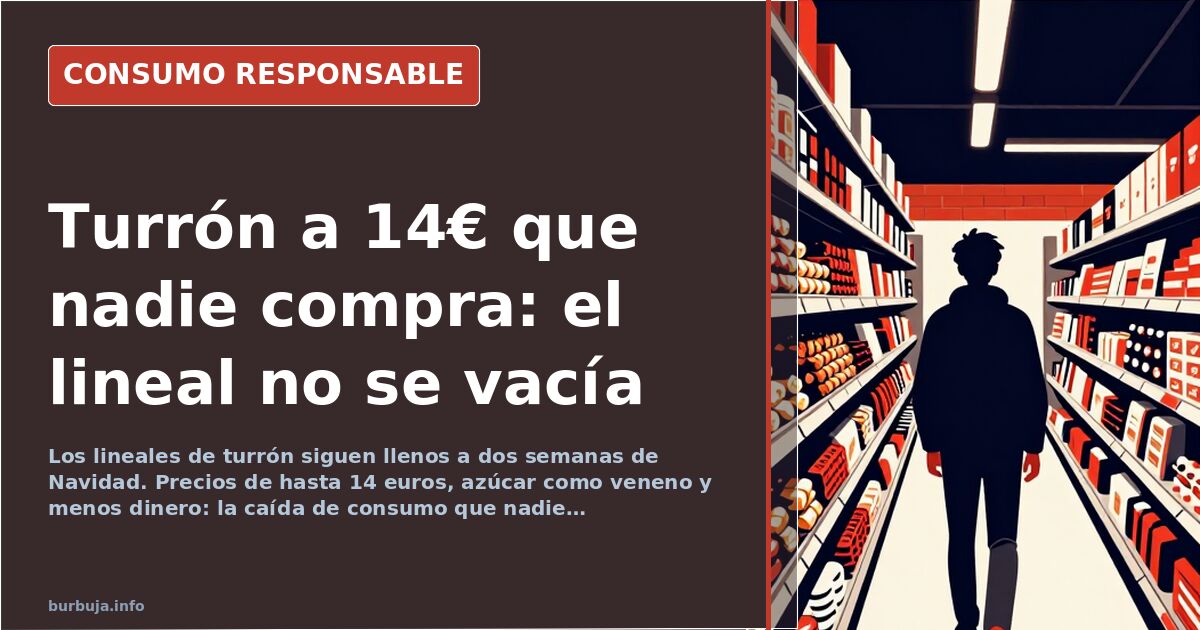
Turrón Unsold: Supermarket Shelves Remain Full Two Weeks Before Christmas
A striking trend is emerging in Spanish supermarkets at the start of December: shelves dedicated to turrón, pole, and marzipan remain fully stocked. In three different stores, the display for traditional holiday sweets looked identical: untouched products, loose bars handled by shoppers who then put them back, and boxes showing no movement. This scene contrasts sharply with previous years, when consumption began weeks earlier. The decline in sales of Christmas sweets has become an unexpected thermometer for a season that refuses to take off.
The phenomenon has several interpretations. One is purely economic: the price of turrón has skyrocketed. Another points to changing habits: sugar is no longer viewed as a treat but as a public health issue. A third, more uncomfortable factor relates directly to household budgets: people have less money and are prioritizing spending.
Turrón Prices: From 600 Pesetas to 14 Euros
The comparison is stark. A turrón that cost 600 pesetas in the 90s now sells for prices four or five times higher. At a well-known department store chain, a premium brand bar reaches 14 euros. In discount supermarkets, soft turrón with 70% almonds has dropped from 4.50 to 3.40 euros per 250 grams, yet it still fails to sell.
The Roscón de Reyes (traditional King’s Cake) is not immune to this escalation: 10 euros at one distribution chain and 11 at another, representing a 40% increase over the previous season. The inevitable question arises: are we facing a real rise in costs, or opportunistic seasonal pricing?
Some argue that industrial turrón is little more than refined sugar with almonds. The calculation is simple: of a 200-gram bar, nearly 100 grams are sugar, an ingredient costing less than one euro per kilo. Consequently, margins are substantial. And consumers are starting to do the math.
Sugar as Poison: Changing Awareness Alters Consumption
Perceptions of sugar have shifted. It is no longer just a Christmas indulgence; it is an ingredient actively avoided by a growing segment of the population. The idea that sugar is harmful has taken root in the collective imagination, with direct consequences on holiday sweet sales.
The logic trinc: if sugar was scarce and expensive for centuries, its value came from that rarity. Now that it is cheap and abundant, it has lost its aura. Overabundance repels. If it is also perceived as damaging, rejection is twofold.
Some consumers have taken this logic to the extreme, eliminating added sugars entirely from their diets, including the sweetest fruits. The argument is that after years without sugar, the palate readapts and sweetness becomes cloying. Consumed fruit is citrusy and acidic: oranges, mandarins, lemons, kiwi, pineapple, pomegranate. No grapes, cherries, or melon. They claim this results in savings of 10 to 15 euros previously spent on Christmas sweets.
The Turrón Scam: When Consumers Stop Falling for It
The term "scam" appears repeatedly when discussing Christmas sweets. The accusation has multiple layers. First, the price: paying 14 euros for a bar containing mostly sugar and palm oil seems like an abuse to many. Second, quality: chocolate turrón varieties reportedly contain substitutes rather than real chocolate. Third, expiration dates: they are assigned a ten-month shelf life so buyers don’t save them year-over-year, although they hold up perfectly under proper conditions.
Consumer response is twofold. Some choose not to buy. Others make it themselves. Homemade baking is enjoying a boom: sugar-free cakes, pole baked with Iberian ham fat, peanut butter, and natural whipped cream as substitutes. The message is clear: if industrial products are poor quality and expensive, make them at home.
Bulk Sweets Disappear Due to Shoplifting
A revealing detail: bulk displays of Christmas sweets are vanishing from supermarkets. Coconut balls, candied fruits, and liqueur cherries sold by weight are gone. The reason cited is that people ate them before paying. This phenomenon, known as shoplifting, has led chains to withdraw these formats.
The anecdote has its charm and bitter side. If bulk options disappear, honest consumers lose choice. Those who didn’t pay simply change strategies.
The Consumption Drop Nobody Wants to See
The conclusion drawn from all this is uncomfortable. The drop in Christmas sweet consumption isn’t just about price. It’s a combination of factors: rising costs, sugar awareness, distrust of industrial products, and, above all, less disposable income.
The lingering question is whether this decline is temporary or structural. If consumers have learned to live without turrón, discovered they can make it at home, or decided it’s not worth paying 14 euros for a bar, the sector faces a problem. And solutions don’t seem likely to come from shaving cents off the price.
Meanwhile, shelves remain full. In a business that thrives on emptying them, that is the most disorienting data point.
A striking trend is emerging in Spanish supermarkets at the start of December: shelves dedicated to turrón, pole, and marzipan remain fully stocked. In three different stores, the display for traditional holiday sweets looked identical: untouched products, loose bars handled by shoppers who then put them back, and boxes showing no movement. This scene contrasts sharply with previous years, when consumption began weeks earlier. The decline in sales of Christmas sweets has become an unexpected thermometer for a season that refuses to take off.
The phenomenon has several interpretations. One is purely economic: the price of turrón has skyrocketed. Another points to changing habits: sugar is no longer viewed as a treat but as a public health issue. A third, more uncomfortable factor relates directly to household budgets: people have less money and are prioritizing spending.
Turrón Prices: From 600 Pesetas to 14 Euros
The comparison is stark. A turrón that cost 600 pesetas in the 90s now sells for prices four or five times higher. At a well-known department store chain, a premium brand bar reaches 14 euros. In discount supermarkets, soft turrón with 70% almonds has dropped from 4.50 to 3.40 euros per 250 grams, yet it still fails to sell.
The Roscón de Reyes (traditional King’s Cake) is not immune to this escalation: 10 euros at one distribution chain and 11 at another, representing a 40% increase over the previous season. The inevitable question arises: are we facing a real rise in costs, or opportunistic seasonal pricing?
Some argue that industrial turrón is little more than refined sugar with almonds. The calculation is simple: of a 200-gram bar, nearly 100 grams are sugar, an ingredient costing less than one euro per kilo. Consequently, margins are substantial. And consumers are starting to do the math.
Sugar as Poison: Changing Awareness Alters Consumption
Perceptions of sugar have shifted. It is no longer just a Christmas indulgence; it is an ingredient actively avoided by a growing segment of the population. The idea that sugar is harmful has taken root in the collective imagination, with direct consequences on holiday sweet sales.
The logic trinc: if sugar was scarce and expensive for centuries, its value came from that rarity. Now that it is cheap and abundant, it has lost its aura. Overabundance repels. If it is also perceived as damaging, rejection is twofold.
Some consumers have taken this logic to the extreme, eliminating added sugars entirely from their diets, including the sweetest fruits. The argument is that after years without sugar, the palate readapts and sweetness becomes cloying. Consumed fruit is citrusy and acidic: oranges, mandarins, lemons, kiwi, pineapple, pomegranate. No grapes, cherries, or melon. They claim this results in savings of 10 to 15 euros previously spent on Christmas sweets.
The Turrón Scam: When Consumers Stop Falling for It
The term "scam" appears repeatedly when discussing Christmas sweets. The accusation has multiple layers. First, the price: paying 14 euros for a bar containing mostly sugar and palm oil seems like an abuse to many. Second, quality: chocolate turrón varieties reportedly contain substitutes rather than real chocolate. Third, expiration dates: they are assigned a ten-month shelf life so buyers don’t save them year-over-year, although they hold up perfectly under proper conditions.
Consumer response is twofold. Some choose not to buy. Others make it themselves. Homemade baking is enjoying a boom: sugar-free cakes, pole baked with Iberian ham fat, peanut butter, and natural whipped cream as substitutes. The message is clear: if industrial products are poor quality and expensive, make them at home.
Bulk Sweets Disappear Due to Shoplifting
A revealing detail: bulk displays of Christmas sweets are vanishing from supermarkets. Coconut balls, candied fruits, and liqueur cherries sold by weight are gone. The reason cited is that people ate them before paying. This phenomenon, known as shoplifting, has led chains to withdraw these formats.
The anecdote has its charm and bitter side. If bulk options disappear, honest consumers lose choice. Those who didn’t pay simply change strategies.
The Consumption Drop Nobody Wants to See
The conclusion drawn from all this is uncomfortable. The drop in Christmas sweet consumption isn’t just about price. It’s a combination of factors: rising costs, sugar awareness, distrust of industrial products, and, above all, less disposable income.
The lingering question is whether this decline is temporary or structural. If consumers have learned to live without turrón, discovered they can make it at home, or decided it’s not worth paying 14 euros for a bar, the sector faces a problem. And solutions don’t seem likely to come from shaving cents off the price.
Meanwhile, shelves remain full. In a business that thrives on emptying them, that is the most disorienting data point.
Summary of a discussion on Burbuja.info - Foro de economía, actualidad y política., translated from Spanish and reviewed before publication. Read the full discussion (150 replies).
More summaries
-
Fish consumption drops as salmon reaches 25 euros per kg
Farm-raised salmon at 25 euros per kg and cut tuna at 10 euros are central to the debate on falling fish consumption in Spain.
-
Heating Cost Meters: Genuine Savings or Bureaucratic Scam in Spain?
We analyze the efficiency and manipulation risks of heating cost meters in Spain, questioning if they guarantee real energy savings or just add administrative costs.
-
Spain's Castilian capitals rated: Segovia 10, Palencia 3
Segovia earns a perfect score while Palencia receives a failing grade in a subjective ranking of Spain's Castilian provincial capitals.
-
Kia Niro vs. Toyota Auris Hybrid: DCT vs. CVT Transmission Battle
The Auris hybrid cost €3,000 more than its petrol version, requiring 150,000 km of city driving to break even. A technical comparison of CVT and dual-clutch transmissions.
-
NFC cash withdrawals arrive at Spanish ATMs
Spanish banks are upgrading ATMs to support NFC, allowing mobile cash withdrawals. This shift raises concerns about privacy, control, and accessibility for those without smartphones.
-
Black Friday lacks real deals as users report inflated prices
Users report fake discounts and financing tricks on Black Friday, with real sales limited to clothing.