
Spain's Euro Final Goal Reignites Debate on National Identity
A decisive goal in the European final sparks a heated discussion in Spain about national identity, team selection, and the political narrative of sports.
English · Original discussion in Spanish · Published
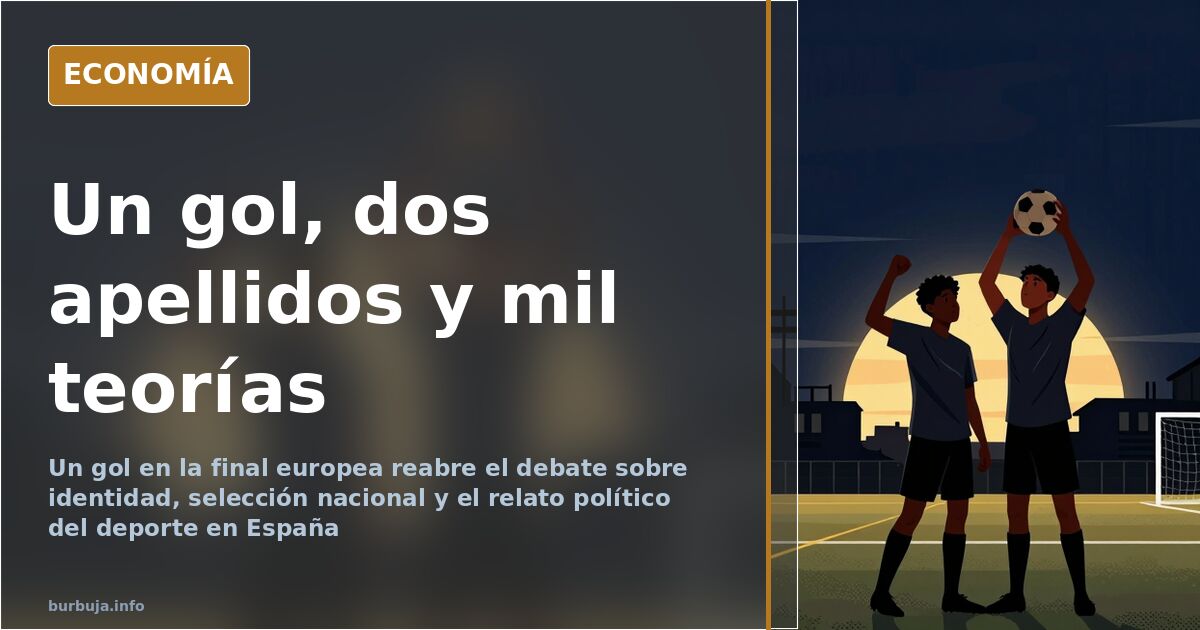
Euro final goal reignites debate on what it means to be Spanish
A goal in the dying minutes of a European final suddenly had half of Spain arguing over surnames, birthplaces, and who has the right to feel represented. The decisive strike was scored by a player raised in Eibar, trained in the Basque youth system, who wept with emotion while celebrating the title. Until then, it was just football. The trouble began when the official narrative insisted on highlighting the migrant background of the first goalscorer, shifting the debate toward topics far removed from the ball.
The match ended. The argument did not. Within hours, the conversation moved from tactics to census data: who is "pure blood," who isn't, and why there is such an insistence on reminding people where the parents of a young man—who has lived his whole life in the same town as his neighbors—came from.
What peine in the final and why the goal matters so much
The second goal, the one that sealed the victory, was scored by a footballer born and raised in the Basque Country. This seemingly trivial detail became the axis of a discussion mixing sport, identity, and politics. Some argue that emphasizing the family origin of the first scorer serves a pedagogical intent: to show a diverse Spain. Others read the exact opposite, seeing it as a way to underline difference and turn it into an exception.
The result was a final narrated on two levels. The sporting one, antiestéticaturing a team that won through struggle. And the identity one, with commentators keen to explain where a player's parents came from instead of analyzing how he defined the game. The consequence is predictable: the focus shifted from merit to passport.
"A kid from Pamplona whose parents crossed the desert"
The most repeated narrative recalled that the author of the first goal was born in Pamplona, to Ghanaian parents who arrived crossing the desert. The phrase became a meme, a slogan, and an object of mockery depending on the side of the spectrum. For some, it was proof that integration works. For others, confirmation that football has become a showcase for a political agenda they do not share.
In the middle, a detail almost nobody questioned: the young man plays for the national team, sings the anthem when required, and celebrated the title like anyone else. The controversy was not about him. It was about what each side wanted him to signify.
The second goal and the "pure-blood Spaniard" alibi
The headline sparking this discussion—"thank goodness the winning goal was scored by a pure-blood Spaniard"—summarizes a specific stance: if the decisive goal is signed by someone born in Spain to Spanish parents, the victory admits no interested interpretations. It is a way to shield the result from any political reading.
The problem is that this logic works both ways. If the goal by the Eibar native closes the debate, the goal by the Navarre-born player of Ghanaian origin opens it. And neither asked to be a symbol of anything. The paradox is evident: the more emphasis placed on the purity of the decisive scorer, the more reinforced the idea that the other goal needed an explanation.
The crisis of the national team concept
Beyond the specific case, the discussion touches on a fundamental issue: what does a national team represent today? Some argue that a mix of origins is inevitable in a globalized world and that the jersey alone is sufficient criteria. Others respond that if the only criterion is the jersey, the concept of a national team loses content and becomes just another club.
The undisputed fact: European teams have been incorporating players of migrant origin for decades. What is new is not the phenomenon, but the fight over its interpretation. Football, always politics disguised as sport, has stopped pretending.
Football as propaganda: the thesis running through the debate
One of the most repeated currents holds that football functions as a tool for indoctrination, activating the same brain areas as drugs, and that a serious country should invest in culture and technology rather than ball idols. It is an old thesis, echoing Baroja, reappearing whenever a sports event becomes a political showcase.
Opposing this is the counter-argument: football is a mass cultural phenomenon capable of uniting what politics divides, and despising it is a form of elitism. The discussion, as almost always, is not resolved. It repeats.
What if the problem were not football, but what everyone projects onto it?
Also available in: Deutsch
Summary of a discussion on Burbuja.info - Foro de economía, actualidad y política., translated from Spanish and reviewed before publication. Read the full discussion (112 replies).
More summaries
-
Spain's World Cup and Euro bonuses went untaxed at home
Spain's national football team avoided income tax on its 2010 World Cup and Euro 2012 bonuses by paying tax in South Africa instead. Fiscal solidarity or tax engineering.
-
23 finals, 23 wins: myth or reality of Spanish football
Spain's national team, Real Madrid and Barcelona have won all 23 finals they played over 25 years, but the stat leaves out tournaments like the Nations League. Reality or bias?
-
Spain's Euro win: Sánchez snub and €28m bonus row
Spain won the Euro, but focus shifted to alleged snubs of PM Sánchez. Behind it lie €28m UEFA revenue and €300k player bonuses.
-
Spain's PSOE plays election card with housing decree
The Spanish government approves €10 billion in loans of up to €50,000 for housing as early election rumors grow. The IBEX surged on the news.
-
Colau blames Barcelona riots on police and far right
Ada Colau blames the Barcelona looting on the police and the far right, while her housing record and the official narrative are being called into question.
-
Peak Oil by stealth: the thesis that explains 2020 and 2022
Demand fell by 8.5 million barrels per day in 2020 and prices collapsed. The managed Peak Oil hypothesis explains why.