
Spain's €5,000 pension bonus: equal to three months' salary
A €5,000 extra payment for a Spanish retiree reignites debate on pension sustainability and the growing gap between generations.
English · Original discussion in Spanish · Published
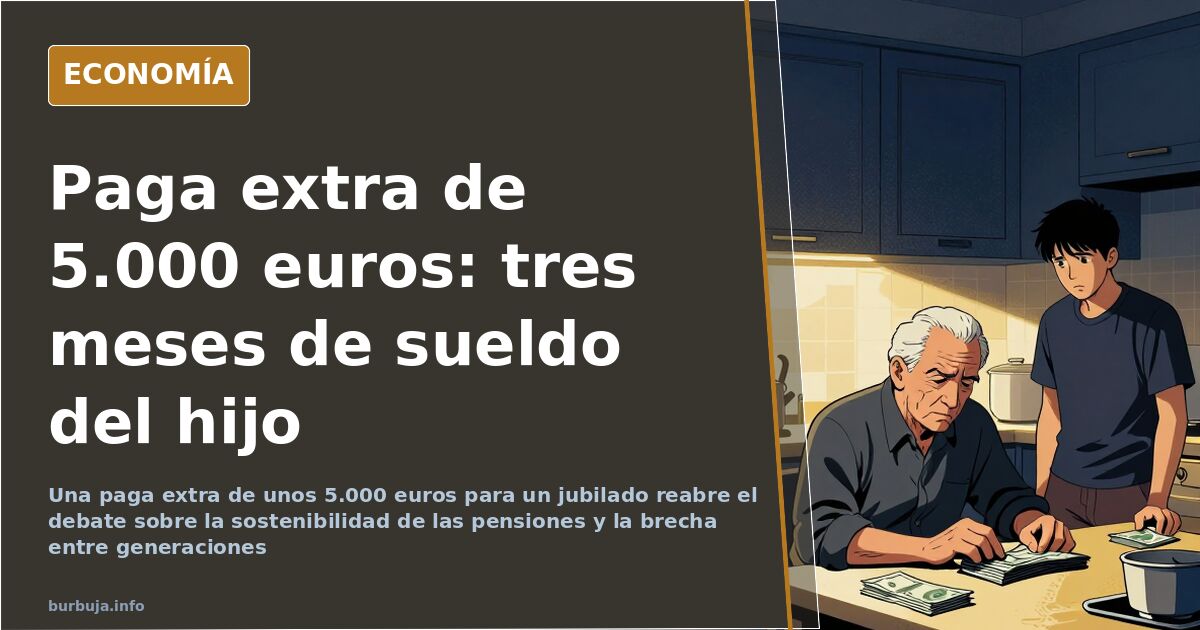
The €5,000 double payment and the widening generational divide
November paychecks have once again raised an uncomfortable question regarding Spain's pension system: how much of what retirees receive did they actually fund, versus what current workers are paying? The trigger is a specific case. A retiree recently received a bonus estimated at around €5,000, a sum their salaried son equates to three months of his own income. The ensuing discussion isn't about envy, but whether the system can withstand such disparities.
How much more do pensioners get than they contributed?
The most cited figure comes from the Banco de España: each pensioner receives €1.74 for every euro contributed, meaning a 74% return above contributions. Estimates suggest the average retiree collects €4,500 annually without having paid in, recovering their total contributions within twelve years of retirement. Beyond that point, every month represents a surplus.
Systemic figures offer little comfort. The so-called hucha (pension reserve fund) shifted from accumulating €66 billion to owing €66 billion to the tax treasury. This data turns an extraordinary payment into a political issue.
From 20 contributors per pensioner to one: the ratio explaining the crisis
Arithmetic dictates reality. During the Franco era, there were twenty contributors for every pensioner; today there are two, with projections showing just one contributor per retiree in coming decades. No pay-as-you-go system—funded by current inflows rather than past savings—can sustain this slope without raising contributions, cutting pensions, or adding new workers. Debates on individual merit pale beside this structural challenge.
Origins remain contested. Some argue Social Security began as a funded system where benefits matched contributions, transformed into a pay-as-you-go model by a government under Felipe González via non-contributory pensions and subsidies. If accurate, criticism should target the design, not the recipients.
The bonus: prorate it, eliminate it, or keep it?
Extra payments face scrutiny. One view labels them a Francoist legacy demanding abolition; another pragmatically suggests spreading them over twelve months for predictable income and better savings habits. Behavioral arguments note that lump-sum bonuses encourage immediate spending over long-term planning.
Consumption patterns complicate removal. Critics warn eliminating extras would cause spending to plummet, severely impacting an economy where households account for nearly half of all consumption.
Adjustment proposals and high-end pensions
Concrete austerity packages circulate. Recurring proposals include cutting public sector salaries by 35%, halving the number and pay of politicians, aligning all contributory pensions with the Minimum Interprofessional Wage (SMI), and transferring non-contributory ones to the Vital Minimum Income (IMV). Proponents claim these measures would close the state deficit, though analysts warn they could spark street protests.
High-income pensions remain separate. Approximately one million pensions exceed €2,500 monthly. Combined with bonuses and asset income, these profiles differ vastly from retirees struggling to reach month-end. Confusing these groups muddies the debate.
Money flows between parents and children
Underlying generational tension is an overlooked fact: Spanish household economies rely on continuous intergenerational transfers. Money and purchasing power flow from parents to children not out of generosity, but necessity: housing deposits, daily expenses, grandchildren. A society requiring permanent umbilical cords is hardly a welfare paradise.
Counter-examples cite retired civil servants in Group A earning over €10,000 in combined bonuses, or former industrial workers with no degrees receiving similar sums. Fiscal pressure adds context: 90.4% of IRPF (income tax) revenue comes from fewer than eight million taxpayers—one-sixth of the population.
Demography: the uncontrolled variable
Future sustainability hinges on demographics. Data indicates 2023 saw notable birth rates involving at least one foreign-born parent, led by Catalonia and the Balearic Islands. Interpretations diverge: some deem this demographic contribution essential for future pension payments; others view it as an added cost reducing margins for current contributors.
A tangential curiosity involves university scholarships for those over 50 in lifelong learning programs, justified by claims that this generation pioneered sending children abroad via Erasmus exchanges.
Analysis stalls here. Pay-as-you-go systems distribute today’s earnings from current workers, making each bonus a snapshot of conflict: recipients see rights, payers see bills. No narrative yet balances exploitation antiestéticars against privilege accusations.
Also available in: Deutsch
Summary of a discussion on Burbuja.info - Foro de economía, actualidad y política., translated from Spanish and reviewed before publication. Read the full discussion (217 replies).
More summaries
-
Debate: 36,000-euro flats for Spain's 1970s generation?
Housing access in Spain: was it a gift for the 1970s generation? A heated debate on prices, wages and policies that reopens the generational divide.
-
Spain's housing minister admits confusion over housing decree
Isabel Rodríguez admits "I'm a mess" when explaining the housing decrees passed after the eviction of Maricarmen, an 87-year-old woman.
-
Electric cars hit 52.8% of new registrations in the Netherlands
Electric cars accounted for 52.8% of new registrations in the Netherlands in September, with Tesla second. In Spain, nearly 18,000 public chargers remain out of service.
-
Spain's Verifactu invoicing system delayed to October 2028 in fourth postponement
Spain's Verifactu system, which will force freelancers to send every invoice to the tax authorities in real time, is delayed to October 2028 in its fourth postponement. The software…
-
Video of a head strike reignites the police baton debate in Spain
A video shows a person striking another's head with what appears to be a police baton, reigniting the debate over its material and legality in Spain.
-
Spain's road tax doesn't cover the land a car occupies
In Spain, a car can occupy the same stretch of street for 30 or 40 years without paying for public land, while a tent on the street sparks outrage.