
Spain's €23bn Gas Savings Claim Contradicts Rising Bills
Gas consumption for electricity rose 67% between 2016 and 2025, yet a claimed €23bn saving persists. The numbers do not add up.
English · Original discussion in Spanish · Published
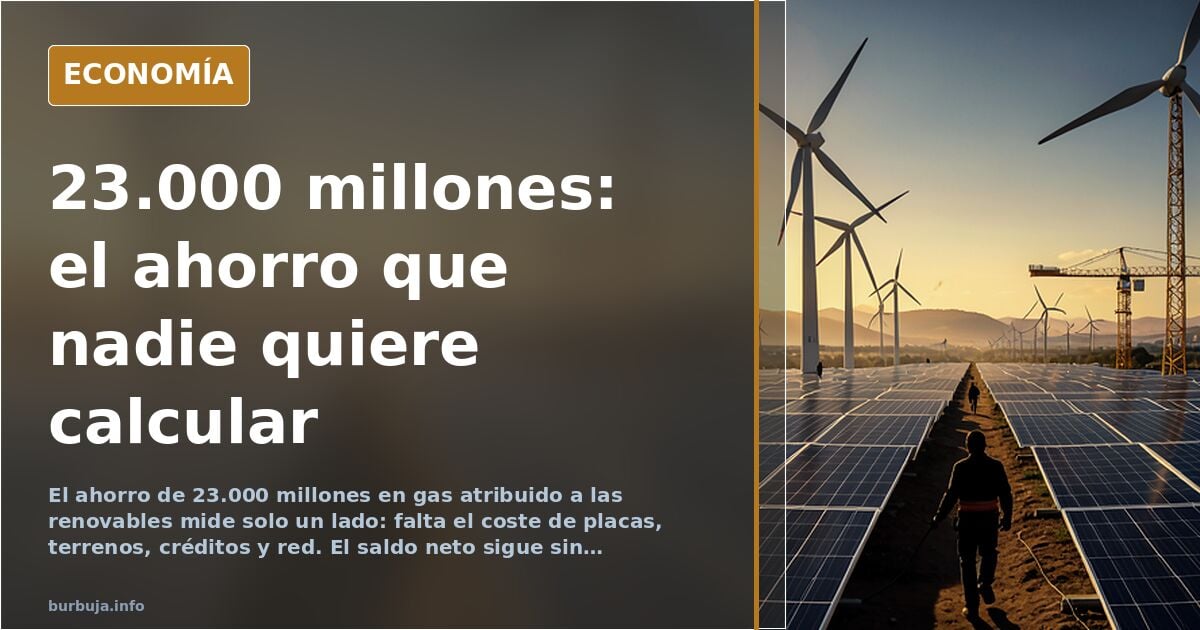
Spain's €23bn Gas Savings Claim Contradicts Rising Bills
Spain allegedly avoided purchasing €23 billion worth of gas thanks to renewables, a figure touted as a major achievement in recent debates. However, this claim is challenged when examining actual bills: gas used for power generation surged from 59.7 TWh in 2016 to 99.7 TWh in 2025, while total generation grew by just 3.8%, according to data presented by participants. If the savings are real, one must explain why more gas than ever is being burned.
The €23 billion figure is presented as a net balance but ignores the other half of the equation: the investment required to install, maintain, and connect renewable production to the grid. Critics note that costs for land, panels, wind turbines, loan amortization, and balancing services are omitted from headlines. Without them, the savings are merely an accounting illusion, akin to claiming fuel savings by leaving your car at home and taking taxis daily.
More Gas Burned Despite More Renewables Installed
Industry data does not support the narrative of significant savings. Between 2016 and 2025, gas used for combined-cycle plants jumped by 67%, while total electricity generation rose only 3.8%, according to debate figures. This means 32 GW of renewable capacity were added, bringing installed capacity to 139 GW, yet typical demand remains around 30 GW. The uncomfortable conclusion is that there is surplus capacity being wasted, while gas remains an essential backup.
Critics argue that the design of the electricity market exacerbates this paradox. The pool pays all energy at the price of the last technology entering the system, which is almost always gas. Consequently, every kWh of renewable energy is remunerated at gas prices, not its actual production cost. Consumers pay the difference. Bills do not fall; they rise. Meanwhile, retailers pass adjustment services and tolls—supposedly intended to compensate for massive renewable entry—onto receipts.
The Hidden Cost of the Transition
A comparison of generation costs dismantles another myth, based on data presented by participants. Nuclear power has an average cost of around €30/MWh, but after taxes and fees, it reaches €67/MWh in the market. Photovoltaic solar, with a similar generation cost (€35/MWh), stays at €35/MWh after fees. The difference is not technological but fiscal: nuclear is penalized while solar is favored. The result is a system paying energy at gas prices, with distorted incentives and final bills that do not reflect real production costs.
A complete breakdown reveals surprising discrepancies. Proponents of the savings claim that without renewables, gas expenditure would have been much higher; critics counter that transition costs have eaten into margins. In the middle, consumers pay an average of 20 cents per kWh, peaking at 40 cents during night hours, according to debate data. Where is the saving?
Your Electricity Bill
The debate is not whether renewables are good or bad. It is whether the savings narrative withstands numerical scrutiny. So far, the answer is no. Gas consumption has increased, electricity bills have risen, and the system still depends on gas to guarantee supply, critics say. Meanwhile, the €23 billion figure is repeated like a mantra without anyone explaining its origin or which costs are excluded.
The open question is uncomfortable: if the savings are so evident, why do bills not reflect them?
Also available in: Deutsch
Summary of a discussion on Burbuja.info - Foro de economía, actualidad y política., translated from Spanish and reviewed before publication. Read the full discussion (65 replies).
More summaries
-
Spain's shrinking industry halts as renewables falter
Lower summer wind output and a 35% cut in curtailment payments are bringing Spanish industry to a standstill. Meanwhile, nuclear's future is being decided behind closed doors.
-
Spain’s Power Bill: Renewables vs. Germany, the Truth
A viral claim says Spain pays less for electricity than Germany or Italy. The reality is complex, involving hydro, gas, and grid rules.
-
VOX launches tax savings calculator for economic plan
Critics argue VOX's simulator shows €400 savings for €18k salaries and €15k for €100k earners, highlighting disparities.
-
Ocarina of Time: The Classic Many Never Played
Released in 1998, Ocarina of Time defined 3D combat with Z-targeting. Rumors of a 2027 remake spark debate between myth and nostalgia.
-
Koldo García claims PP lawyer agreed to €1m deal
Koldo García alleges he agreed a €1m payment with the PP's lawyer for information to oust Sánchez, claiming non-payment. OK Diario invoices are central.
-
Adif removed 42 meters of track from Ademuz accident, forum claims
A forum user alleges Adif hid 42 meters of track from the Ademuz accident; Civil Guard photographed officials removing pieces without authorization.