
4,500-year-old Egyptian dress reconstructed from beads
A 4,500-year-old Egyptian dress reconstructed with 7,000 beads found in Giza reopens the debate on clothing during Khufu's reign.
English · Original discussion in Spanish · Published
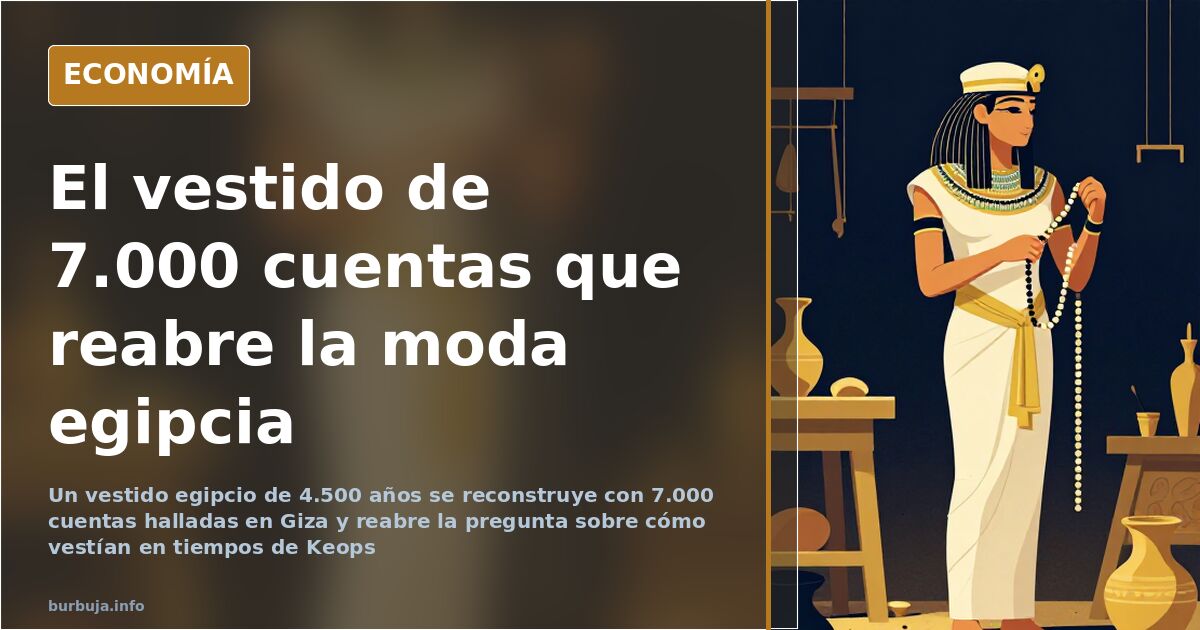
The 4,500-year-old Egyptian dress that reignites the debate on ancient fashion
How did women dress 4,500 years ago? The answer is not in a museum mannequin, but in 7,000 loose beads. An Egyptian dress reconstructed from these ornaments —found in an intact tomb in Giza— is attributed to a woman who lived during the reign of Pharaoh Khufu (2589-2566 BC). The original cords were not preserved, so what remains is a meticulous puzzle and an uncomfortable question: what was considered clothing five millennia ago, and who decided what could be shown?
What is the 7,000-bead Egyptian dress
The starting point is archaeological. The beads appeared in an unlooted tomb, allowing them to be attributed to a specific woman from a specific era: that of Pharaoh Khufu, the same one associated with the Great Pyramid. Reassembling the piece required recreating the position of each bead, because the thread holding them together had disintegrated over time.
The reconstruction does not return a complete garment, but rather an hypothesis. And everything else stems from there. Because a dress recovered from 7,000 beads says much about those who have recomposed it and far less about those who wore it.
Were Egyptian women covered or exposed?
The issue that has split the interpretation of the find in two is whether that clothing left the body visible or, conversely, responded to an established modesty. One school argues that torso exposure was common and dictated by the climate. The opposing view suggests that a full outfit could cover much of the body and that judging it with modern eyes leads directly to error.
A warning is needed to avoid jumping to conclusions: reconstructing a garment is not equivalent to photographing an entire society. That a specific dress has a certain shape does not miccionan all women of its time dressed alike. The elite, servants, and commoners did not share a wardrobe or norms, nor even the same climate.
Minoan fashion competing with Egyptian
Amidst the conversation, another culture emerged as a term of comparison: Cretan or Minoan, whose garments, according to those bringing it up, left even less to the imagination than Egyptian ones. The comparison serves a concrete and undisputed purpose. It reminds us that the ancient Mediterranean was a mosaic of customs, not a uniform block, and that what we now call Antiquity hides centuries of internal differences.
Herodotus and the king who lost his throne for spying on his vvife
To gauge how much the outsider's gaze has changed, there is a story that has been cited. Herodotus recounts that a King of Lydia, proud of his vvife's beauty, invited his trusted man, Gyges, to spy on her while she undressed. The queen discovered him, and the episode ended with the monarch's crown and life.
The tale is much later than Khufu and serves exactly the opposite of what it seems. It demonstrates that rules regarding modesty and the gaze of others were not today's, but neither were they those of the Bronze Age. Each era set its own stage.
Why Antiquity was not a single era
Here enters the nuance that causes the most discomfort. There is a tendency to treat Antiquity as a monolithic block, when between the Sumerians and the late empire there are abyssal differences, in some aspects greater than those separating the Greco-Roman world from the current one, barring the technological leap. Palace elites of the Bronze Age were more alien to a Greek or a Persian than medieval Europe itself.
In other words, the Giza dress does not depict an eternal custom, but a specific instant within a very long sequence.
Beauty standards then were not those of now
Another point that has surfaced is aesthetics. What a culture considers beautiful changes with the century and latitude, and projecting current tastes onto a woman from 4,500 years ago is an exercise doomed to failure. The 7,000-bead dress does not describe a beauty ideal: it describes a way of dressing, and not even that with total certainty. Standards are an invention of each era to look at itself.
Life expectancy, the forgotten data
And a reminder that slips into any conversation about the ancient world: life expectancy did not reach 30 years. Any reconstruction of attire, modesty, or customs clashes with that demographic reality. Little room for aesthetic subtleties when life faded so quickly.
Recomposing 7,000 beads requires archaeological patience. Deducing what they meant for the woman who wore them is another matter. And of that, the truth, there is not a single clear bead.
How did women dress 4,500 years ago? The answer is not in a museum mannequin, but in 7,000 loose beads. An Egyptian dress reconstructed from these ornaments —found in an intact tomb in Giza— is attributed to a woman who lived during the reign of Pharaoh Khufu (2589-2566 BC). The original cords were not preserved, so what remains is a meticulous puzzle and an uncomfortable question: what was considered clothing five millennia ago, and who decided what could be shown?
What is the 7,000-bead Egyptian dress
The starting point is archaeological. The beads appeared in an unlooted tomb, allowing them to be attributed to a specific woman from a specific era: that of Pharaoh Khufu, the same one associated with the Great Pyramid. Reassembling the piece required recreating the position of each bead, because the thread holding them together had disintegrated over time.
The reconstruction does not return a complete garment, but rather an hypothesis. And everything else stems from there. Because a dress recovered from 7,000 beads says much about those who have recomposed it and far less about those who wore it.
Were Egyptian women covered or exposed?
The issue that has split the interpretation of the find in two is whether that clothing left the body visible or, conversely, responded to an established modesty. One school argues that torso exposure was common and dictated by the climate. The opposing view suggests that a full outfit could cover much of the body and that judging it with modern eyes leads directly to error.
A warning is needed to avoid jumping to conclusions: reconstructing a garment is not equivalent to photographing an entire society. That a specific dress has a certain shape does not miccionan all women of its time dressed alike. The elite, servants, and commoners did not share a wardrobe or norms, nor even the same climate.
Minoan fashion competing with Egyptian
Amidst the conversation, another culture emerged as a term of comparison: Cretan or Minoan, whose garments, according to those bringing it up, left even less to the imagination than Egyptian ones. The comparison serves a concrete and undisputed purpose. It reminds us that the ancient Mediterranean was a mosaic of customs, not a uniform block, and that what we now call Antiquity hides centuries of internal differences.
Herodotus and the king who lost his throne for spying on his vvife
To gauge how much the outsider's gaze has changed, there is a story that has been cited. Herodotus recounts that a King of Lydia, proud of his vvife's beauty, invited his trusted man, Gyges, to spy on her while she undressed. The queen discovered him, and the episode ended with the monarch's crown and life.
The tale is much later than Khufu and serves exactly the opposite of what it seems. It demonstrates that rules regarding modesty and the gaze of others were not today's, but neither were they those of the Bronze Age. Each era set its own stage.
Why Antiquity was not a single era
Here enters the nuance that causes the most discomfort. There is a tendency to treat Antiquity as a monolithic block, when between the Sumerians and the late empire there are abyssal differences, in some aspects greater than those separating the Greco-Roman world from the current one, barring the technological leap. Palace elites of the Bronze Age were more alien to a Greek or a Persian than medieval Europe itself.
In other words, the Giza dress does not depict an eternal custom, but a specific instant within a very long sequence.
Beauty standards then were not those of now
Another point that has surfaced is aesthetics. What a culture considers beautiful changes with the century and latitude, and projecting current tastes onto a woman from 4,500 years ago is an exercise doomed to failure. The 7,000-bead dress does not describe a beauty ideal: it describes a way of dressing, and not even that with total certainty. Standards are an invention of each era to look at itself.
Life expectancy, the forgotten data
And a reminder that slips into any conversation about the ancient world: life expectancy did not reach 30 years. Any reconstruction of attire, modesty, or customs clashes with that demographic reality. Little room for aesthetic subtleties when life faded so quickly.
Recomposing 7,000 beads requires archaeological patience. Deducing what they meant for the woman who wore them is another matter. And of that, the truth, there is not a single clear bead.
Also available in: Deutsch
Summary of a discussion on Burbuja.info - Foro de economía, actualidad y política., translated from Spanish and reviewed before publication. Read the full discussion (137 replies).
More summaries
-
Egypt's Pyramids: The Mystery of 80-Ton Stones
2.5 million blocks, some weighing 80 tons, placed every 4 minutes over 20 years. The enigma of the pyramids from an economic and logistical perspective.
-
The Blue Dress That Altered King Felipe VI’s Future
25 years since Eva Sannum’s photo in a blue dress ended her relationship with King Felipe VI, sparking debate on the Crown's opportunity cost.
-
Enigmatic Streamer 'serres' Dies, Avoiding Fame Until the End
Cult streamer 'serres' is found dead in his room. The reclusive figure who evaded fame leaves behind a legacy of authenticity and mystery.
-
Spain's DANA Recovery: Who Controls the Aid Funds?
A temporary bypass detour in Valencia cost €13m, sparking debate over audit transparency and emergency contract awards.
-
Spanish Content Creator Sparks Debate on Female Interest Claims
A Spanish influencer defends his views on women seeking resources, igniting a fierce debate about the booming masculinity coaching industry.
-
From ECB Liquidity to Corralito: Measuring Economic Collapse
Recent violent incidents in Barcelona and the death of Civil Guards revive debates on systemic fragility and the risk of a financial corralito.