
Spain's ECO Label: 18L SUVs Allowed, 4.3L Diesels Banned
In Madrid, high-consumption SUVs with the Spanish 'ECO' environmental badge enter low-emission zones while efficient diesel cars are restricted.
English · Original discussion in Spanish · Published
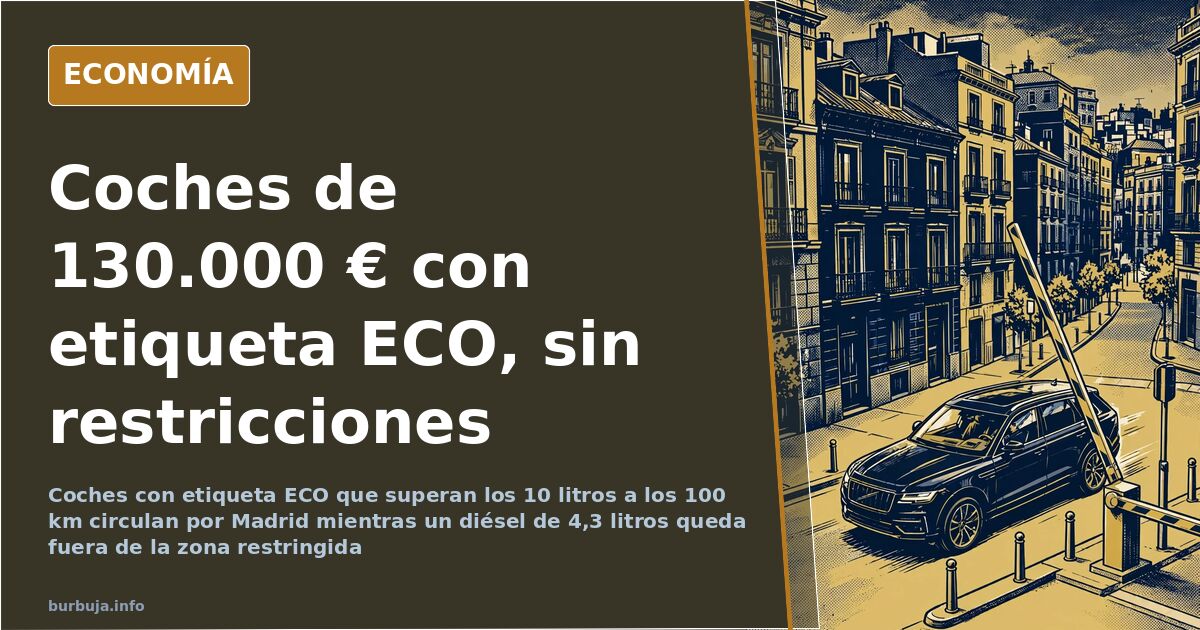
The Rich Pay Less: High-Consuming ECO Cars Still Drive in Spain
Why can a three-tonne crossover consuming 18 liters per 100 km still enter central Madrid, while a diesel car using just 4.3 liters is barred? The official answer lies in the environmental badge. Common sense, however, offers no such label.
Current classification does not measure real fuel consumption but rather vehicle technology. Any car with hybridization—including so-called mild hybrids, which cannot move even one meter in electric mode—qualifies for the ECO badge. Critics argue this creates a market where badges are bought: vehicles certified as ECO exceed 10 liters per 100 km and cost over €130,000.
Why Does a €130,000 Hybrid Get an ECO Badge While a 1,000cc City Car Doesn't?
Because regulations reward propulsion systems, not environmental outcomes. A 1,000cc petrol city car remains classified as C, and a diesel consuming 4.3 liters—which participants claim is more efficient than many authorized vehicles—also fails to upgrade, despite valid inspections and documentation.
This is the core issue. Administrative criteria separate owners of small diesel cars from hybrid SUV owners, not based on pollution levels. The prevailing conclusion is that the system rewards those who can afford the badge and punishes those who cannot: it is called a "circus," arguing that authorized lists include models with double-digit consumption figures.
Fines as Business: Calculating €20 Million Monthly Revenue
Some argue the goal is not emission reduction but forcing fleet renewal through penalties. Estimates circulating suggest municipal CO2-related fines exceed €20 million in a single month, primarily paid by drivers from outer suburbs. This remains an unverified estimate and should be read as such.
A more uncomfortable interpretation suggests the measure forces new car purchases on those who cannot afford them, while those unable to buy still pay. The underlying thesis is that private car ownership is becoming a luxury reserved for minorities, not via explicit bans but through economic filters of rules, fees, and sanctions. This pattern appears elsewhere: nothing is banned; costs simply rise until most people opt out.
The Root Problem: Offices Moved Near Executives' Homes
Transport issues aren't solved by changing labels, and structural data repeats itself: jobs concentrate where management lives and works. Practically, a suburban worker may spend two or three hours daily commuting between the M30 and M40 ring roads, while their boss takes ten minutes to arrive, only on office days.
One anecdote describes a reverse relocation: when the owner's vvife, holding an administrative role, had a child, the forty-minute commute to the center became unbearable. Headquarters moved next to the executive housing estate, leaving all other employees facing three hours of daily public transport commutes. The sarracena is hard to dispute: whoever decides office location dictates how much time others lose.
London and Oslo: Direct Congestion Charges Without Labels
International comparisons cited point in the same direction. London and Oslo implemented direct congestion charges for all entering restricted zones, without disguising them as technological labels. The result, critics say, is less hypocritical: those who cannot pay are excluded, but openly and without pretending to save the planet.
Towards the end, unconfirmed warnings emerge about European regulations making used vehicle repairs difficult, pushing consumers toward new purchases. This aligns with the general thesis: declared goals focus on climate; observable effects concentrate resources among the wealthy while average citizens lose mobility.
Has Restriction Worked? Traffic Remains Unchanged
Here, street-level data divides opinions. Some assert Madrid remains impossible at all hours, with restrictions showing no impact: same jams, same queues, same feeling that air quality doesn't improve regardless of windshield stickers.
Conversely, another testimony highlights a different side effect: driving around the capital reveals nearly all license plates belong to recent series, with older prefixes increasingly rare. If confirmed, the measure hasn't reduced car numbers but accelerated fleet replacement. Madrid now has one of the country's newest vehicle fleets, at significant financial cost to families forced to finance upgrades.
Campaign Slogans and Social Shields
Politics plays a background role. Electoral promises to abolish Madrid Central and subsequent policy reversals are recalled, highlighting overlaps between opposition critics and government maintainers. The environmental badge has ceased being technical, becoming campaign ammunition.
Accusations circulate that certain rules are designed considering official cars and drafters' interests, suggesting systemic classism. These claims lack proof and fail scrutiny as closed accusations. Yet as descriptions of public discontent, they explain why the issue ignites widespread anger. Given these dynamics, it is unsurprising the ECO badge sparked controversy; what is surprising is anyone still believing the badge measures air quality.
Why can a three-tonne crossover consuming 18 liters per 100 km still enter central Madrid, while a diesel car using just 4.3 liters is barred? The official answer lies in the environmental badge. Common sense, however, offers no such label.
Current classification does not measure real fuel consumption but rather vehicle technology. Any car with hybridization—including so-called mild hybrids, which cannot move even one meter in electric mode—qualifies for the ECO badge. Critics argue this creates a market where badges are bought: vehicles certified as ECO exceed 10 liters per 100 km and cost over €130,000.
Why Does a €130,000 Hybrid Get an ECO Badge While a 1,000cc City Car Doesn't?
Because regulations reward propulsion systems, not environmental outcomes. A 1,000cc petrol city car remains classified as C, and a diesel consuming 4.3 liters—which participants claim is more efficient than many authorized vehicles—also fails to upgrade, despite valid inspections and documentation.
This is the core issue. Administrative criteria separate owners of small diesel cars from hybrid SUV owners, not based on pollution levels. The prevailing conclusion is that the system rewards those who can afford the badge and punishes those who cannot: it is called a "circus," arguing that authorized lists include models with double-digit consumption figures.
Fines as Business: Calculating €20 Million Monthly Revenue
Some argue the goal is not emission reduction but forcing fleet renewal through penalties. Estimates circulating suggest municipal CO2-related fines exceed €20 million in a single month, primarily paid by drivers from outer suburbs. This remains an unverified estimate and should be read as such.
A more uncomfortable interpretation suggests the measure forces new car purchases on those who cannot afford them, while those unable to buy still pay. The underlying thesis is that private car ownership is becoming a luxury reserved for minorities, not via explicit bans but through economic filters of rules, fees, and sanctions. This pattern appears elsewhere: nothing is banned; costs simply rise until most people opt out.
The Root Problem: Offices Moved Near Executives' Homes
Transport issues aren't solved by changing labels, and structural data repeats itself: jobs concentrate where management lives and works. Practically, a suburban worker may spend two or three hours daily commuting between the M30 and M40 ring roads, while their boss takes ten minutes to arrive, only on office days.
One anecdote describes a reverse relocation: when the owner's vvife, holding an administrative role, had a child, the forty-minute commute to the center became unbearable. Headquarters moved next to the executive housing estate, leaving all other employees facing three hours of daily public transport commutes. The sarracena is hard to dispute: whoever decides office location dictates how much time others lose.
London and Oslo: Direct Congestion Charges Without Labels
International comparisons cited point in the same direction. London and Oslo implemented direct congestion charges for all entering restricted zones, without disguising them as technological labels. The result, critics say, is less hypocritical: those who cannot pay are excluded, but openly and without pretending to save the planet.
Towards the end, unconfirmed warnings emerge about European regulations making used vehicle repairs difficult, pushing consumers toward new purchases. This aligns with the general thesis: declared goals focus on climate; observable effects concentrate resources among the wealthy while average citizens lose mobility.
Has Restriction Worked? Traffic Remains Unchanged
Here, street-level data divides opinions. Some assert Madrid remains impossible at all hours, with restrictions showing no impact: same jams, same queues, same feeling that air quality doesn't improve regardless of windshield stickers.
Conversely, another testimony highlights a different side effect: driving around the capital reveals nearly all license plates belong to recent series, with older prefixes increasingly rare. If confirmed, the measure hasn't reduced car numbers but accelerated fleet replacement. Madrid now has one of the country's newest vehicle fleets, at significant financial cost to families forced to finance upgrades.
Campaign Slogans and Social Shields
Politics plays a background role. Electoral promises to abolish Madrid Central and subsequent policy reversals are recalled, highlighting overlaps between opposition critics and government maintainers. The environmental badge has ceased being technical, becoming campaign ammunition.
Accusations circulate that certain rules are designed considering official cars and drafters' interests, suggesting systemic classism. These claims lack proof and fail scrutiny as closed accusations. Yet as descriptions of public discontent, they explain why the issue ignites widespread anger. Given these dynamics, it is unsurprising the ECO badge sparked controversy; what is surprising is anyone still believing the badge measures air quality.
Also available in: Deutsch
Summary of a discussion on Burbuja.info - Foro de economía, actualidad y política., translated from Spanish and reviewed before publication. Read the full discussion (137 replies).
More summaries
-
Madrid Court Cancels Low Emission Zones Due to Flawed Economic Report
The TSJM cancels Madrid’s Low Emission Zones, striking down Centro and Plaza Elíptica due to an insufficient economic impact assessment. The ruling is subject to appeal before the Supreme Court.
-
Low Emission Zones (ZBE) in Autumn: 'B' Stickers Lose Value, 'Eco' Hybrids Gain
Spanish Low Emission Zones (ZBE) are delayed until autumn. 'B' stickers become less valuable, while 'Eco' hybrid cars gain traction.
-
Madrid fines 200 euros for driving without environmental label
Madrid ends grace period: 200 euro fine for driving without label in low-emission zone, new ordinance pending.
-
Spain aims to approve 4.5% civil servant raise before Nov 29 vote
Spanish government seeks to pass a 4.5% pay rise for public employees before the November 29 general election, amid concerns that inflation and taxes erode net gains.
-
Homeowner Arrested After Defending Against Armed Intruders
Three armed men break into a home; the resident injures one and is arrested, reigniting debate on self-defense laws.
-
Saunas and PSOE: Unproven Theory on Sánchez's Origin
A commentator claims Pedro Sánchez entered the PSOE via his father-in-law's saunas. No evidence supports this alleged political blackmail.