
Homeowner Arrested After Defending Against Armed Intruders
Three armed men break into a home; the resident injures one and is arrested, reigniting debate on self-defense laws.
English · Original discussion in Spanish · Published
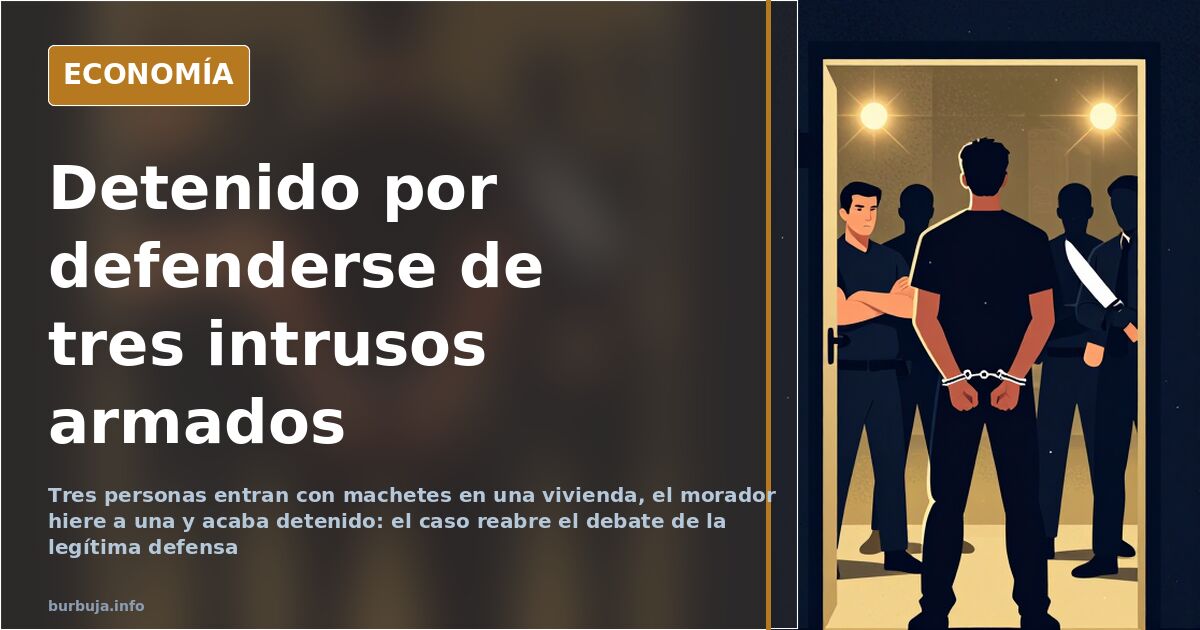
Man Arrested for Using Machete to Fight Off Three Intruders
A 48-year-old man was in his home when three people armed with machetes broke in. They attacked him. He struggled, seized a weapon from one aggressor, and injured him. When police arrived, only the homeowner was handcuffed. This is the core of an incident that has sparked conversation: the assault victim, arrested; the injured attacker, hospitalized.
Two incompatible narratives have emerged from this event. One argues that arresting the resident shows the system treats citizens who defend themselves as incivil. The other offers a more pragmatic view: police do not acquit or convict; they investigate, and preventive detention is not a verdict. The gap between these views defines the issue.
What Happens When Someone Defends Their Home?
The first answer is uncomfortable: there is no license to use lethal force without consequences. The law examines whether the response was necessary and proportionate to the attack, considering physical disadvantage, numerical superiority, and the exact moment the threat ceased.
In this case, according to circulating accounts, three armed individuals entered, threats were not just verbal, and the resident had to defend himself using one of the weapons used against him. The resident was 48; one attacker was 16 years younger. It is argued that this scenario fits the criteria for responding to a sudden aggression within the home. However, the final classification is decided by a judge, not headlines or the victim's state of mind.
Who Is Detained and How Details Refine the Headline
The most widespread summary claims the resident is the only person detained. Other versions suggest the injured man in the hospital may also face charges, and others would be if they hadn't fled. If true, the headline loses its impact, and the case becomes routine: a police report with multiple suspects.
Procedural aspects are also noted. Police can detain preventively for injuries caused, leaving the rest to the court, potentially allowing the resident to return home. A procedural asymmetry is highlighted: injuring someone in a street fight differs legally from injuring someone who just broke into your house.
The Twist That Changes the Narrative: Identities and Retaliation
The piece that most alters the story appears at the end: the detainee shares origins with some attackers. With this data, the robbery hypothesis weakens, and retaliation gains traction, according to information emerging about the case.
This is not a minor detail. If it was retaliation, the episode ceases to be about a citizen repelling strangers and becomes something else: a prior conflict between acquaintances. Here, the heroic narrative evaporates, along with public interest.
US Cases Used as a Mirror
The most repeated contrast comes from the United States. In one cited incident, six people broke into a home: one died on the spot, and five fled, though they were later arrested. In another, all three intruders ended up dead. The conclusion drawn is simple: there, defenders rarely end up handcuffed.
The mirror has another side. Recall the case of an elderly man who shot an attacker armed with a chainsaw and then finished off the wounded intruder on the ground; he was convicted. Shooting someone who no longer poses a threat is not self-defense. The exact line between defense and execution is what no headline resolves.
Private Property, Legal Uncertainty, and an Academic Anecdote
The economic underpinning is familiar: if defending your property exposes you to prosecution, the cost of ownership rises. Insurance, bars, weapons in drawers, and decisions not to intervene are rational responses to this uncertainty, none of which are free.
An academic anecdote circulates: a student who answered that private property rights do not exist in practice in Spain was marked incorrect but continued defending their thesis outside class. It might be an exaggeration. Or it might not.
With these elements, the 48-year-old detainee is just the latest piece in an old discussion: how much self-defense does a State tolerate before calling it a crime? The three people who entered his home remain unnamed publicly. He now has a name, but not the one he wanted.
In the US episode serving as a mirror, five of six intruders fled and were later arrested. Here, so far, the detention making headlines is that of the man who had every right to be in that house.
A 48-year-old man was in his home when three people armed with machetes broke in. They attacked him. He struggled, seized a weapon from one aggressor, and injured him. When police arrived, only the homeowner was handcuffed. This is the core of an incident that has sparked conversation: the assault victim, arrested; the injured attacker, hospitalized.
Two incompatible narratives have emerged from this event. One argues that arresting the resident shows the system treats citizens who defend themselves as incivil. The other offers a more pragmatic view: police do not acquit or convict; they investigate, and preventive detention is not a verdict. The gap between these views defines the issue.
What Happens When Someone Defends Their Home?
The first answer is uncomfortable: there is no license to use lethal force without consequences. The law examines whether the response was necessary and proportionate to the attack, considering physical disadvantage, numerical superiority, and the exact moment the threat ceased.
In this case, according to circulating accounts, three armed individuals entered, threats were not just verbal, and the resident had to defend himself using one of the weapons used against him. The resident was 48; one attacker was 16 years younger. It is argued that this scenario fits the criteria for responding to a sudden aggression within the home. However, the final classification is decided by a judge, not headlines or the victim's state of mind.
Who Is Detained and How Details Refine the Headline
The most widespread summary claims the resident is the only person detained. Other versions suggest the injured man in the hospital may also face charges, and others would be if they hadn't fled. If true, the headline loses its impact, and the case becomes routine: a police report with multiple suspects.
Procedural aspects are also noted. Police can detain preventively for injuries caused, leaving the rest to the court, potentially allowing the resident to return home. A procedural asymmetry is highlighted: injuring someone in a street fight differs legally from injuring someone who just broke into your house.
The Twist That Changes the Narrative: Identities and Retaliation
The piece that most alters the story appears at the end: the detainee shares origins with some attackers. With this data, the robbery hypothesis weakens, and retaliation gains traction, according to information emerging about the case.
This is not a minor detail. If it was retaliation, the episode ceases to be about a citizen repelling strangers and becomes something else: a prior conflict between acquaintances. Here, the heroic narrative evaporates, along with public interest.
US Cases Used as a Mirror
The most repeated contrast comes from the United States. In one cited incident, six people broke into a home: one died on the spot, and five fled, though they were later arrested. In another, all three intruders ended up dead. The conclusion drawn is simple: there, defenders rarely end up handcuffed.
The mirror has another side. Recall the case of an elderly man who shot an attacker armed with a chainsaw and then finished off the wounded intruder on the ground; he was convicted. Shooting someone who no longer poses a threat is not self-defense. The exact line between defense and execution is what no headline resolves.
Private Property, Legal Uncertainty, and an Academic Anecdote
The economic underpinning is familiar: if defending your property exposes you to prosecution, the cost of ownership rises. Insurance, bars, weapons in drawers, and decisions not to intervene are rational responses to this uncertainty, none of which are free.
An academic anecdote circulates: a student who answered that private property rights do not exist in practice in Spain was marked incorrect but continued defending their thesis outside class. It might be an exaggeration. Or it might not.
With these elements, the 48-year-old detainee is just the latest piece in an old discussion: how much self-defense does a State tolerate before calling it a crime? The three people who entered his home remain unnamed publicly. He now has a name, but not the one he wanted.
In the US episode serving as a mirror, five of six intruders fled and were later arrested. Here, so far, the detention making headlines is that of the man who had every right to be in that house.
Also available in: Deutsch
Summary of a discussion on Burbuja.info - Foro de economía, actualidad y política., translated from Spanish and reviewed before publication. Read the full discussion (111 replies).
More summaries
-
US Embassy Staff Collaborated with Police in Zapatero Money Laundering Probe
US embassy staff assisted Spanish police in the Zapatero money laundering investigation, sparking debate on political purges vs. justice.
-
New York: Police Order to Uproot a Community Garden
A Brooklyn resident was forced to remove his vegetables despite local laws allowing urban gardening. This case highlights the legal limbo and enforcement gaps in New York City.
-
Galician regional government to fund driving licenses for legalized migrants
The Xunta will cover the cost of driver's licenses for migrants who have regularized their status: over €1,000 per person, and a growing debate about who should foot the bill.
-
Barcelona Cookie Girl Video Sparks Debate on Human Behavior
A viral 2019 video shows a girl offering free cookies in Barcelona, triggering a rush that highlights human behavior when resources are unregulated.
-
Europe Controls Just 5% of AI Compute: Critical Dependency
Europe holds only 5% of global AI compute capacity versus the US's 75%. Strategic dependency and energy bottlenecks pose significant risks.
-
Spain's Transport Minister Mandates Green Paint for All Buses
Óscar Puente orders all state-concession buses to be painted green to unify public image, sparking criticism over costs and business suspicions.