
Spain's driving test for older drivers that almost nobody fails
An accident involving an octogenarian driver who was not drug-tested reopens the debate: the medical fitness test fails almost no one and substance checks are rare.
English · Original discussion in Spanish · Published
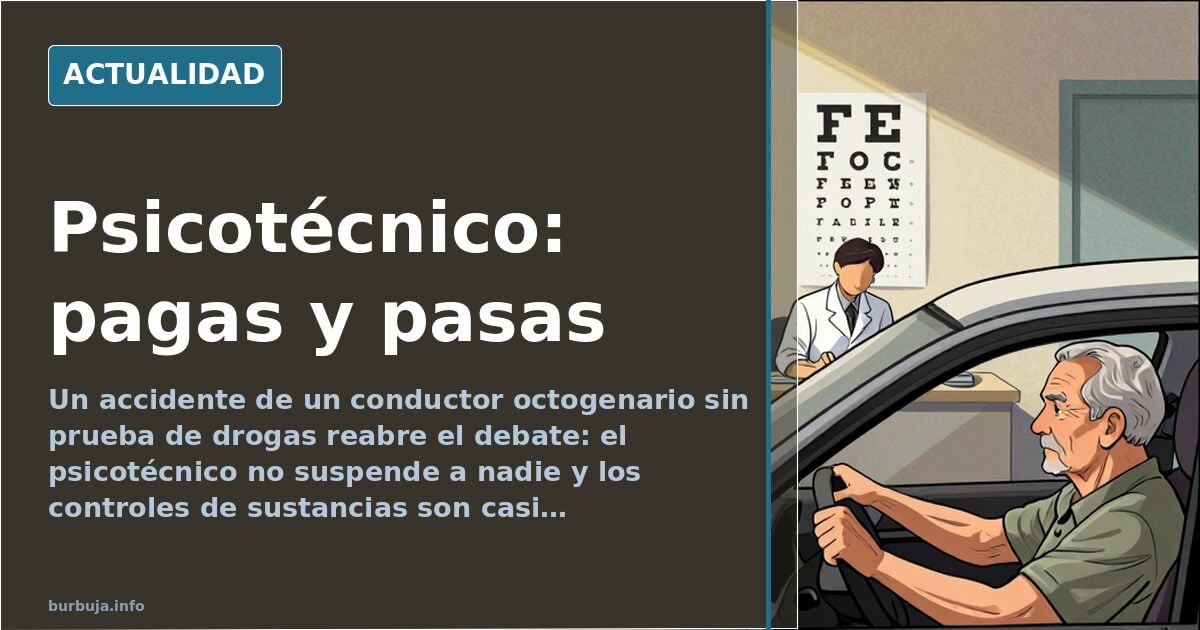
The fitness test that almost nobody fails
An octogenarian causes a traffic accident and is not given a drug test. The reason circulating in the debate is not technical: if he tested positive, the matter would stop being an accident and become a social problem. The suspicion is not backed by data, but the fact that does come up again and again is another one. Nobody knows anyone whose driving fitness test was failed. And in a country where the over-80s already number more than six million, that phrase carries more weight than any official statistic.
What peine and why drug tests are being discussed
The case that peine the issue is an accident caused by an octogenarian driver. What matters is not the crash itself, but what did not happen afterwards: he was not given a drug test. The explanation repeated is that a positive result would force open an uncomfortable can of worms, that of older drivers who take medication or substances and keep driving with a valid certificate.
Some argue that the omission was a matter of convenience. If the positive result were made public, the story would stop being an "accident" and become "incapacitated elderly person driving", with a political problem underneath: the over-65s are the most disciplined voting bloc at the polls. Angering them comes at a cost. Against this weighs a simple argument: there is no evidence that such an instruction exists, and attributing a deliberate omission to the administration without proof is, for now, a hypothesis.
The fitness test you pass by paying
The heart of the matter is not the drug test. It is the medical fitness test. The experience repeated most insistently is always the same: there is not a single known case of failure. Octogenarian parents by the dozen, all with their certificate renewed. The only case mentioned of a licence being withdrawn is that of some children who handed it in at a police station because their father was not fit to drive. And he had passed the fitness test. If you pay, you pass, sums up the most repeated conclusion.
That turns the system into just another administrative procedure rather than a health filter. The practical consequence is that the decision to stop driving is left to the family or to the driver himself, not to the medical examination. And that is where the matter stops being an anecdote and becomes a road safety problem with no effective control mechanism.
The accidents that are not counted as such
The second thread of the issue is statistics. It is argued that crashes involving older drivers are not broken down or publicised with the same detail as others. The suspicion is that the lack of data is not accidental: what is not measured does not exist politically. If there is no specific statistical series, there is no pressure to change the rules.
Alongside this appears the opposite complaint, that of professional drivers. It is argued that a lorry or bus driver is forced to retire at 60 for safety reasons, while a private individual is allowed to keep driving at 90. The asymmetry is real and the argument has mileage: if age is an objective risk factor for a professional, it is hard to see why it stops being one for a private driver. The usual answer is that the professional drives eight hours a day and the private individual half an hour. True. But the private individual does not take a real medical exam.
The drug test nobody is given
The third front is testing. The complaint is not only that older drivers are not tested: it is that testing is not done in general. Cases are mentioned of drivers who test positive and keep driving, and of those sanctioned who take the law into their own hands. The perception of impunity is the common denominator of all positions, even those that do not share the diagnosis about older drivers.
There is the unsettling point: the discussion is not about whether octogenarians are dangerous. It is about whether the control system exists or is just a facade. A fitness test that fails no one, a drug test that is not carried out and statistics that do not break down the data. Three pieces that, together, sketch out a road safety mechanism that works only on paper.
The question is not whether older people should have their licences taken away. It is whether the examination that should detect the problem is good for anything. With the available data, the honest answer is that we do not know. And in road safety, that is worse than a no.
An octogenarian causes a traffic accident and is not given a drug test. The reason circulating in the debate is not technical: if he tested positive, the matter would stop being an accident and become a social problem. The suspicion is not backed by data, but the fact that does come up again and again is another one. Nobody knows anyone whose driving fitness test was failed. And in a country where the over-80s already number more than six million, that phrase carries more weight than any official statistic.
What peine and why drug tests are being discussed
The case that peine the issue is an accident caused by an octogenarian driver. What matters is not the crash itself, but what did not happen afterwards: he was not given a drug test. The explanation repeated is that a positive result would force open an uncomfortable can of worms, that of older drivers who take medication or substances and keep driving with a valid certificate.
Some argue that the omission was a matter of convenience. If the positive result were made public, the story would stop being an "accident" and become "incapacitated elderly person driving", with a political problem underneath: the over-65s are the most disciplined voting bloc at the polls. Angering them comes at a cost. Against this weighs a simple argument: there is no evidence that such an instruction exists, and attributing a deliberate omission to the administration without proof is, for now, a hypothesis.
The fitness test you pass by paying
The heart of the matter is not the drug test. It is the medical fitness test. The experience repeated most insistently is always the same: there is not a single known case of failure. Octogenarian parents by the dozen, all with their certificate renewed. The only case mentioned of a licence being withdrawn is that of some children who handed it in at a police station because their father was not fit to drive. And he had passed the fitness test. If you pay, you pass, sums up the most repeated conclusion.
That turns the system into just another administrative procedure rather than a health filter. The practical consequence is that the decision to stop driving is left to the family or to the driver himself, not to the medical examination. And that is where the matter stops being an anecdote and becomes a road safety problem with no effective control mechanism.
The accidents that are not counted as such
The second thread of the issue is statistics. It is argued that crashes involving older drivers are not broken down or publicised with the same detail as others. The suspicion is that the lack of data is not accidental: what is not measured does not exist politically. If there is no specific statistical series, there is no pressure to change the rules.
Alongside this appears the opposite complaint, that of professional drivers. It is argued that a lorry or bus driver is forced to retire at 60 for safety reasons, while a private individual is allowed to keep driving at 90. The asymmetry is real and the argument has mileage: if age is an objective risk factor for a professional, it is hard to see why it stops being one for a private driver. The usual answer is that the professional drives eight hours a day and the private individual half an hour. True. But the private individual does not take a real medical exam.
The drug test nobody is given
The third front is testing. The complaint is not only that older drivers are not tested: it is that testing is not done in general. Cases are mentioned of drivers who test positive and keep driving, and of those sanctioned who take the law into their own hands. The perception of impunity is the common denominator of all positions, even those that do not share the diagnosis about older drivers.
There is the unsettling point: the discussion is not about whether octogenarians are dangerous. It is about whether the control system exists or is just a facade. A fitness test that fails no one, a drug test that is not carried out and statistics that do not break down the data. Three pieces that, together, sketch out a road safety mechanism that works only on paper.
The question is not whether older people should have their licences taken away. It is whether the examination that should detect the problem is good for anything. With the available data, the honest answer is that we do not know. And in road safety, that is worse than a no.
Also available in: Deutsch
Summary of a discussion on Burbuja.info - Foro de economía, actualidad y política., translated from Spanish and reviewed before publication. Read the full discussion (103 replies).
More summaries
-
Tennessee fails to execute Christa Pike after two lethal doses
Christa Pike, 50, nearly three decades on Tennessee's death row, survived two doses of lethal injection in a failed execution.
-
Viral flight attendant video sparks debate over gendered stares
A tall flight attendant in a provocative uniform captures attention in airports, sparking discussions on whether women or men stare more.
-
Spain: Investigation missing after reports of mixed-gender showers at Bernedo camp
A complaint from last year alleges minors shared showers with monitors in mixed spaces at a camp in Bernedo, Spain, with no formal investigation.
-
Antonia: €115,000 debt forgiven, one year later
A Murcia commercial court forgave €115,431 of Antonia's debt under Spain's Second Chance Law. A year later, the case reopens the debate over who pays when someone stops paying.
-
Forecast of mass migrant expulsion divides economic analysis in Spain
A forecast is spreading through analyses: migration pressure will force a mass expulsion. The debate over who pays pensions and what will happen to bonds.
-
Twenty technologies that divide generations on a forum
A forum revisits twenty technologies from the past: from the fax to the cassette, from the video store to dial-up. Some used them all and others don't know what they are