
Spain's Dia Sells Argentine Unit Amid $100M Losses
Spanish retailer Dia sells its Argentina subsidiary to Grupo de Narváez for €47.8m, booking €100m in losses due to weak supermarket consumption.
English · Original discussion in Spanish · Published
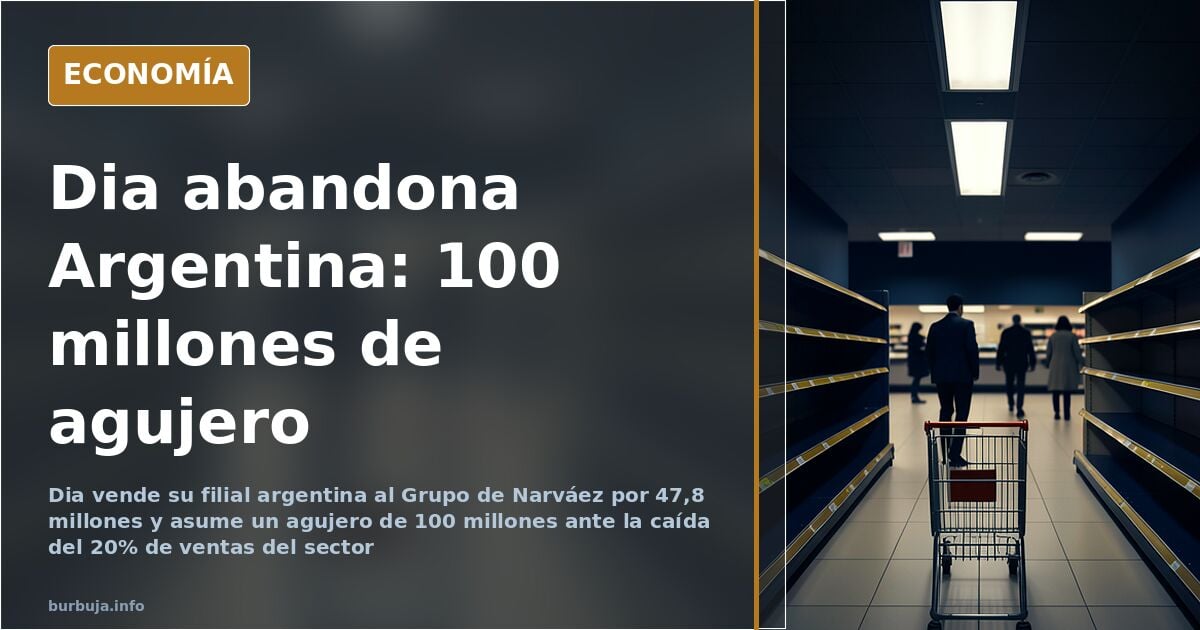
Dia exits Argentina with €100m loss as consumer spending remains under pressure
The scene carries an uncomfortable symbolism: on the very day Argentine President Javier Milei spoke at the Ibero-American Summit in Madrid, supermarket chain Dia confirmed in writing to the CNMV (Spain’s National Securities Market Commission) the sale of 100% of its business in Argentina. The buyer is Grupo de Narváez, a retail-focused holding company already operating in the country under the ChangoMás brand. The price: $53.8 million, approximately €47.8 million. The accounting hole: €100 million. The cause cited by the company: deteriorating economic conditions and consumption, "with no signs of recovery."
A farewell marked by accounting losses and depleted cash
The figures accompanying the deal do not suggest a tactical retreat. In the twelve months leading up to June 2026, the Argentine subsidiary accumulated accounting losses of €54 million and burned through €14 million in cash. By the end of the first half, losses stood at €24 million, with sales down 12%. The company justifies the exit citing a 20% contraction across the country’s entire supermarket sector. It adds a warning-like argument: the operation "eliminates the need for future capital injections" and isolates results from exchange rate volatility.
CEO Martin Tolcachir, an Argentine executive, presented it as a difficult but necessary decision: "It strengthens our financial solidity and allows us to give greater visibility to the strength and results of our business in Spain." This statement contrasts sharply with what the same executive declared only months ago, when he assured that activity in Argentina was "self-financed" and that the focus was on maintaining market share. In March 2025, the strategic plan defined Argentina as a "business with great potential" and a "leading position" with 15% national market share and 30% in Buenos Aires. Plans included expanding the network. As of December 31, 2025, there were 1,007 stores; by June 30 of this year, 996.
Mass consumption fails to rebound: what the data shows
The deterioration in consumption cited by the company is not merely a perception. Since the start of Milei’s government in December 2023, mass consumption and supermarket sales have suffered prolonged contraction: an initial collapse in 2024, with year-on-year drops exceeding 16% in the most critical months, trinc by a moderation that has not changed the trend. In August 2026, mass consumption fell 1.5% year-on-year and 0.7% compared to July, accumulating a decline of around 2.7% year-to-date. These are data from consultancy Scentia and statistical surveys cited in case analyses.
Interpretations vary. Some argue that a 20% drop in Dia’s sales does not equate to a 20% drop in overall consumption: some customers may have shifted to other formats, including low-cost options. The counterargument is that Dia already operates in the value-for-money segment, making a shift toward even cheaper formulas hard to sustain as the sole explanation. The discussion then moves to the broader context: inherited inflation, which Milei’s government places at 211% upon taking office and claims to have reduced to 30%, against evidence that basic consumption has not recovered ground.
The sale is not a closure: ownership changes, supermarkets remain
It is important to separate two things often conflated by noise. Dia is not closing its Argentine stores: it is transferring them. Grupo de Narváez, which already manages ChangoMás trinc the Walmart era, takes over operations. The buyer believes they can manage it better or that the price compensates for the risk. This is the argument used by those who downplay the signal: a sale is a transaction, not an economic death certificate. The objection is reasonable but does not answer the uncomfortable question: if the business were thriving, why would the seller accept €100 million in accounting impairment to exit?
Moreover, the operation coincides with a delicate calendar. Debt refinancing negotiations for the group begin in January, and the company has already redirected all resources to the Spanish market, where it concentrates its 2025-2029 strategic plan. Dia had previously exited Portugal and Brazil. Only Spain remains, plus little else. The parallel with other commercial withdrawals—such as Marks & Spencer once closing all its stores on the continent—serves to remind us that a corporate exit is not a judgment on an entire country, but nor does it exempt the situation from explanation.
The liberal experiment and the cost of transition
This case has peine debate on the pace and costs of Argentina’s economic agenda. The official argument is that three years are insufficient to reverse half a century of interventionism, that inflation has fallen, and that fiscal adjustment is a prerequisite for any sustained recovery. The critical argument is that the litmus test is not the exchange rate or fiscal balance, but the shopping basket: if consumption of food and cleaning products declines, promised prosperity has not reached people’s pockets. Between these extremes lies a less epic observation: mass consumption data measures volume and value, and part of the decline may reflect brand and format substitution rather than hunger. But substitution has limits, and Dia has hit one.
The detail that is disorienting is not the sale itself. It is the timing: the company sold on the same day Milei landed in Madrid to promote his model. And the buyer is not a vulture fund seeking liquidation, but a local operator who believes in the market. Someone is mistaken. Or perhaps not, and simply selling cheap food in Argentina requires a different kind of patience.
Also available in: Deutsch
Summary of a discussion on Burbuja.info - Foro de economía, actualidad y política., translated from Spanish and reviewed before publication. Read the full discussion (145 replies).
More summaries
-
Huerta de Soto breaks down Milei's ten points from Davos in class
Analysis of Milei's Davos speech: from Adam Smith as a lukewarm social democrat to 58% of income seized by the state, with Argentina footing the bill
-
Javier Milei: "up against the wall"
We analyze Javier Milei's visit to the Western Wall and the debate over its impact on Argentina's foreign policy and its real significance back home.
-
Milei Promotes $LIBRA, Erases Crypto Crash Trail
Argentine President Javier Milei promoted crypto token $LIBRA, triggering a crash and fraud allegations in New York.
-
AI's Double Standard in Domestic Conflict Queries
AI assistants respond differently to domestic abuse queries based on gender, sparking debate over ideological bias versus statistical reflection.
-
Colau’s €50k Salary Threshold: When High Income Becomes a Privilege
A €50,000 gross salary nets €2,963 monthly, placing earners in Spain's top 10%. Colau’s tax proposal reignites debate on who qualifies as wealthy.
-
Debate over alleged bulletproof vest for Spanish PM Sánchez
Speculation about Pedro Sánchez wearing a bulletproof vest sparks debate on security efficacy and political narratives, lacking official confirmation.