
Colau’s €50k Salary Threshold: When High Income Becomes a Privilege
A €50,000 gross salary nets €2,963 monthly, placing earners in Spain's top 10%. Colau’s tax proposal reignites debate on who qualifies as wealthy.
English · Original discussion in Spanish · Published
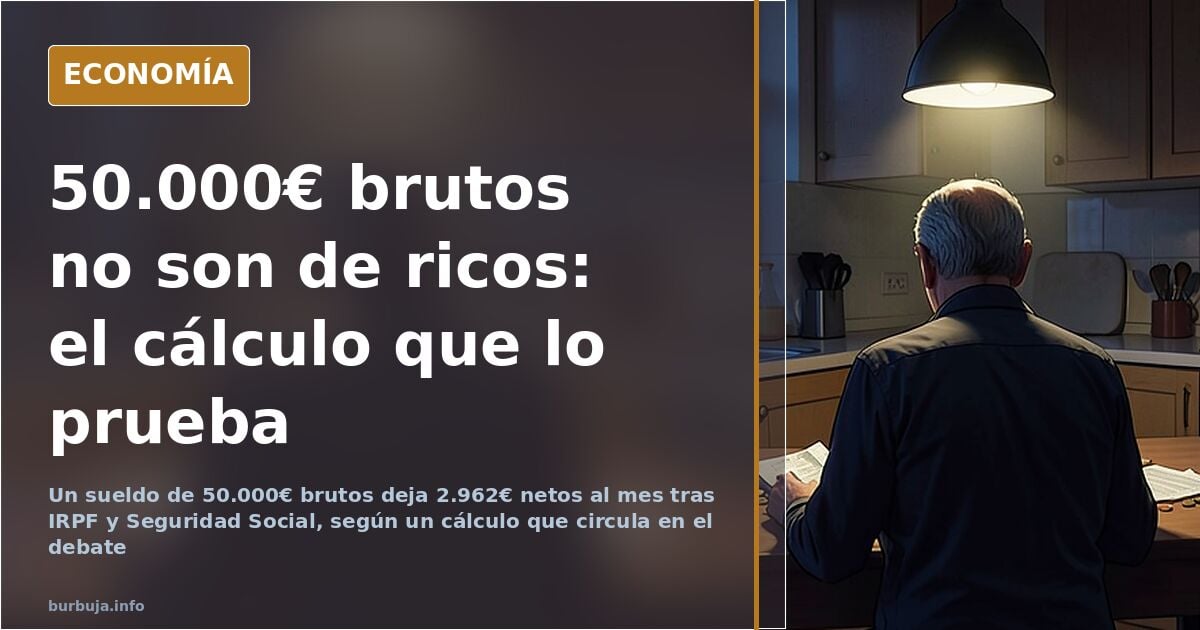
Colau targets high salaries as Spaniards realize €50,000 barely covers living costs
Earning €50,000 gross annually places you in the top 10% of Spanish earners, according to Tax Agency data. Yet in Madrid, this income barely affords a working-class apartment with a mortgage and a modest lifestyle, as cited in public debates. This contradiction—between statistical 'high income' and insufficient purchasing power—is central to Ada Colau’s latest fiscal proposal: increasing pressure on wealth and high incomes, using €50,000 as the symbolic dividing line.
The figure stings because it is not just a number; it is a label. And like any tax label, it depends on where the threshold is set.
How much remains from €50,000 gross annually?
Arithmetic is stubborn. A €50,000 annual gross salary incurs €11,205 in IRPF (personal income tax) withholdings and €3,240 in social security contributions. Net income: €35,555, or €2,962.92 per month over twelve payments. The withholding rate is 22.41%.
Then begins the second drain, invisible on the payslip: fuel taxes, IBI (property tax) if owning a home, vehicle tax, and VAT on every bill. Critical analyses suggest real disposable income drops to around €24,000 after these deductions. Moreover, this ignores the full tax wedge paid by employers before issuing the payslip.
With €2,963 net monthly in Barcelona or Madrid, one makes ends meet but does not join the upper class. This is the recurring argument: the gap between declared gross income and actual spendable money.
The top 10% that doesn’t feel rich
Tax Agency data indicates surpassing €50,000 gross places earners in Spain’s highest decile. The median salary hovers around €22,000–€24,000. The gap is real: earning more than double the national median.
However, the median does not cover market rents. Calculations show: after years of saving, a €100,000 down payment and a €220,000 mortgage for a €300,000 apartment result in a €1,000 monthly installment. Only €1,900 remains for food, utilities, energy, fuel, and leisure. Saving €300 monthly is considered a success. Upper class, certainly, does not sound right.
Some argue that without saving at least €1,000 monthly, life is not comfortable. While €30,400 gross allows a decent life in provincial towns, it does not afford homeownership in major cities. Meritocracy, they claim, has broken along the way.
Wealth, primary residence, and the game-changing tax
The hottest issue is not income but wealth. The proposed tax aims to levy the total value of assets, not just returns. Here, the primary residence becomes crucial.
Calculations are stark: removing the exemption for one’s own home would force many Madrid and Barcelona residents with apartments in reasonable areas to pay €20,000–€30,000 annually simply for living there. A house over 50 years old and a 100-horsepower car would make their owner a tax target, even if their salary hasn’t changed.
The Community of Madrid reduced the wealth tax to nearly zero. In response, the State introduced the Solidarity Tax on Large Fortunes for assets exceeding €3 million, with rates from 1.7% scaling to 3.5% above €10 million. The question remains: where does the asset-rich middle class—inherited apartments, rented premises—fit into this scale?
MPs and double tax accounting
The debate shifts to the consistency of those proposing adjustments. MPs’ employment income benefits from specific rules reducing their tax bill, while allowances and travel expenses remain exempt from IRPF. Paying tax on €100,000 is not the same as paying on €33,000 plus exempt allowances and extras.
Colau’s salary as an opposition councilor is estimated at €3,340 net monthly, or €92,600–€96,304 gross annually. Recently separated, she left her fifteen-year apartment and moved in with family due to inability to afford rent alone. Critics use this as ammunition: someone who struggled to manage personal finances despite earning over €100,000 annually seeks to order the country’s economy.
Territorial gap: Mérida is not Madrid
The same salary buys different things in different postal codes. €50,000 in Mérida supports a comfortable life; in Madrid, it insults quality of life, according to popular sentiment. Housing inflation in capitals makes this figure a deceptive threshold.
Income charts do not distinguish between earning €50,000 in an Extremadura village versus central Barcelona with €1,600 rent. Fiscal policy also fails to account for this. Such geographic blindness drives voter behavior.
What’s next: thresholds as electoral weapons
The €50,000 figure works because it is round, recognizable, and divisive. No need to explain the tax system: just point to those one step above. The question is whether that step exists or is a statistical illusion punishing savers.
Given these disparities, raising taxes on the 'posh' is electorally profitable. The trap is that the 'posh' earning €50,000 has a mortgage, a car, and a paycheck exhausted by the 28th. And they vote.
Also available in: Deutsch
Summary of a discussion on Burbuja.info - Foro de economía, actualidad y política., translated from Spanish and reviewed before publication. Read the full discussion (136 replies).
More summaries
-
Inda links Inquilinas spokesman in Sol to €80 million
Eduardo Inda attributes €80 million in real estate companies to the spokesman of the Tenants Union in Sol, amid allegations of pressure on Urbagestión.
-
Debate over alleged bulletproof vest for Spanish PM Sánchez
Speculation about Pedro Sánchez wearing a bulletproof vest sparks debate on security efficacy and political narratives, lacking official confirmation.
-
Spain's Dia Sells Argentine Unit Amid $100M Losses
Spanish retailer Dia sells its Argentina subsidiary to Grupo de Narváez for €47.8m, booking €100m in losses due to weak supermarket consumption.
-
Morant Leads Chants for Puente at PSOE Rally Amid DANA Criticism
Diana Morant led chants thanking Óscar Puente at a PSOE rally while Sánchez looked on. The video fuels debate over the party's handling of the DANA floods and rail accidents.
-
Krakow market square shooting kills at least five
At least five dead and ten seriously injured in a Krakow market square shooting. The attacker, aged around 24, fired from a car.
-
Global birth rate collapse is economic, not ideological
Fertility drops in Iran, Morocco and Colombia like in Europe: children shifted from labor assets to twenty-year liabilities with monthly costs.