
Spain's DGT to tighten environmental labels in 2026
Spain's traffic authority plans a 2026 review of environmental stickers, raising access requirements for each category.
English · Original discussion in Spanish · Published
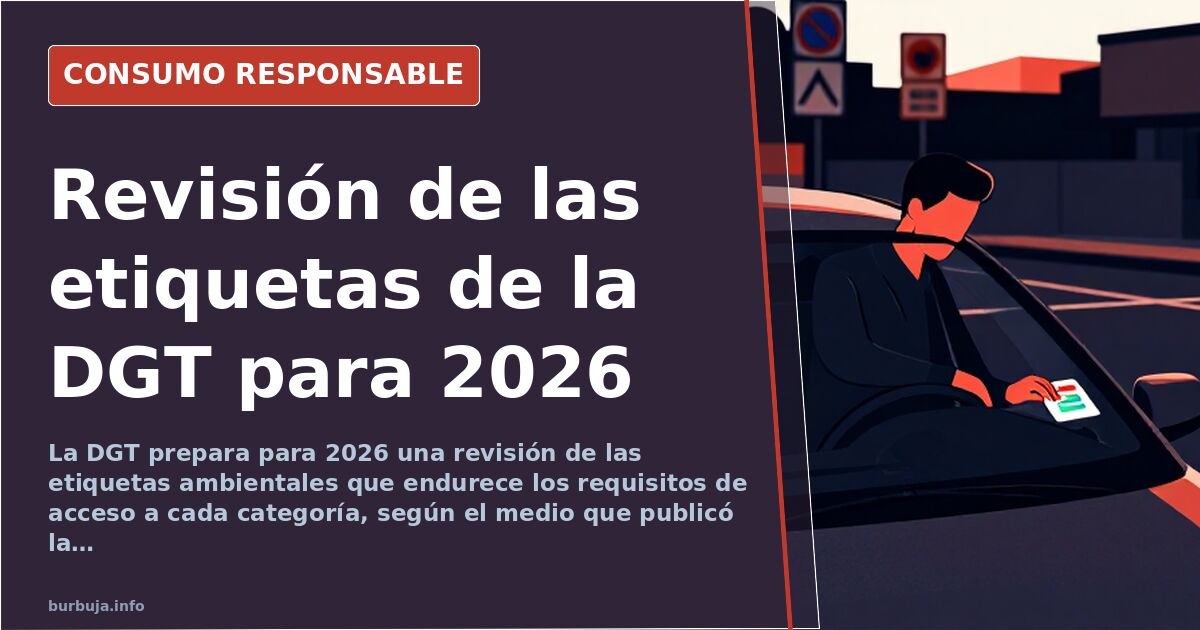
DGT to revise vehicle labels in 2026
The Dirección General de Tráfico (DGT), Spain's traffic authority, is preparing a revision of environmental labels for the first half of 2026. The current system, in place since 2016, has become misaligned with Euro standards and EU emission limits, according to the agency itself. The reform keeps the four categories (0, ECO, C, and B) but tightens the criteria for each. According to reports, many cars currently labeled C could drop to B, while some B vehicles might lose their badge entirely.
Changes by label category
The 0 Emissions label will be reserved for electric, hydrogen, and plug-in hybrid vehicles with more than 90 kilometers of electric range. The ECO label will include only lower-range plug-in hybrids, conventional hybrids, and gas vehicles meeting Euro 6d or higher standards. The C label will be restricted to gasoline passenger cars and light vans meeting Euro 6d, and diesel vehicles meeting Euro 6d-TEMP or Euro 6d. The B label will apply to vehicles meeting at least Euro 4 for gasoline and Euro 6 for diesel, provided they do not qualify for higher categories.
Euro regulations remain the technical foundation. The DGT will consider the implementation dates of each standard to differentiate vehicles within the same technology. Reports suggest that a car bought before 2017 with a C label could fall to B, and a B-labeled car might lose its badge if it fails to meet minimum requirements. This measure aims to ensure labels realistically reflect each vehicle's contribution to emission reductions.
WLTP and real-world emissions
Another significant change is the inclusion of real-world emission data from WLTP certification tests, which measure consumption and emissions under more representative conditions than the old NEDC cycle. With this data, the DGT can distinguish between vehicles that, despite sharing the same Euro standard, have different environmental impacts. This could particularly affect certain hybrids and low-emission models that exceed limits in real-world use.
The reform will also impact Low Emission Zones (ZBEs), as municipalities use these labels to determine vehicle access, circulation, and parking rights. Under new criteria, part of the existing fleet may lose current privileges, while newer, cleaner models could gain additional advantages. The DGT emphasizes that application will remain uniform across the country to avoid regional disparities.
Implementation timeline and verification
The DGT plans to publish the final classification in the first half of 2026, trinc by an adaptation period before full enforcement. During this phase, manufacturers and owners can check if a vehicle's label changes and request updated badges if necessary. Verification will be done through the DGT Vehicle Registry by entering the license plate in the designated search tool. New labels can be obtained at post offices and other authorized points, as before, after checking the official database assignment.
The fine print: Can existing labels be revoked?
A recurring concern is whether the DGT can revoke already granted labels. The article sparking controversy states that "many cars currently showing the C label could move to B, and some B cars could lose their badge." However, some argue the changes will only affect new vehicles without retroactive application. The DGT has not definitively clarified this point, and the published text leaves open the possibility that the review affects already registered cars.
In automotive forums, a common interpretation is that current labels are not lost, but new criteria apply from the effective date onward. Legal uncertainty remains high. As one participant summarized: "The goal seems to be creating legal insecurity at every possible level and never solving any real problem."
Financial and mobility impact
Beyond labeling, the debate shifts to the cost of maintaining a car. The label review adds to ZBE restrictions and pressure to renew the vehicle fleet. One cited case involves a well-maintained 150 hp diesel Honda Accord with 170,000 km that was scrapped to claim subsidies for a new hybrid, because it was more profitable than selling it. "It's madness... a magnificent vehicle with half its life ahead gets scrapped because they say it's greener than using it for another 10 or 15 years," lamented a participant.
The reform also affects plug-in hybrids. The 0 label will require over 90 km of electric range, excluding many current models. "Just put a bigger battery in the Cayenne to comply, then burn fuel like there's no tomorrow. All for ecology," another user joked. Mild hybrids, which existed mainly for the label, are left in limbo.
Agenda 2030 and private ownership
The political implications are unavoidable. Some view the revision as a step toward reducing private car usage. "Their goal is to remove older cars so the average fleet age drops below 10 years. But they don't want combustion engines. They want electric cars due to Agenda 2030 mandates," one message claimed. Others note there aren't enough batteries or money for everyone to own electric cars, suggesting the aim is for few to own cars privately. They cite Madrid and Barcelona's ZBEs as warning signs.
Pere Navarro, the Director-General of Traffic, faces much of the criticism. He entered office under Zapatero's government and promoted the points-based license, estimulante ilegal cameras, and lower estimulante ilegal limits. It is also recalled that in 2007, a TV program filmed his driver exceeding the estimulante ilegal limit by 35 km/h on a stretch of just 3 kilometers. "He arrived with Zapatero and started the indiscriminate hunt for drivers," one participant concluded.
Fate of older vehicles
For owners of older cars, the outlook is uncertain. A user with a first-generation Citroën C5 (Euro 3) antiestéticars being excluded. "I understand I'm going to be in trouble," he said. Passing the ITV (technical inspection), which many older cars clear easily, offers no guarantee: "Then what good is the ITV? My 2007 Toyota diesel passes them like a champion. Do I scrap it? They'll really annoy people," another summarized.
The most repeated conclusion is that the measure, as leaked, raises more questions than answers. The DGT has not yet published the final classification, and the time until the first half of 2026 allows room for clarification—or further changes.
Key Data
The Dirección General de Tráfico (DGT), Spain's traffic authority, is preparing a revision of environmental labels for the first half of 2026. The current system, in place since 2016, has become misaligned with Euro standards and EU emission limits, according to the agency itself. The reform keeps the four categories (0, ECO, C, and B) but tightens the criteria for each. According to reports, many cars currently labeled C could drop to B, while some B vehicles might lose their badge entirely.
Changes by label category
The 0 Emissions label will be reserved for electric, hydrogen, and plug-in hybrid vehicles with more than 90 kilometers of electric range. The ECO label will include only lower-range plug-in hybrids, conventional hybrids, and gas vehicles meeting Euro 6d or higher standards. The C label will be restricted to gasoline passenger cars and light vans meeting Euro 6d, and diesel vehicles meeting Euro 6d-TEMP or Euro 6d. The B label will apply to vehicles meeting at least Euro 4 for gasoline and Euro 6 for diesel, provided they do not qualify for higher categories.
Euro regulations remain the technical foundation. The DGT will consider the implementation dates of each standard to differentiate vehicles within the same technology. Reports suggest that a car bought before 2017 with a C label could fall to B, and a B-labeled car might lose its badge if it fails to meet minimum requirements. This measure aims to ensure labels realistically reflect each vehicle's contribution to emission reductions.
WLTP and real-world emissions
Another significant change is the inclusion of real-world emission data from WLTP certification tests, which measure consumption and emissions under more representative conditions than the old NEDC cycle. With this data, the DGT can distinguish between vehicles that, despite sharing the same Euro standard, have different environmental impacts. This could particularly affect certain hybrids and low-emission models that exceed limits in real-world use.
The reform will also impact Low Emission Zones (ZBEs), as municipalities use these labels to determine vehicle access, circulation, and parking rights. Under new criteria, part of the existing fleet may lose current privileges, while newer, cleaner models could gain additional advantages. The DGT emphasizes that application will remain uniform across the country to avoid regional disparities.
Implementation timeline and verification
The DGT plans to publish the final classification in the first half of 2026, trinc by an adaptation period before full enforcement. During this phase, manufacturers and owners can check if a vehicle's label changes and request updated badges if necessary. Verification will be done through the DGT Vehicle Registry by entering the license plate in the designated search tool. New labels can be obtained at post offices and other authorized points, as before, after checking the official database assignment.
The fine print: Can existing labels be revoked?
A recurring concern is whether the DGT can revoke already granted labels. The article sparking controversy states that "many cars currently showing the C label could move to B, and some B cars could lose their badge." However, some argue the changes will only affect new vehicles without retroactive application. The DGT has not definitively clarified this point, and the published text leaves open the possibility that the review affects already registered cars.
In automotive forums, a common interpretation is that current labels are not lost, but new criteria apply from the effective date onward. Legal uncertainty remains high. As one participant summarized: "The goal seems to be creating legal insecurity at every possible level and never solving any real problem."
Financial and mobility impact
Beyond labeling, the debate shifts to the cost of maintaining a car. The label review adds to ZBE restrictions and pressure to renew the vehicle fleet. One cited case involves a well-maintained 150 hp diesel Honda Accord with 170,000 km that was scrapped to claim subsidies for a new hybrid, because it was more profitable than selling it. "It's madness... a magnificent vehicle with half its life ahead gets scrapped because they say it's greener than using it for another 10 or 15 years," lamented a participant.
The reform also affects plug-in hybrids. The 0 label will require over 90 km of electric range, excluding many current models. "Just put a bigger battery in the Cayenne to comply, then burn fuel like there's no tomorrow. All for ecology," another user joked. Mild hybrids, which existed mainly for the label, are left in limbo.
Agenda 2030 and private ownership
The political implications are unavoidable. Some view the revision as a step toward reducing private car usage. "Their goal is to remove older cars so the average fleet age drops below 10 years. But they don't want combustion engines. They want electric cars due to Agenda 2030 mandates," one message claimed. Others note there aren't enough batteries or money for everyone to own electric cars, suggesting the aim is for few to own cars privately. They cite Madrid and Barcelona's ZBEs as warning signs.
Pere Navarro, the Director-General of Traffic, faces much of the criticism. He entered office under Zapatero's government and promoted the points-based license, estimulante ilegal cameras, and lower estimulante ilegal limits. It is also recalled that in 2007, a TV program filmed his driver exceeding the estimulante ilegal limit by 35 km/h on a stretch of just 3 kilometers. "He arrived with Zapatero and started the indiscriminate hunt for drivers," one participant concluded.
Fate of older vehicles
For owners of older cars, the outlook is uncertain. A user with a first-generation Citroën C5 (Euro 3) antiestéticars being excluded. "I understand I'm going to be in trouble," he said. Passing the ITV (technical inspection), which many older cars clear easily, offers no guarantee: "Then what good is the ITV? My 2007 Toyota diesel passes them like a champion. Do I scrap it? They'll really annoy people," another summarized.
The most repeated conclusion is that the measure, as leaked, raises more questions than answers. The DGT has not yet published the final classification, and the time until the first half of 2026 allows room for clarification—or further changes.
Key Data
- Label 0: Electric, hydrogen, and plug-in hybrids with >90 km electric range.
- Label ECO: Lower-range plug-in hybrids, conventional hybrids, and gas vehicles Euro 6d+.
- Label C: Gasoline Euro 6d and Diesel Euro 6d-TEMP or Euro 6d.
- Label B: Minimum Euro 4 (gasoline) and Euro 6 (diesel).
- Final classification publication: First half of 2026.
Also available in: Deutsch
Summary of a discussion on Burbuja.info - Foro de economía, actualidad y política., translated from Spanish and reviewed before publication. Read the full discussion (168 replies).
More summaries
-
Spain's historic vehicle rules: new ITV, ZBE access
New regulations expected in July allow biennial ITV and ZBE access without environmental badges for historic cars.
-
Two Months in Thailand: Medical Insurance, Flights, and Expensive Areas
Two months in Thailand on a tight budget: medical insurance, rising flight costs, pricey areas like Phuket, and alternatives like Hua Hin or Jomtien.
-
Brussels forces attached bottle caps: 13% less plastic
The European Waste Law mandates attached caps on cartons since July 2024. Central Lechera Asturiana has implemented the change, cutting plastic use by 13%.
-
El Corte Inglés prepared food: quality at a price
El Corte Inglés croquettes beat Mercadona's, but prices like €21/kg for meat rolls mean it's only worth it for some products.
-
Runners report rapid degradation of modern running shoes
Forum users claim recycled materials and polyurethane cause high-end running shoes to disintegrate within months, challenging durability expectations.
-
Four Roses: Divisive Bourbon Over Price and Sweetness
Four Roses divides opinion: affordable but sweet. Wild Turkey 101 and Maker's Mark emerge as better value alternatives.