
Brussels forces attached bottle caps: 13% less plastic
The European Waste Law mandates attached caps on cartons since July 2024. Central Lechera Asturiana has implemented the change, cutting plastic use by 13%.
English · Original discussion in Spanish · Published
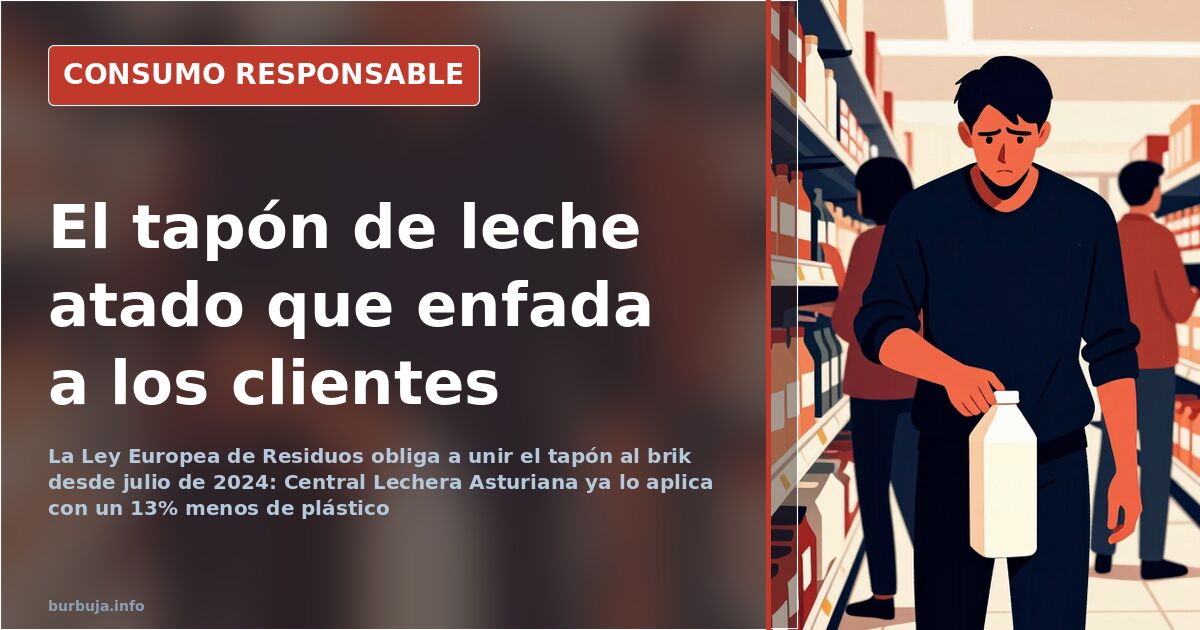
Brussels mandates attached caps: the milk nobody knows how to open
July 2024 marks when the new European Waste Law stops being a draft and requires single-use beverage containers, including plastic bottles and cartons, to have permanently attached caps. Central Lechera Asturiana has beaten the deadline and now sells cartons with this new system. The result: a cap that breaks, spins wildly, lifts upward, and has turned a daily routine into a YouTube tutorial. The company claims the redesign reduces plastic use by 13% compared to previous packaging. The frustration, judging by complaints on social media, is proportional to the confusion.
What the law exactly requires and why it is not the brand's idea
This is not a commercial gimmick. European regulations require that caps of single-use containers remain attached to the container so they do not end up loose in the environment. This measure will not stay limited to the Asturian brand: after summer 2024, it will reach the rest of the market, as no company using cartons or bottles can avoid it. The company itself had to publish an explanatory video due to an avalanche of messages from customers who cannot figure out how to open it. There is also a line of analysis pointing out that the focus is misplaced: the real recycling problem is not the cap, but the entire container.
The breaking cap and the two-click closure
The technical detail matters. The system does not work by conventional screwing: you turn it half a turn, lift the cap, and it stays attached by a hinge. Closing has two positions, one gentle enough to just cover, and another stronger, more airtight; if you press too hard, you must turn it back to open it. Those who have understood it say it works well and that the complaint is just a matter of habit. Those who haven't have found broken caps from the first try. "It is not badly designed, but it is common to complain when our habits change," summarizes one of the most repeated views. On the other side, another current argues that the design is poorly resolved: the arrow indicating how to open appears backward, and some have directly stopped buying the brand for this reason.
Tetra Pak is not recycled: the contradiction of cap-based environmentalism
This is where the green argument cracks. Tetra Pak mixes aluminum, paper, and plastic glued together, making separation practically impossible and real recycling, when it exists, scarce. In contrast, older formats allegedly more sustainable are recalled: the plastic milk bag from the 1980s, made of single plastic and more inert, or the returnable glass bottle that melts and reuses without limit. One view holds that all this sustainability is just an excuse to justify larger measures, while another suggests directly stopping waste separation as a response. The old wrapping, this side argues, was better than the modern one sold as eco-friendly.
Milk as poison: casein, lactose, and other parallel wars
The discussion soon shifted to the product. One sector defends that cow's milk is designed for a calf to grow in just over a year and that an adult primate has other digestive priorities; they point to the 11,000 years of evolution, insufficient for adaptation, and note that almost everyone talks about lactose but almost no one about casein, that protein the industry uses as glue. Others recall nonagenarian relatives fed on whole milk for decades without apparent problem. In between, the usual warning: in case of any suspicion of allergy or intolerance, consult a healthcare professional.
An oligopoly with an appearance of variety
And underneath it all, the market. It is argued that the current offer is a false diversity: many different brands belong to the same group, and the underlying product is more uniform than ever. The Asturian brand, some recall, was 40 to 50 cents cheaper than the expensive ones before the pandemic; now the difference barely reaches ten cents, making switching brands almost free. Consumers who have already switched to others confirm this. The practical consequence of the inconvenient cap is not an ideological boycott, but a silent shift of shopping carts toward the competition.
With these threads, the conclusion should be simple: a container that is difficult to open, an official tutorial to explain the basics, and a 13% plastic saving. What remains unanswered is whether the regulation has improved anything, or if it has only served to make millions of people remember every morning that someone in Brussels decided for them how to close the milk.
July 2024 marks when the new European Waste Law stops being a draft and requires single-use beverage containers, including plastic bottles and cartons, to have permanently attached caps. Central Lechera Asturiana has beaten the deadline and now sells cartons with this new system. The result: a cap that breaks, spins wildly, lifts upward, and has turned a daily routine into a YouTube tutorial. The company claims the redesign reduces plastic use by 13% compared to previous packaging. The frustration, judging by complaints on social media, is proportional to the confusion.
What the law exactly requires and why it is not the brand's idea
This is not a commercial gimmick. European regulations require that caps of single-use containers remain attached to the container so they do not end up loose in the environment. This measure will not stay limited to the Asturian brand: after summer 2024, it will reach the rest of the market, as no company using cartons or bottles can avoid it. The company itself had to publish an explanatory video due to an avalanche of messages from customers who cannot figure out how to open it. There is also a line of analysis pointing out that the focus is misplaced: the real recycling problem is not the cap, but the entire container.
The breaking cap and the two-click closure
The technical detail matters. The system does not work by conventional screwing: you turn it half a turn, lift the cap, and it stays attached by a hinge. Closing has two positions, one gentle enough to just cover, and another stronger, more airtight; if you press too hard, you must turn it back to open it. Those who have understood it say it works well and that the complaint is just a matter of habit. Those who haven't have found broken caps from the first try. "It is not badly designed, but it is common to complain when our habits change," summarizes one of the most repeated views. On the other side, another current argues that the design is poorly resolved: the arrow indicating how to open appears backward, and some have directly stopped buying the brand for this reason.
Tetra Pak is not recycled: the contradiction of cap-based environmentalism
This is where the green argument cracks. Tetra Pak mixes aluminum, paper, and plastic glued together, making separation practically impossible and real recycling, when it exists, scarce. In contrast, older formats allegedly more sustainable are recalled: the plastic milk bag from the 1980s, made of single plastic and more inert, or the returnable glass bottle that melts and reuses without limit. One view holds that all this sustainability is just an excuse to justify larger measures, while another suggests directly stopping waste separation as a response. The old wrapping, this side argues, was better than the modern one sold as eco-friendly.
Milk as poison: casein, lactose, and other parallel wars
The discussion soon shifted to the product. One sector defends that cow's milk is designed for a calf to grow in just over a year and that an adult primate has other digestive priorities; they point to the 11,000 years of evolution, insufficient for adaptation, and note that almost everyone talks about lactose but almost no one about casein, that protein the industry uses as glue. Others recall nonagenarian relatives fed on whole milk for decades without apparent problem. In between, the usual warning: in case of any suspicion of allergy or intolerance, consult a healthcare professional.
An oligopoly with an appearance of variety
And underneath it all, the market. It is argued that the current offer is a false diversity: many different brands belong to the same group, and the underlying product is more uniform than ever. The Asturian brand, some recall, was 40 to 50 cents cheaper than the expensive ones before the pandemic; now the difference barely reaches ten cents, making switching brands almost free. Consumers who have already switched to others confirm this. The practical consequence of the inconvenient cap is not an ideological boycott, but a silent shift of shopping carts toward the competition.
With these threads, the conclusion should be simple: a container that is difficult to open, an official tutorial to explain the basics, and a 13% plastic saving. What remains unanswered is whether the regulation has improved anything, or if it has only served to make millions of people remember every morning that someone in Brussels decided for them how to close the milk.
Summary of a discussion on Burbuja.info - Foro de economía, actualidad y política., translated from Spanish and reviewed before publication. Read the full discussion (246 replies).
More summaries
-
Spain fines drivers 200 euros for using the center lane
A driver reports center-lane violations with dashcam footage, sparking legal debates over evidence validity and 200 euro penalties for ignoring the right lane.
-
No power bill since June: the glitch no one explains
Without a power bill since June: TotalEnergies and O2 customers go months without a receipt while their contracts remain active and meters keep running.
-
How to Cancel a Mortgage Without Surprising Notary Fees
Practical guide to canceling a mortgage and saving on notary and registry fees without falling into banking traps.
-
Italian Students Fined 1,000 Baht for Noise on Bangkok’s BTS
Five Italian students were fined 1,000 baht in Bangkok for shouting on the BTS Skytrain, reigniting the debate on tourist behavior and local respect.
-
Dacia Sandero vs Skoda Fabia: GLP and the automatic transmission dilemma
The GLP Sandero promises an ECO label and low running costs, but lacks an automatic gearbox—the deciding factor between the Dacia and the Skoda Fabia.
-
Living with 89 Items: Spain's Minimalism Radiograph
One man has lived with 89 items for three months, aiming for 70, revealing the real savings of the 100 Things challenge.